
 United States Beethoven, R. Schumann, Ravel: Marc-André Hamelin (piano). E.J. Thomas Performing Arts Hall, University of Akron, 21.10.2025. (MSJ)
Beethoven – Piano Sonata No.29 in B-flat major, Op.106, ‘Hammerklavier’
R. Schumann – Waldszenen, Op.82
Ravel – Gaspard de la nuit
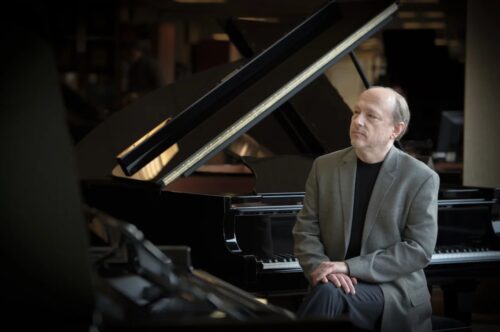
Akron’s Tuesday Musical concert series got off to a memorable start for its 138th season, featuring the all-encompassing mastery of Canadian pianist Marc-André Hamelin. For the occasion, Hamelin played an audacious program of two of the Everests of the piano repertory, along with a set of miniatures that more than held their own against the two big pieces.
Hamelin’s recital started with Beethoven’s spacious ‘Hammerklavier’ sonata. He opened briskly, with energetically sprung rhythms, but gave the driving music ample space to expand in contrasting phrases, outlining the sonata’s world in the opening gestures. Thank God, Hamelin smudged a note in the first movement (one of only a couple[!] the whole evening), proving that he is, in fact, human. The truth is that all the listener has to do is listen attentively, and the humanity of Hamelin’s playing comes through in its thoughtfulness and attention to atmosphere. His virtuosity is legendary, but never for a moment does one sense that the man is playing just to show us how impressive his technique is. He eyes a wider horizon.
After a coiled Scherzo, Hamelin took the slow movement into visionary territory, achieving a rapt stillness that nonetheless never lost focus or quiet forward flow. The finale, with its wild chains of trills and thundering climaxes, never flagged in momentum, even gaining vigor as it progressed unstoppably to the end. It was Beethoven playing of the highest order.
After intermission, knowing that, if anything, an even more daunting piece was lurking at the end of the program, Robert Schumann’s Forest Scenes could have been treated as a mere program filler, dismissed as quaint, early-romantic scene painting. Not Hamelin, though. If anything, I would go so far as to say that his emotional concentration was higher in the Schumann than in anything else that evening, because he recognized that each of Schumann’s miniatures is its own universe, a couple of them rivaling anything else in the program for intensity. Even in the opening pictures, ‘Arrival’ and ‘Hunter on the Watch’, Hamelin thought in terms of clarifying voices and textures, so that Schumann’s beloved lower-mid range of the keyboard didn’t sound cloudy and dense on a modern Steinway grand. No phrase passed without a sense that Hamelin had thought about where that phrase led, what its musical function was and what its emotional ramifications were.
A quiet moment like ‘Solitary Flowers’ became remarkable for how atmospherically alive its delicacy was, without ever being handled in a precious or swooning manner. Hamelin made it plainspoken, but its ‘words’ were poetry. How many pianists can achieve that? Not nearly as many as you might think, and that is why no opportunity to hear Hamelin should be missed. This was quiet alchemy from a pianist who knows how to deploy the tones of his instrument like a mad genius mixing ingredients in his secret laboratory.
And these were the lighter parts! With movements like ‘Haunted Place’ and ‘Bird as Prophet’, Hamelin brought on a literally spine-tingling chill where most pianists gloss over the sheer weirdness of the music. The performance was subtly intensified by a palette of colored lights cast on the back wall of the stage. No designer or director was credited for the lights, but they were well-considered for each movement and were a welcome touch.
The program’s most intimidating piece, Ravel’s Gaspard de la nuit, came at a spot where any other pianist would have been exhausted, at least if they were playing with Hamelin’s intensity. He again upped the ante, unleashing his full range of color and volume for these seductive yet nightmarish pictures. The pianist’s opening trills portraying the water sprite ‘Ondine’ were almost impossibly soft, both in volume and texture. The stage lights changed to a burning bloodred for ‘Le Gibet’, reflecting the Bertran poem that inspired Ravel which pictures a body hanging from a gibbet, reddened by the setting sun. It is the movement I most frequently find underwhelming in performances of this piece but not here. Hamelin was able to put Ravel’s spare textures together in a way that quietly but devastatingly emphasized how strange and haunting they are. The closing ‘Scarbo’ unleashed full malevolence at a breathtaking speed, seemingly shaking the whole room before suddenly vanishing at the end. The ovation was rightly enthusiastic for this stunning playing and drew an encore, Debussy’s Reflets dans l’eau, which shimmered gracefully. From the technical terrors of Beethoven to the creepy atmospheres of Schumann and the jump-scares of Ravel, it was a perfect Halloween program.
Mark Sebastian Jordan