
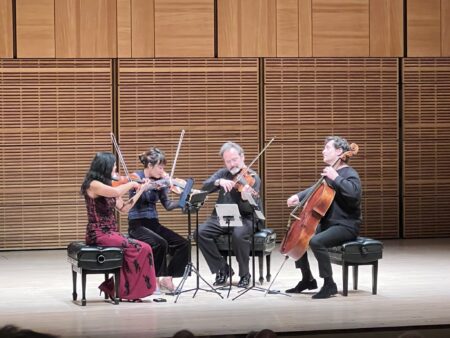
 United States Mozart, Dean, Beethoven: Belcea Quartet (Corina Belcea, Suyeon Kang [violins], Krzysztof Chorzelski [viola], Antoine Lederlin [cello]). Zankel Hall, Carnegie Hall, New York, 22.10.2025. (ES-S)
Mozart – String Quartet No.19 in C major, K.465, ‘Dissonance’
Brett Dean – String Quartet No.4, ‘A Little Book of Prayers’
Beethoven – String Quartet No.16 in F major, Op.135
Few openings in Mozart are as unsettling as the K.465 Quartet’s Adagio, and few performances have captured its poised anxiety as fully as the Belcea Quartet did in the first minutes of their Zankel Hall recital. The ambiguity of the soundscape – harmonies drifting in uncertain light, each dissonance allowed to breathe, each silence charged with intent – was molded with extraordinary finesse. With tension alive in every bow stroke, the music’s freshness and novelty felt rekindled. When the Allegro broke through with exuberant precision, its brightness felt both natural and inevitable. The quartet’s lean textures made each line clearly discernible, every phrase imbued with spontaneity.
The Andante cantabile that followed was a model of poise, its songlike exchanges rendered with luminous balance between outer calm and inner agitation. Corina Belcea’s phrasing had a vocal inflection, her tone vivid but never excessive, while Antoine Lederlin’s cello grounded the music with unassuming warmth. In the Menuetto third movement, wit and elegance coexisted: the rhythm danced lightly while remaining tethered to structure. The final Allegro molto combined exuberance with control, the articulation fleet, the ensemble so finely tuned that it gave the impression of a single, unified instrument.
The connection between Mozart’s ‘Dissonance’ and Beethoven’s Op.135, played after the interval, felt almost organic. Composed four decades later, Beethoven’s last completed composition still moves on a Classical orbit – emotion framed through proportion, not excess – reimagined as introspection. The Belcea Quartet drew that link with calm conviction: the same clarity that shaped Mozart’s Adagio now illuminated Beethoven’s quiet lucidity. The opening Allegretto unfolded with conversational grace, its contrast between angular motifs and moments of serenity managed with scrupulous control. The sound was focused but never hard-edged; each phrase carried a natural ease, born of the players listening intently to one another.
The Vivace, taut yet unhurried, bristled with rhythmic wit, the ensemble negotiating its asymmetries with unanimity that never felt rigid. In the Lento assai, the Belceas found a fragile glow, the tone hovering at the edge of audibility, each modulation unfolding like a slow intake of breath. The finale’s question – ‘Must it be?’ – was phrased with quiet wonder, the answer emerging not in defiance but radiating a sense of attained enlightenment, as though the music were glancing back toward the hesitant beginning of its own journey and to the unresolved stillness that opens Mozart’s ‘Dissonance’.
In a program of multiple echoes, one could discern reminiscences of Beethoven’s hymn-like third movement, marked ‘song of repose or peace’, in both the extract from Adès’s Arcadiana, played as an encore, and the three prayers that form the spine of Brett Dean’s String Quartet No.4. Co-commissioned by Carnegie Hall and receiving its world premiere on this occasion, ‘A Little Book of Prayers’ is dedicated to the memory of Laura Samuel, the Belcea Quartet’s founding second violinist. There are special passages throughout the score featuring the second violin, and Suyeon Kang shaped them with interpretive acumen. The first, third and fifth movements of Dean’s composition are, in his own words, ‘wordless prayers of petition, contemplation and lament respectively’.
The idiom that binds them – taut, textural and emotionally concentrated – also extends to the two faster movements, which explore ‘other rituals of prayer or adoration’. One can hear what seem to be the sounds of nature – watery streams of constantly shifting color, birds chattering and arguing in onomatopoeic bursts. The Belceas sustained this fragile equilibrium with complete assurance, giving each pause a sense of expectancy rather than emptiness. ‘Speaking in Tongues’ unfolded with ritualistic urgency, the quartet articulating Dean’s jagged rhythmic cells with precision that never turned mechanical. The fourth movement, filtering a gospel refrain through ‘glassy harmonics’, was fashioned with greater restraint. Bookended by two towering examples of the string quartet repertoire, Dean’s new work held the listener’s attention through its finely calibrated contrasts.
Across the evening, the Belcea Quartet reaffirmed their reputation as an ensemble that balances intellect with instinct, anchored in a discipline that feels alive and never constraining.
Edward Sava-Segal