 Austria Salzburg Festival 2025 [9] – Vivaldi/ Ovid, Hotel Metamorphosis: Soloists, Il Canto di Orfeo chorus, Les Musiciens du Prince – Monaco / Gianluca Capuano (conductor). Recorded live (directed by Tiziano Mancini) at the Haus für Mozart, Salzburg, June 2025 and viewed on arte.tv.
 United States Various, Orgy & Bess: Deep Throats and High Notes: Soloists, Band, Heartbeat Opera. Judson Memorial Church, New York, 31.10.2025. (ES-S)

At opposite ends of the operatic spectrum – at least in terms of resources – two recent productions reimagined how the art form can transform itself. In Salzburg, Barrie Kosky’s Hotel Metamorphosis – which I saw last week in its arte.tv broadcast version – turned Vivaldi’s Baroque idiom and Ovid’s myths into a lavish meditation on desire and loss. In New York, on Halloween night and just steps from the parade, Heartbeat Opera’s Orgy & Bess dismantled Porgy and Bess through drag, parody and irreverence. One treated metamorphosis as introspection, the other as rebellion. One reveled in full orchestral sound with chorus, a ballet corps and some of today’s foremost Baroque singers, the other in the glittering chaos of cabaret, played out on a small stage with a quartet of instrumentalists beside it. Yet both shared a belief that opera endures only by shedding its skin and finding new bodies to inhabit.
Kosky’s production, conceived with dramaturg Olaf A. Schmitt, revives the Baroque practice of the pasticcio – a collage of arias, ensembles and instrumental interludes – while anchoring it in a single space: a sleek, impersonal hotel room designed by Michael Levine. From this room, framed by rocafilm’s video projections that dissolved walls into color, texture and myth, Ovid’s tales unfold as a sequence of dreams and delusions, each one a meditation on change and longing. The actress Angela Winkler, as an aged Orpheus haunted by memory, narrates the tales in German – a constant presence whose voice bridges the five episodes drawn from ‘Pygmalion’, ‘Arachne’, ‘Myrrha’, ‘Echo and Narcissus’ and ‘Eurydice’. The concept might have risked fragmentation, yet Kosky’s control of rhythm, tone and image made the evening feel uncannily cohesive – part mythic pageant, part psychodrama and wholly operatic in its intensity.
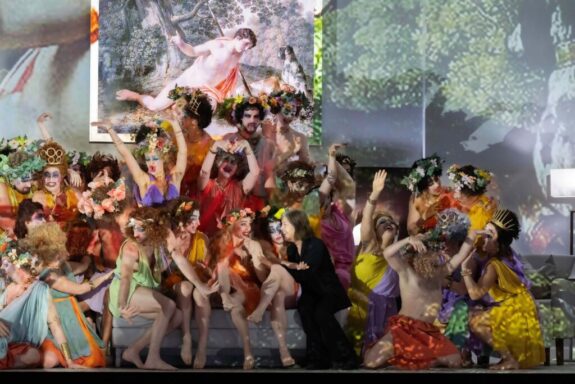
Within the stories’ unifying, impersonal, hotel room setting, Kosky and his collaborators revealed an astonishing range of theatrical invention. The room seemed alive: doors opened and closed on their own, beds swallowed singers whole and walls flickered with rocafilm’s projections that shifted from what seemed reproductions of Baroque-like paintings illustrating the underlying myths to dissolving abstractions. Meanwhile Klaus Bruns’s costumes moved fluidly between contemporary and mythic-evoking registers. Despite the potentially constraining stage space, each tale found a distinct visual language – the digital avatars of Arachne’s contest with Minerva, the mirror duet of Narcissus and his double, the bed that devoured Myrrha in shame. In the final transformation, the entire room rose to reveal the underworld where Eurydice’s voice, suspended between love and oblivion, brought the cycle to its close. Otto Pichler’s choreography for a small ensemble of dancers extended that sense of metamorphosis into movement – from the stylized, almost mechanical gestures of Pygmalion’s statue to the grotesque bacchanal surrounding Narcissus. Kosky’s direction balanced irony and empathy, allowing myth, dance and desire to merge in tableaux that felt both intimate and dreamlike.
Gianluca Capuano’s musical direction, closely aligned with the production’s conceptual design, gave coherence to Kosky’s collage of myths. Leading Les Musiciens du Prince – Monaco and the Il Canto di Orfeo chorus, he shaped Vivaldi’s arias and instrumental fragments with a dramatic sensibility that mirrored the constant flux of the staging. The score breathed with the same elasticity as the imagery – shifting between rhythmic precision and expressive freedom – and Capuano’s attention to rhetorical contour gave the music both urgency and clarity. Cecilia Bartoli as Eurydice and as Arachne, commanded the stage with a blend of precision and abandon: her ‘Armatae face et anguibus’ (Juditha triumphans) blazed with defiant fury in Arachne’s contest, answered by Nadezhda Karyazina’s imperious ‘Se lento ancora il fulmine’ (Argippo) as Minerva. The closing ‘Gelido in ogni vena’ (Farnace) became a vision of frozen grief. Philippe Jaroussky as Pygmalion and Narcissus brought refinement and pathos, shaping ‘Gemo in un punto e fremo’ (L’Olimpiade) with inward delicacy even if the instrument itself has darkened. A youthful Lea Desandre, floating around the stage with radiant poise yet fully grounded in character, reaffirmed her place among today’s most natural Vivaldi interpreters, luminous in timbre and alert to dramatic nuance, spinning coloratura lines of dazzling precision in ‘Agitata da due venti’ (La Griselda) as Myrrha.
Hotel Metamorphosis occasionally included hints of Kosky’s penchant for satire and cabaret-like irony. Arachne’s duel with Minerva became a fashion media circus, complete with paparazzi flashes. In the Narcissus episode, a surreal pas de deux played out between two near-identical masked male dancers in white underwear mirroring each other like nightclub doubles.
Orgy & Bess: Deep Throats and High Notes pushed those impulses to their fullest expression. Heartbeat Opera’s tenth anniversary ‘drag-opera extravaganza’, created by co-founder Ethan Heard and artistic director Jacob Ashworth, compressed the grand narratives of the operatic canon into the glittering intimacy of Judson Memorial Church. What in Salzburg unfolded in a vast orchestral and choreographic panorama was here refracted through a handful of singers, a four-piece band and the anarchic humor of drag. Yet the aim was not parody for its own sake – Orgy & Bess used excess, camp and self-exposure as instruments of critique, asking what kinds of bodies and voices opera has traditionally celebrated or excluded.
Like Kosky’s Hotel Metamorphosis, Orgy & Bess was also a kind of pasticcio – a collage of operatic and theatrical fragments, from Porgy and Bess to Turandot, from Lucia di Lammermoor to Pagliacci, from Carmina Burana to Handel’s Samson – stitched together by Dan Schlosberg’s witty re-orchestrations for a jazz-cabaret ensemble.
Under the direction of Ethan Heard and Jacob Ashworth, Porgy and Bess served more as a touchstone than a literal narrative. The show borrowed its emotional framework – love, loss, racial and sexual oppression – but exploded it into a series of drag vignettes that mixed Gershwin’s themes with arias and popular numbers from across the canon. Bess, as a central figure, encountered other ‘operatic queens’, each representing archetypes of desire or tragedy, transformed into expressions of freedom and self-invention. Bess is no longer the sinner addicted to ‘happy dust’ but a woman who claims the multiplicity of her desires. Cio-Cio-San, long trapped in opera’s fantasy of self-sacrificing devotion, was transformed into a victim ready to embrace spectacle, her sacrifice staged as irony rather than submission. And Lucia di Lammermoor, no longer a passive madwoman, turned her delirium into liberation – coloratura reimagined as the sound and gestures of rebellion.
The small ensemble – sporting make-up and Valkyrian helmets – under violinist Ashworth’s direction moved fluidly between Gershwin’s swing rhythms and the stylized pulse of opera. Bernard Holcomb’s Bess combined vocal power with theatrical adaptability, his tenor reshaped through falsetto and speech into a vocabulary of emotional extremes. Around him, costumed as extravagantly – and perfectly suited for a Halloween night – by David Quinn, sopranos Angela Yam (Cio-Cio-San) and Jamilyn Manning (Lucia), mezzo-soprano Sishel Claverie (in the many-faced Pants Role) and John Taylor Ward (as the Patroness) formed a shifting chorus of multiple characters and commentators: arguing, conspiring or standing in sudden solidarity. Each vignette became a burst of theater in miniature, played not for polish but for immediacy – music as an act of reinvention and self-exposure.
Among these shifting figures, John Taylor Ward’s Patroness offered the evening’s slyest transformation. At first a parody of operatic authority – powdered, imperious, visibly appalled by the desecration of tradition – she became a figure of unexpected complicity. As the vignettes grew wilder, the Patroness slowly shed her hauteur, joining in the spectacle she had once so strongly condemned. Her final gestures suggested that acceptance, too, can be a form of metamorphosis – an acknowledgment, much like the one embodied by Barrie Kosky and Olaf A. Schmitt’s conception of Hotel Metamorphosis, that art survives not through acts of preservation but through an endless capacity for change – its oldest, and perhaps still most necessary, act of faith.
Edward Sava-Segal
Featured Image: A scene from Hotel Metamophosis © SF/Monika Rittershaus
Hotel Metamorphosis
Production:
Texts – Ovid
German translation – Hermann Heiser
Arrangement – Barrie Kosky and Olaf A. Schmitt
Director – Barrie Kosky
Dramaturgy – Olaf A. Schmitt
Sets – Michael Levine
Costumes – Klaus Bruns
Lighting – Franck Evin
Video – rocafilm
Choreography – Otto Pichler
Cast:
Orpheus (spoken role) – Angela Winkler
Eurydice / Arachne – Cecilia Bartoli
Pygmalion / Narcissus – Philippe Jaroussky
Statua / Myrrha / Echo – Lea Desandre
Minerva / Juno / Nutrice – Nadezhda Karyazina
Orgy & Bess: Deep Throats and High Notes
Production:
Creation – Ethan Heard & Jacob Ashworth
Script & new English lyrics – Ethan Heard, Peregrine Heard & Jacob Ashworth
New arrangement – Dan Schlosberg
Director – Ethan Heard
Co-Music directors – Jacob Ashworth & Dan Schlosberg
Costumes – David Quinn
Choreographer & Assistant director – Dylan Cole
Cast:
Bess – Bernard Holcomb
Cio-Cio-San – Angela Yam
Lucia – Jamilyn Manning
The Patroness – John Taylor Ward
Pants Role – Sishel Claverie