
 United States Czernowin, Abrahamsen – ‘Sound On’: Members of Neue Vocalsolisten, Members of Julliard Orchestra, New York Philharmonic / Brad Lubman (conductor). Wu Tsai Theater, David Geffen Hall, New York, 29.10.2025. (DS)
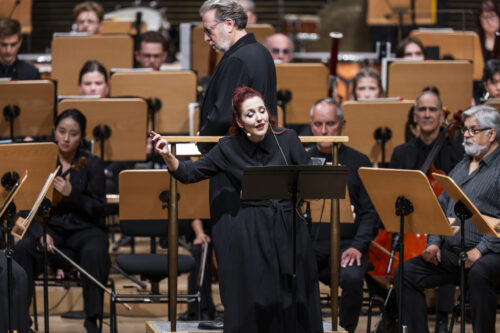
Chaya Czernowin – Unforeseen dusk: bones and wings
Hans Abrahamsen – Vers le silence
The 2025-26 season at the New York Philharmonic features only two concerts in their ‘Sound On’ series of contemporary music. The first was staged this fall in October, and its freshness and success left me wishing the next one was not as far off as May. Brad Lubman (well known for his directorship of New York-based Ensemble Signal among other new music accolades) was on the podium, and he meticulously and dramatically led New York Philharmonic players and Juilliard Orchestra students in a successful mix of professionals and those who soon will be.
The evening’s New York premiere was Chaya Czernowin’s Unforeseen dusk: bones into wings along with the first New York appearance of the Neue Vocalsolisten ensemble from Stuttgart. True to Czernowin’s typical tour de force compositions, Unforeseen dusk creates sound spaces of both narrative and abstract material. Her blend of electronic, instrumental and vocal music created more a recollection of melody than any graspable line. Still, the first sound, a groan from a soprano, had me hooked, alert to what might unfold.
In shattering semiotic structures, Czernowin’s musical playing field opens up to the universal. Momentum builds over a palpable yet broad structure in the score while connections of instrumental and electronic material meet each other across the orchestra in a growing density of sound. Lubman skillfully maintained the authenticity of each sound, all still perceptible within the mass conglomeration.
The Neue Vocalsolisten singers were sensational. To say that their voices have range is an understatement: their gurgling, ululating sounds seemed like gleaming arias. As the plot thickened, they tore through screaming pitches or rolled out extended bass drones in juxtaposition to an array of instrumental acrobatics leaning towards the microtonal with a silky effortless result.
Drawing somewhat on the representational characteristics of the tone poem, the performance revealed glimpses of imagery to the listener – bone-like sounds crackled, voice parts and instrumentation metamorphosized into airy gusts, a bird’s formation became gradually discernable in the listening process as fragmented sounds fell to the wayside. A creation myth unfolded which we experienced as a timeless primordial moment. A Firebird for the twenty-first century or maybe its backstory – raw and uncontaminated.
With Hans Abrahamsen’s Vers le silence, the focus shifted to color, rhythmic structure and the possibilities of compositional form. Written in the last five years, it is the culminating work of a trilogy and, in concept, ties to Unforeseen Dusk with inspiration taken from the five elements of creation: fire, earth, air, water and that perplexing fifth, the ether spirit. Nevertheless, I found the connection to these concepts vague.
The hall is initially filled with sweeping forte gestures: the piece is meant to approach silence, not start there. As in Czernowin’s work, we grasp an underlying form – in this case made up of clearly delineated rhythmic intervals that are based upon prime numbers (as the program notes explained). Dialogues between instrumental sections scatter throughout: violas play invitingly to spark enlivening material from the piano and harp, violins interject in an emergence of repetitive sounds. In the second movement, the eclectic, bell-heavy percussion section drives the rhythmic pattern while the melodic line takes the form of a gentle, gradual descent that eventually shifts into a jagged rondo flickering past in a nod to classical forms. The third movement layered patterns by orchestral sections ‘with utmost force’, but it also offered momentary shifts into quiet: a meditative duo between clarinet and bassoon was particularly memorable.
The fourth movement was the most stunning. Abrahamson’s life-long mastery of the full orchestra was apparent, and the players under Lubman rose to the interpretive challenge. They achieved the quiet yet bold presence of a heavily decked-out orchestra (imagine, two flutes at times doubling as piccolo and a vast set of drums in the mix) that came to a show-stopping end with a bass drum prompting a bell-like chime. Silence was announced.
To Lubman’s credit, the deft performances of the two works raised their stature to the symphonic without overshadowing the sophistication of the experimental material which continues to push the palette of the modern ear.
May is far off for the next ‘Sound On’ production, and I am eager to hear what is in store for New York new-music devotees and those adventurous enough to listen for the first time.
Daniele Sahr
Featured Image: Brad Lubman conducts members of the New York Philharmonic and Juilliard Orchestra © Chris Lee