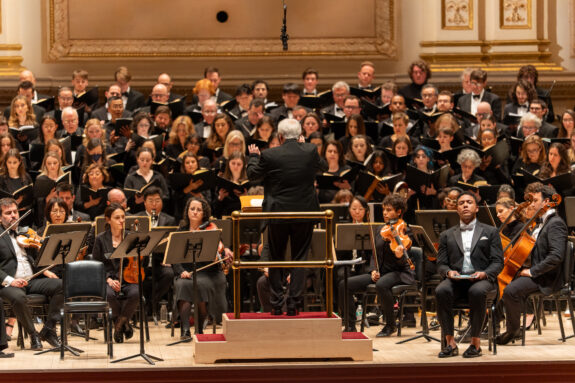
 United States Hailstork, Brahms: Brandie Sutton (soprano), Justin Austin (baritone), Cecilia Chorus of New York with Orchestra / Mark Shapiro (music director, conductor). Carnegie Hall, New York, 26.4.2025. (DS)

Adolphus Hailstork (text by Rita Dove) – The World Called (NY Premiere)
Brahms – Ein Deutsches Requiem (A German Requiem)
New York is nothing if not full of dedicated musicians. The many choral groups based in the city are testament to this fact: members are often active in other fields yet still dedicate precious time to the elevation and continuation of this soul-shaping art.
There is no better example of this than the closing concert of the 2024-25 season by the Cecilia Chorus of New York at Carnegie Hall under the baton of Mark Shapiro – the group’s visionary and tenacious music director. The ambitious and impassioned choices were the New York premiere of The World Called by Adolphus Hailstork and Brahms’s Ein Deutsches Requiem. Both of these powerhouse works connected listeners with feelings of mourning, resilience, introspection and grace.
Soprano Brandie Sutton brought her gleaming voice to The World Called, a societally relevant work that marks, with motivic material throughout, the 2017 death of activist Heather Heyer in Charlottesville, Virginia. Heyer was peacefully protesting against a white-supremacist rally held in that university town when a car deliberately drove into the crowd and killed her. Chorus, orchestra and Sutton approached the piece with the solemn tone it deserved, but they had no reservations in expressing poignant gestures of optimistic glorification as the composition demanded in its build. Hailstork’s use of European classical structures and American folk material come together in a sumptuous blend that succeeds in capturing the spirit of unity at its core.
In her brief speech before the performance, Heyer’s mother, Susan D. Bro, wanted to ensure there was no idol-worship of her daughter. Rather, she unequivocally instructed listeners to take the work as a reminder to ‘use [their] lives for good service’. Together with Bro’s words, The World Called captured a sense of resilience. It was impossible not to be heartened by the strength that art has to reinforce a communal sense of meaning and purpose which can activate good acts beyond the concert hall.
Brahms’s Ein Deutsches Requiem proved to be an astute pairing with the Hailstork. The requiem’s text was appropriate in its questioning of life’s meaning in the face of death’s mystery. Brandie Sutton remained to perform in the fifth movement with a tonally colorful palette that meshed well with the oboe’s solo line. Joining the musicians was baritone Justin Austin, whose technical virtuosity corresponded with his sensitive expression. Austin’s unfaltering voice added soothing textures in the third and sixth movements: he approached his solos with a reverence that exposed the inherent doubts existent in human revelation.
From the podium, Mark Shapiro shone in his ability to balance orchestra and chorus in a work known to test every singer’s endurance while demanding that players approach repetitive patterns with inventive phrasing and precise dynamics – a testament to the Cecilia Chorus’s dedication to producing high-quality recitals for exacting works in the repertoire. Singers and musicians were up to the challenge. Even after nearly seventy minutes of concentrated performance, the final movement, ‘Selig sind die Toten, die in dem Herren sterben’, was mesmerizing in its expression of Brahms’s ability to use art to unveil that which goes beyond human understanding – the power to remain strong and hopeful even in the face of sorrow.
Daniele Sahr
Featured Image: Conductor Mark Shapiro, baritone Justin Austin and the Cecilia Chorus of New York and Orchestra © Kevin Parada
How wonderful. Congratulations to the chorus. Great review.