 Italy Classiche Forme 2025 [1] – (tra parentesi): Chaos String Quartet (Susanne Schäffer and Eszter Kruchió [violins], Sara Marzadori [viola], Bas Jongen [cello]), Beatrice Rana (piano). Masseria Le Stanzie, Supersano, 19.7.2025. (LV)
Haydn – String Quartet No.4 in D major, Op.20 Hob:III:34
Riccardo Panfili – String Quartet No.3 (tra parentesi) (2025)
R. Schumann – Piano Quintet in E-flat major, Op.44
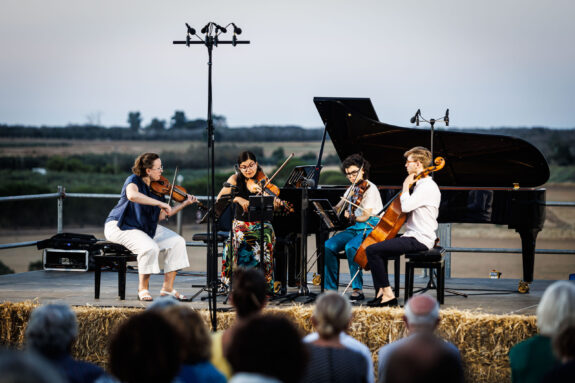
As the sun dipped beneath the horizon in Supersano – a small agricultural town inland from the Ionian coast in Italy’s southern Puglia region – the penultimate concert of the 2025 Classiche Forme festival unfolded in an open field beside the main house of Masseria Le Stanzie, where a platform had been erected for the musicians. This seventeenth-century estate, known for its atmospheric beauty and its iconic ‘te pendula’ hanging tomatoes, provided an evocative backdrop: stars blinked overhead as music filled the warm Apulian night. The program, played without intermission, framed a provocative world premiere between Haydn and Robert Schumann, offering a glimpse of chamber music’s timeless elasticity and its continuing reinvention.
The concert began with Haydn’s String Quartet No.4 in D major, one of the six works in his revolutionary Op.20 set of 1772. Often cited as the moment the string quartet came of age, the set marks a turning point where Haydn moved from elegant divertimentos to serious, polyphonic and emotionally complex structures. The Vienna-based Chaos String Quartet approached the piece not as an historical prototype but as a fully mature, deeply absorbing conversation. They brought out the rustic snap and rhythmic swagger of the Menuet alla Zingarese: Allegretto without rushing it and let the Presto e scherzando unfold with buoyant clarity and not too helter-skelter a speed. Throughout the evening, second violinist Eszter Kruchió played with brilliance and flair – her flashing accents and rich tonal weight formed a striking complement to Susanne Schäffer’s silkier, more lyrical sound. The balance between them gave the quartet’s texture a layered expressiveness that never wavered.
If Haydn represented the origins of the genre, Riccardo Panfili’s String Quartet No.3 pointed vividly toward its future. Commissioned by the festival and receiving its world premiere, the piece titled (tra parentesi) – which translates as ‘in parentheses’ – unfolded in three evocatively named movements, (‘Il sole tra il letto e l’orologio’ [inspired by Edvard Munch’s Self-Portrait. Between the Clock and the Bed]; ‘Pavane d’un enfant après les bombes’; ‘Gli ingegneri del caos’, referring to Giuliano da Empoli’s 2019 political essay on how populist power thrives on data, spin, chaos and calculated strategy), plus a finale of propulsive energy.
The first movement hovered inside a kind of static energy – buzzing and luminous – filled with sounds that seemed half-natural, half-imagined, dissolving into the night air. Against a sustained high note in the second violin and pizzicatos in the cello, the viola spins out a beautiful melody, later joined by the first violin in a surge of songful passion. The second movement begins with a rustic folk impulse before veering into a jazzy interlude – brief, sly and bitter-edged. In the third movement, the cello sings a slow, yearning line with the first violin echoing like silk pulled through sand, eventually relaxing into a hymn-like passage leading to an increasingly energetic ending with a crescendo of sixteenth notes punctuated by left-hand pizzicatos. The finale struggles forward amid a tide of irregular rhythms until, after a series of fragmented forte chords, the texture literally fractured – Bas Jongen had broken a string and dashed off the stage mid-phrase. After a five-minute pause, he bounded back, resumed his place and the piece continued as if nothing had happened. A series of lyrical phrases grows into a feverish delirium, with the quartet careening through angular lines and abstract unisons before the movement closes in a rush of unresolved energy.
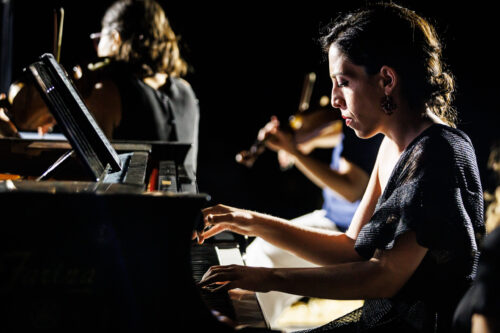
Beatrice Rana then joined the quartet on the stage and, after Jongen gave her a quick thumbs-up, she launched straight into a performance of Schumann’s Piano Quintet that brought the composer’s unique energy alive with collaborative precision and exquisite warmth. Her phrasing of the long-lined themes in the opening movement was both self-effacing and luminous – a balance of deliberate and impulsive, never overly epigrammatic, always clear.
In the second movement, Rana displayed remarkable restraint and sensitivity, following the first violin with respectful attentiveness before taking command of the triplets with grace and quiet authority as the viola entered with its expansive tune and the violins shimmered above it. In the central section, the cello added subtle portamentos – the only such gesture from any of the string players during the evening. The final sequence glowed with a chaste, interior beauty.
The third movement’s 6/8 rhythm pulsed with exuberance thanks to Rana’s motoric propulsion – joyful and urgent, even against the grim insistence of the meter. The first interlude hovered like a breath, the second coalesced with uncanny precision. Rana’s ability to knit these episodes together was pure genius.
In the finale, the strings shaped their brilliant passages with immense care and elegance, building toward the final sequence with a steady, noble tread. The last floating phrases sealed the evening with just enough triumph to lift the audience – who had sat on hay bales covered in blankets through the entire warm night – into a final round of grateful, enthusiastic applause.
For some, the concert served as a luxurious appetizer to a candlelit dinner of local specialties in the adjoining courtyard. The estate setting with its stone porticoes, sun-dried produce and a history of tobacco cultivation, deepened the sense of music as both cultural ritual and sensory immersion. The elemental night with its roots in Haydn, wings in Schumann and, in Panfili’s parenthetical world, something hovering, seemed unfixed, electric and new.
Laurence Vittes
Featured Image: The Chaos Quartet playing Haydn at Supersano © Flavio Ianniello
fabulissimo!