 Italy Britten, The Turn of the Screw: Soloists, Teatro dell’Opera di Roma Orchestra / Ben Glassberg (conductor). Rome Opera, Teatro Costanzi, 23.9.2025. (RP)
Rome Opera’s new production of Benjamin Britten’s The Turn of the Screw is a very British affair. Deborah Warner’s staging is simple, intense and powerful. Tenor Ian Bostridge reprised one of the key roles of his now three-decade-long career, creating an intriguing Quint with both his voice and body. The production was a reunion for Warner and Bostridge, who first worked together on the opera for the Royal Opera in 1997.
Composed in 1954, The Turn of the Screw is Britten’s final chamber opera. It is based on the 1898 Gothic horror novel of the same name by Henry James, an American author best known for his penetrating observations on the human character through the social interplay between émigré Americans and the English. There is none of that in The Turn of the Screw, but James’s probing of the corruption of innocence, another of his recurrent themes, also captivated Britten.
The story revolves around a Governess hired by a guardian to care for two children, Miles and Flora, at Bly, a remote country house. The guardian has given instructions that he is never to be bothered, and she is never to abandon the children. Upon arrival, the Governess reads a letter stating that Miles has been dismissed from his school and is never to return. She starts seeing ghosts, whom the housekeeper, Mrs Grose, identifies as the previous governess, Miss Jessel, and the former valet, Peter Quint, who have both died.
As the children’s behavior becomes increasingly erratic, the Governess is haunted by more frequent appearances of the ghosts. She is likewise consumed by the dismissal of Miles, a perfect boy in both her and the housekeeper’s eyes, from his school, and she obsesses over what evil could exist in such a boy. Convinced that Quint and Miss Jessel have returned to claim the children, she sends Mrs Grose to London with Flora, and Quint pays one final, fatal visit.
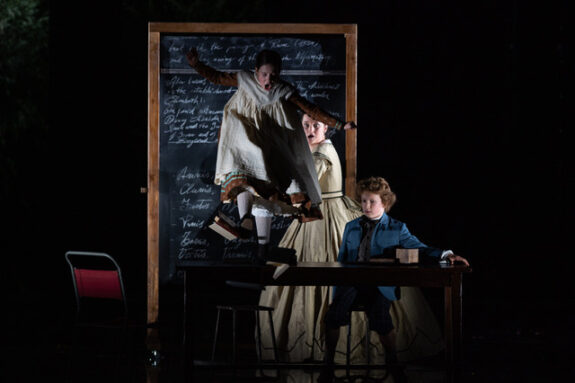
Warner’s concept has scant visual elements, just some odd pieces of furniture, including a chalkboard with the Latin declensions that Miles must memorize. The black walls open to reveal a lush green forest, as menacing as it is welcoming. Wooden boards descend from the sky, entrapping the Governess in the labyrinth of confusion and delusion from which she cannot free herself. This bare-bones approach works because Warner helped shape characters who make the drama seethe with tension: with so few visual distractions, the focus is always on them.
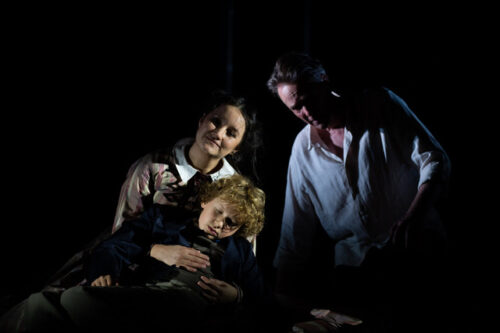
Bostridge’s delivery of the Prologue is direct and emotionally flat. He is telling a story, with his crisp articulation and penetrating tenor voice, nothing more. As Quint, Bostridge’s voice takes on more color, but remains almost otherworldly, as mysterious and menacing as his long, angular body. His mere presence is disconcerting, which completely unhinges the Governess.
Anna Prohaska’s Governess arrives at Bly, proud and confident, determined to love her charges and fulfill her duties, whatever the misgivings she has about the conditions that go with the job. The circumstances of Miles’s dismissal trouble her, but do not shake her resolve. Once Prohaska’s Governess starts seeing ghosts, her grip on reality slackens, yet the steely resolve to rise to the situation remains. The soprano’s voice is equally dauntless, always forthright and rich and capable of expressing emotion through subtle vocal colorings.
Emma Bell’s Mrs Grose is full-voiced and warm-hearted, but her gullibility and eagerness to parcel out bits of the past fuel the Governess’s imagination. As Miss Jessel, Christine Rice is harried and dazed. Her voice is focused and direct as she accuses Quint of betrayal, while he nonchalantly sings of the friend he seeks.
Cecily Balmforth as Flora and Zandy Hull as Miles embodied high-spirited children, eager to please and to indulge their fancies, as well as those of their elders. With youthful voices that ring true and clear, they zero in on their Governess’s fear and foibles with laser beam accuracy. Hull is particularly adept at charming one moment and then expressing a worldliness far beyond his years. Miles telling the Governess ‘You see, I am bad’ is bone-chilling due to Hull’s angelic appearance and cutthroat delivery.
In the pit, the young British conductor Ben Glassberg drew a detailed, precisely etched performance from the small ensemble of the Rome Opera Orchestra. Glassberg’s ability to harness the music’s beauty with such clarity underpinned the opera’s excruciating dramatic trajectory which culminates in the horrific final scene.
Rick Perdian
Featured Image: Cecily Balmforth (Flora), Anna Prohaska (Governess), and Zandy Hull (Miles) © Fabrizio Sansoni-Teatro dell’Opera di Roma
Production:
Stage director – Deborah Warner
Sets – Justin Nardella
Costumes – Luca Costigliolo
Lighting – Jean Kalman
Stage movements – Joanna O’Keeffe
Cast:
The Prologue / Quint – Ian Bostridge
Governess – Anna Prohaska
Miles – Zandy Hull
Flora – Cecily Balmforth
Mrs Grose – Emma Bell
Miss Jessel – Christine Rice