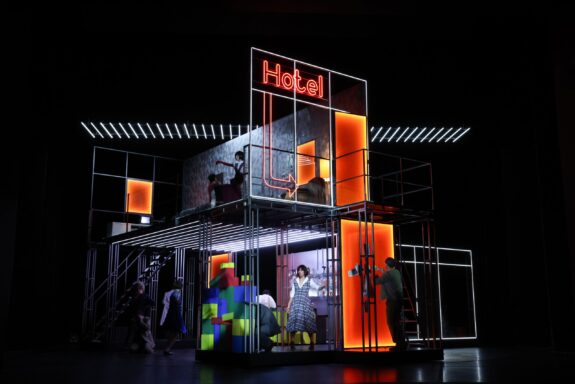
 Germany Prokofiev, The Fiery Angel: Soloists and Chorus of Theater Bremen, Bremer Philharmoniker / Stefan Klingele (conductor). Theater Bremen, 18.12.2025. (DM-D)

Although it was composed in the 1920s, Prokofiev never saw this opera on the stage: it received its first production in Venice in 1955, two years after his death. The central character, Renata, is a young woman who has had visions of a fiery (male) angel since childhood. In Barbora Horáková’s haunting Theater Bremen production, the visions were related to assumed child sexual abuse; Horáková added epileptic fits to Renata’s case history, in addition to Renata’s failed attempts at coming to terms with her trauma. Doctors and priests tried have been unable to support Renata, quite the opposite. Ruprecht, a man with psychological issues of his own, felt the calling to support, protect and save her, but only made things worse. In the end, we had a five-act, two-hour extended nightmare. The production team’s achievement was to frame that nightmare sufficiently well to avoid unbearable chaos.
As spectators entered the auditorium, they saw video footage of a sleeping Renata surrounded by shadows of hands. Predominantly, the long fingers in Sergio Verde’s video were gently reminiscent of Nosferatu images. Renata’s face and body appeared relaxed. Prokofiev set the opera in the Middle Ages – hence the appearance of famed universal medieval scholar Agrippa von Nettesheim (1486-1535) in Prokofiev’s medieval context as a character of authority to help Renata. In the Theater Bremen production we saw a metal structure identified as a hotel, with a bedroom, a bar and several staircases as distinct areas. The costumes were contemporary as well.
Stefan Klingele conducted Prokofiev’s score with much attention to detail, and an appropriate variety of tempos and volume. He was thus able to bring out the very sudden shifts in intensity and modes of the music, intended to mirror Renata’s different states of mind, which were equally prone to shift from one moment to the next. Nadine Lehner sang Renata. The role is a tour de force, both in terms of acting and singing, and Lehner did so much more than full justice on both accounts. It was an outstanding performance. Lehner conveyed numerous detailed nuances of madness, with immaculate precision and full commitment. She took us all on the journey of her character’s immense and ineradicable anguish and suffering, which she conveyed unambiguously, through her art as an actress, as those of a fictional character, so that the presentation remained firmly within the world of art. For that very reason, Lehner was able to have such a deep impact – much more so than a more realistic approach to acting would have been able to achieve. Her use of voice matched that approach: Lehner’s voice sounded beautiful even in scenes of madness.
The performance was followed by a short official ceremony during which Carmen Emigholz, the chair of Theater Bremen’s supervisory board, presented Lehner with the honorary title of Kammersängerin. It is the highest honour a federal state or municipality can bestow on a singer for their long and esteemed services to the company. Lehner has been a member of the Bremen Opera Company since 2004, singing numerous leading roles, most recently including Kundry in Parsifal, Ortrud in Lohengrin, Herodias in Salome, the Marschallin in Der Rosenkavalier and Marie in Die tote Stadt. She has always combined full commitment to her respective roles with enormous stage presence. Over the years she has carefully developed her voice from the mezzo to the soprano range, with an emphasis on character roles over predominantly lyrical ones. In his laudatory speech, Theater Bremen’s head director of the music theatre, Frank Hilbrich, emphasised that Lehner’s ability to engage so fully with her often complex characters was to a large extent because she felt so much at home, and thus safe and secure, in the company. In her words of thanks, Lehner confirmed this.
Elias Gyungseok Han sang Ruprecht as Renata’s partner in madness. He was appropriately startled by Renata’s ever so sudden shifts of emotions and intentions but far from merely reactive. With his flexible, sonorous voice, he made the most of the idiosyncrasies of Prokofiev’s music for this role. The other characters appear each for a relatively short period of time according to their function within the plot development. Here, the strength of the Theater Bremen company came to the fore, as the main singers of the company and members of the chorus selected for solo roles performed at the same high level of achievement.
A striking, cogent production, a great lead performance and the award ceremony made this evening a very special event.
Daniel Meyer-Dinkgräfe
Featured Image: Theater Bremen’s The Fiery Angel © Jörg Landsberg
Production:
Director – Barbora Horáková
Stage design – Ines Nadler
Costume design – Eva-Maria van Acker
Lighting design – Christian Kemmetmüller
Video – Sergio Verde
Dramaturgy – Pia Syrbe
Chorus director – Karl Bernewitz
Cast:
Renata – Nadine Lehner
Ruprecht – Elias Gyungseok Han
Innkeeper – Ulrike Mayer
Agrippa von Nettesheim / Doctor – Ian Spinetti
Fortune-teller / Abbess – Nathalie Mittelbach
Inquisitor – Jasin Rammal-Rykała
Faust – Wolfgang von Borries
Mefisto / Jakob Glock – Fabian Düberg
Servant / Innkeeper – Christian Heinrich
Two nuns – Andrezza Reis, María Martín Gonzaléz