 Spain Verdi, Otello: Soloists, Children’s Chorus, Chorus and Orchestra of Teatro Real / Nicola Luisotti (conductor). Teatro Real, Madrid. 25 and 26.9.2025. (JMI)
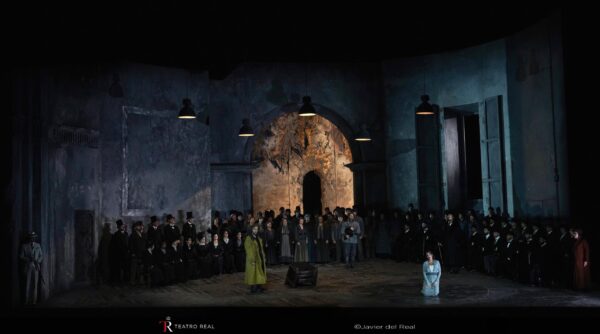
Teatro Real opened its 2025-2026 opera season with this great Verdi opera which was last performed here in 2016 when it also opened the season with the same David Alden production. Clearly, the Teatro Real does not give much importance to the season opener, unlike most European and American theaters. If nine years ago this Otello was disappointing, this time it was again so in terms of the production although the musical and vocal aspects were much improved.
There is a single set which offers only walls on the sides and a large door at the back that opens to reveal a screen with hills in Act II and a kind of gate during the arrival of the Venetian Ambassador. There is not even a bedroom for Desdemona who seems to like sleeping on the floor. These minimalist productions usually make sense for entering deeper into the characters’ drama, but that is not achieved here either. Otello’s death is quite absurd as he sings ‘Un baccio, ancora un baccio’ about 10 meters away from Desdemona’s corpse. The children’s homage to Desdemona in Act II is intuited, as the chorus sings and the soldiers present her with the flowers. For David Alden, the opera’s protagonist is Iago, who is always on the stage, even during Otello’s death, although the libretto tells us he is fleeing.
Without a doubt, one of the aspects that worked best was the musical direction by Nicola Luisotti, a true master of conducting Verdi operas and Teatro Real’s principal guest conductor. His leadership was brilliant and moving, although there was excessive volume at times (which does not diminish the praise for his performance). The Teatro Real Orchestra was wonderful, and the Teatro Real Chorus and Children’s Chorus were also excellent.
Otello in the first cast (currently available on medici.tv) was sung by tenor Brian Jagde, whom we had seen previously in this theater although his performances were not memorable. Jagde was making his debut in the role of Otello, and he was superb when the score called for the upper range of his voice. The same cannot be said for the middle and lower ranges which were clearly insufficient. If Jagde wants to become an outstanding Otello, he needs to work much harder on that middle as the score is very demanding in that area. He is still far from the memories I have of some Otellos, such as those by Plácido Domingo and Jonas Kaufmann and, in purely vocal terms, of Giuseppe Giacomini.
Otello in the second cast was Jorge de León, who has sung Otello in several theaters. His tenor is much better suited for Otello than Jagde’s: the high notes are always bright and full, and his middle notes are perfectly suited to the role. In short, we are talking about one of the few Otellos today that one would want to see and hear again.
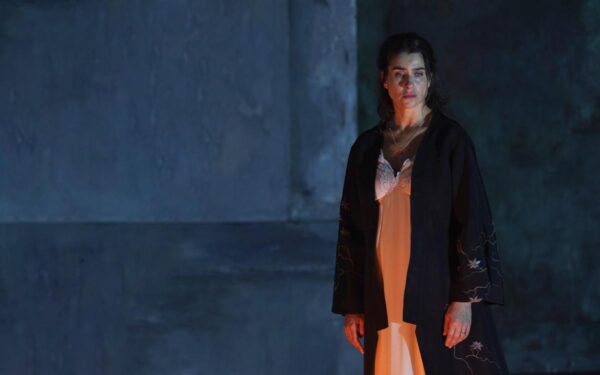
Desdemona was sung by soprano Asmik Grigorian, daughter of the late great Armenian tenor Gegham Grigorian, and I can only say that the part could not be done better. Her performance in Act IV is worthy of being included among the finest moments for a singer. A curious detail: after her ‘Ave Maria’ came the only standing ovation in the entire opera. It could be argued that there weren’t more because Luisotti didn’t stop the orchestra, but it must also be said that he didn’t do so at the end of ‘Ave Maria’, and it was the audience who stopped them. A great soprano and a magnificent Desdemona.
The second Desdemona was a soprano Maria Agresta, one of the outstanding lyric sopranos of today. I will not compare her to Asmik Grigorian because I do not think anyone can compare with her today. Agresta once again delivered a fine performance as Desdemona, as she has done whenever she has sung the role. I remember hearing her do it years ago, and the impression remains positive. But every time I listen to her, I am left with the thought that she is always missing something to rise from a good soprano to an exceptional one. In this case, she was good, but she lacked emotion in her great scene in the last act.
In the part of Iago, Teatro Real had to deal with substitutions in both casts. Baritone Igor Golovatenko was initially announced but he canceled some time ago. His replacement was Gabriele Viviani, who was convincing, although his voice is weak in the lower notes. In the second cast, Iago was sung by baritone Vladimir Stoyanov who replaced the originally scheduled Artur Ruciński. It had been no less than eight years since I last heard Stoyanov live, and I found his voice to be more lyrical than ever, yet with similar projection problems. Nevertheless, he did well this time.
The supporting roles were generally well cast, starting with mezzo-soprano Enkelejda Shkoza’s Emilia. Also good was tenor Airam Hernández as Cassio. Both Albert Casals in the role of Rodrigo and In Sung Sim in that of Ludovico were adequate. Fernando Radò, who doubled the roles of Montano and Herald, also sung and acted well.
José M. Irurzun
Featured Image: Asmik Grigorian (Desdemona) © J. del Real
Production:
Stage director – David Alden
Set and Costume design – Jon Morrell
Lighting design – Adam Silverman
Choreography – Maxine Braham
Chorus director – José Luis Basso
Children’s chorus director – Ana González
Cast:
Otello – Brian Jagde / Jorge de León
Desdemona – Asmik Grigorian / Maria Agresta
Iago – Gabriele Viviani / Vladimir Stoyanov
Cassio – Airam Hernández
Emilia – Enkelejda Shkoza
Roderigo – Albert Casals
Ludovico – In Sung Sim
Montano / Herald – Fernando Rado