
 Germany Robert Schumann, Das Paradies und die Peri: Soloists, Hamburg State Opera Chorus, Hamburg Philharmonic State Orchestra / Omer Meir Wellber (conductor). Hamburg State Opera, 30.9.2025. (DM-D)
Tobias Kratzer as the new Artistic Director and Omer Meir Wellber as the new General Music Director at Hamburg State Opera launched their first season with a production not of an opera classic but with a ‘discovery’, Robert Schumann’s secular oratorio Das Paradies und die Peri, created and first performed in 1843. Schumann based the text on Lalla Rookh, an ‘oriental romance’ by Thomas Moore, written in 1817. The word Peri is Persian and means elf or fairy.
The Peri in Schumann’s oratorio is the child of a fallen angel and a human woman. She has been cast out of heaven. However, if she brings a suitable gift to the heavens, she will gain access. The first gift, the blood of a freedom fighter, is rejected. Her second gift involves a woman: during a pandemic, the woman is still in good health, but her husband is dying from the virus. She decides to be with her husband, so by necessity catches the virus and dies from it as well. The Peri offers up the woman’s last sigh. It, too, is rejected. In the final chapter, children are seen playing in a glass dome, in a miniature world; they die from the fumes emerging from the chimneys of miniature factories.
As the audience entered the auditorium, with doors opening only some 10 minutes before the advertised starting time (compared to the usual 30 minutes), a man in contemporary clothes, trousers and shirt, sat behind a table and worked on a laptop. Near the back wall, which was quite close to the front of the stage, creating a space that was much wider than it was deep, a female body was lying down. She was positioned on her side, facing the back wall, surrounded by fluffy white feathers. Also on the stage were a professional camera on a tripod and a camera operator. Above the stage, typical of Kratzer, a screen showed the images from that camera: members of the audience, in different angles, frames and zoom settings. On the stage, others came and went; some looked suspiciously at the female body, moved a little closer to see better, but not one of them got too close. Several others took over operating the camera, one by one.
Wellber entered the pit without house lights going down or lights on the stage or the pit fading out, either. Soon after the audible tuning of the instruments, the music just started, as did the singing. The computer operator turned out to be the tenor narrating and guiding us through the events.
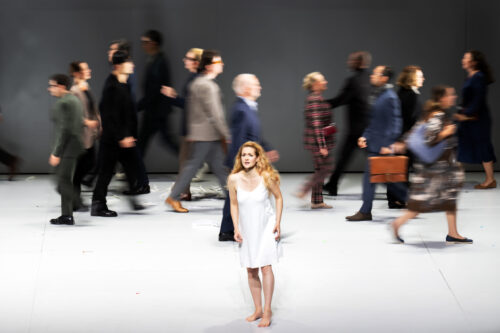
When the woman got up, eventually, she took hold of the feathers (remains of angel’s wings?) and immediately moved her arms and hands to grope in a void where they must have been before. This was the Peri. In a striking image early on, she moved about aimlessly among the crowds of people rushing to work on a busy day.
The audience’s response to the context of the three chapters, the three gifts the Peri offers to the angel as God’s representative, was vital to God’s decision communicated by the angel: when the blood was poured over the Peri, a woman in the audience was filmed getting up, booing and leaving the auditorium in protest, shouting that such images don’t belong in an opera house. While we watched the woman dying next to her dead husband, we saw the camera images of an audience member fast asleep, while the woman next to him, wearing an antiviral mask still only too familiar to all of us from the Covid pandemic, made several futile attempts at waking him up. When the children in the glass dome died, an old man (part of the production) in the auditorium was filmed as he started to cry. Vera-Lotte Boecker came down from the stage and climbed over the armrests and back rests of the rows, supported by spectators, to reach the man. Her Peri collected his tears and brought them as a gift to the angel, which gained her admittance to paradise.
The set, designed by Rainer Sellmaier, was simple, sparse, using only that narrow corridor on the stage; rather than the vast expanse of the space at the team’s disposal at the Hamburg State Opera House. That space expanded only temporarily to reveal the glass dome with the children. A frameless screen was lowered from the ceiling above the front of the stage, in line with the curtain, to show all the live video from the auditorium, as well as the angel: for at least one of his appearances, stagehands brought on a large painting of a blue sky with clouds, which they placed against the back wall, and was held there. The angel, appearing from the wings and once on wires from the ceiling, stood in front of that painting. The live camera then created video of the angel in front of the sky, which appeared on the screen.
These are several details of a production which came across well making it very successful Hamburg debut by Kratzer and his team. The approach was cogent and consistent, the plot unfolded in an uncrowded, straightforward manner. There was no doubt of the high level of assured experience and thorough craftsmanship of all involved. The audience was mildly provoked, notably by highlighted elements such as the booing woman, for example. The production was gently self-reflexive also with regard to the presentation of the angel both in front of the painting, and its juxtaposition with the video image created. The result was impressive to start with and thought-provoking as it unfolded.
The casting may well have been indicative of Kratzer’s approach to his tenure in Hamburg. All soloists were not only very good singers in their own right: they were, without exception, also very good actors. Their full and committed engagement with their roles demonstrated a skilful and attentive directorial approach. Vera-Lotte Boecker did more than full justice to the demanding role of the Peri. She was outstandingly moving in her empathy with the humans she encountered. Her voice was particularly malleable and flexible, full of tenderness and energy as needed. Kai Kluge narrated with a particularly clear and solidly bright tenor. The voices of Eliza Boom (soprano), Kady Evanyshyn (mezzo-soprano) and Annika Schlicht (contralto) were rich and strong in their own right, well differentiated from each other. Christoph Pohl was a sturdy baritone, Lunga Eric Hallam sounded suitably weak as the dying youth, and countertenor Ivan Borodulin came across an as appropriately otherworldly bearded angel. The soloists blended in well with the strong chorus, directed by Alice Meregaglia. Omer Meir Wellber conducted with assurance, sensitive to the score and the soloists; the orchestra played with full commitment and musicianship.
This launch of a new era of Hamburg State Opera was exciting and successful and bodes well for the future.
Daniel Meyer-Dinkgräfe
Featured Image: [front l-r] Vera-Lotte Boecker (Peri), Lunga Eric Hallam (Youth), Kai Kluge (Tenor) and chorus of Hamburg State Opera © Monika Ritterhaus
Production:
Director – Tobias Kratzer
Sets and costumes – Rainer Sellmaier
Video – Manuel Braun
Lighting – Michael Bauer
Dramaturgy – Christopher Warmuth
Chorus director – Alice Meregaglia
Cast:
Peri – Vera-Lotte Boecker
Soprano / Virgin – Eliza Boom
Mezzo-soprano – Kady Evanyshyn
Contralto – Annika Schlicht
Tenor – Kai Kluge
Baritone / Gazna / Man – Christoph Pohl
Angel – Ivan Borodulin
Youth – Lunga Eric Hallam