
 United Kingdom Schnittke, Shostakovich: Timothy Ridout (viola), BBC Symphony Orchestra / Hannu Lintu (conductor). Barbican Hall, London, 24.10.2025. (AV-E)
Schnittke – Viola Concerto (1985)\
Shostakovich – Symphony No.8 in C minor, Op.65, ‘Stalingrad Symphony’ (1943)
Coupling the Alfred Schnittke Viola Concerto with the Dmitri Shostakovich Eighth Symphony was perfect programming for both works were testimonies to suffering with both being given exemplary, highly intense performances by the BBC Symphony Orchestra in top form.
I have always found the viola a schizophrenic instrument to listen to in that it sounds somewhere between a violin and a cello with no identity of its own; viola-solo works like Berlioz’s Harold in Italy just don’t work for me. Yet what changed my bigoted prejudice was the violist, Timothy Ridout, whom for me, gave the viola a voice of its own which I was unaware of before.
Alfred Schnittke’s Viola Concerto is a masterpiece. Timothy Ridout’s playing was masterful. The cryptic compositional combination of winds, brass, piano, celesta and harpsichord gave us a gothic and subterranean soundworld so suiting Ridout’s spooky sounds from ‘Mourning and Melancholia’ of Sigmund Freud to carnivalesque grotesqueries of Mikhail Bakhtin’s ‘Rabelais and His World’.
The score secretes sorrowful sounds of despondent dejection and subdued sullenness: as if whining whilst wandering in the wilderness without forgiveness. Then follows shuddering shards of delighting-in-despairing dancing through darkness before the cascading creepiness of an enveloping eeriness. With the Allegro, angular and agitated, swaying and swirling, and the entry of the piano, the mood melts into a metallically melancholia with a childlike-coyness and aloof aloneness: the delicate orchestration here is beyond words and my words – however I try – can never possibly match sounds or measure moods. As the music progressed, or rather, actually digressed, the soundscape became evanescent, desolate and diffuse, disparate and desperate. Accompanied by the eerie ‘eviling’ of the haunting harpsichord, Ridout produced sounds so unique and unusual that they, indeed, cannot by ‘translated’ into words.
I consider the Schnittke Viola Concerto to be a far more inventive and imaginative to the viola concertos composed by Bartók, Walton and Hindemith by a long shot.
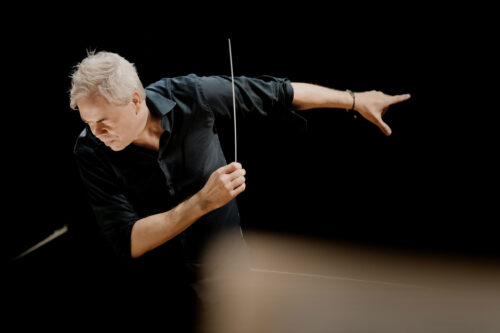
Hannu Lintu is a first-rate Shostakovich conductor who had his fingers on the pulse throughout the gargantuan Eighth Symphony seemingly conducting the five movements in one fell swoop, as if the score was composed in one movement and conceived as an organic whole.
The colossal first movement opened with a gritty grainy attack from the cellos and double basses setting the scene for the devastation ahead. Lintu sustained this 25-minute movement with a measured concentration and nervous tension never allowing the music to drag or sound sectionalised. Throughout, the BBC SO played with the appropriate acidic and sarcastic sounds required.
The two Scherzos had an uncouth gruffness, ruffed bite and camp grotesqueness, as called for: truly, a carnival of catastrophe. The Largo was meticulously measured and played with a melting melancholic mood of gloom and doom from winds and strings. In the concluding Allegro, the mood suddenly shifts to childlike chirpiness of ‘memories’ of ‘future’ days to come; only to be shattered by the oncoming terror of the menacing percussion; and then a return to calm with a dance and the bass-clarinet, solo violin and then the winds and strings drifting into nothing. The closing passages were conducted and played with the utmost concentration.
To prevent premature applause, Lintu kept his hand mid-air for ten seconds to preserve the essential silence after the music died away, only for it to be wrecked by the sound of a plastic cup being crunched, which prompted the conductor to turn round with a smile (of derision?). Throughout the symphony I often heard glass bottles clanging and other cups crunching: why do people need to drink alcohol when they will be getting drunk and intoxicated by the music?
I wrote to Nicola Lake, the Barbican Hall’s Venue Manager, stating that I was shocked to see patrons bringing plastic cups of beer and beer bottles into the auditorium and that they should not be allowed in there out of respect for the music because bottles and cups inevitably get dropped, kicked … or crushed. I now wait with bated breath for her response.
Alexander Verney-Elliott