
 United Kingdom Mozart, Rachmaninov: Paul Lewis (piano), London Philharmonic Orchestra / Karina Canellakis (conductor). Royal Festival Hall, London, 25.10.2025. (AV-E)
Mozart – Idomeneo Overture; Masonic Funeral Music; Piano Concerto No.25 in C major
Rachmaninov – Symphony No.2 in E minor, Op.27
An announcer dedicated this concert: ‘In Memory of Pehr G. Gyllenhammar (1935–2024)’, former Chairman of the London Philharmonic Trust (2006-2011).
I know it is heresy to say this, but Mozart’s Idomeneo Overture is boring beyond belief and could have easily been composed by AI. It has nothing going for it and it goes nowhere. Yet, miraculously enough, Karina Canellakis and the London Philharmonic Orchestra played it with panache and aplomb, and the packed audience gave it courteous applause. Yet we could have well done without this unappetising appetiser.
I was really looking forward to hearing the very rarely played Masonic Funeral Music and was extremely disappointed by the detached and disinterested delivery of this macabre masterpiece. Devoid of mood and emotion, it simply sounded sterile and clinical, pristine and polished, and drastically let down by the barely audible cellos and double basses, with conductor focusing her attention largely on the violins. And yet, the all-important cellos and basses constitute the throbbing-pulse of this solemn score.
The highlight of the evening was Paul Lewis’s paradigm performance of Mozart’s Piano Concerto No.25. Lewis has integrated the score into his nervous system and so his body plays it directly with no thought needed: indeed, thinking would be the ruination of the instantaneous immediacy of his playing which simply has no time to think what is being played: for everything was played as Mozart had written with wit, charm, sparkle and lilting-grace. Karina Canellakis offered exemplary support with her elegant and incisive conducing. It was refreshing to hear the timpanist using hard sticks even if they were barely audible even from the front centre stalls. Due to the sheer size of the hall, the woodwind and timpani should have been raised or brought further forward, for they sounded so distantly opaque.
Whilst the performance of the Rachmaninov Second Symphony was perfectly paced and passionately conducted by Karina Canellakis, it was somewhat of an anticlimax after hearing the mesmerising Mozart 25th Piano Concerto with Lewis.
I have heard the LPO in this symphony several times over the years, yet this is the first time that it did not ignite. It was not heart-on-sleeve but more heart-in-recovery. Conducting with passion does not necessarily elicit emotion, as was evident tonight, where feelings were left fermenting and simmering on the stove of the stage rather that emotions reaching boiling-point and running-over (the top), as required
And, yet again, Canellakis gave scant attention to the cellos and double basses – and yet in this, of all symphonies – they must be heard and accentuated. From where I was sitting there was an audible imbalance between violins/violas and cellos/double basses with the former swamping the latter. I considered this untenable and it completely ruined the performance for me. Canellakis urgently needs to encourage the cellos and double basses to play with much more depth, weight and presence.
Even the famous clarinet solo in the Adagio was far too coy, shy, reserved and failed to melt my frozen heart; furthermore, the closing bars of the last movement lacked the essential punch with the percussion sounding far too restrained.
Yet the packed Royal Festival Hall audience gave it a standing ovation and were visibly moved.
Alexander Verney-Elliott
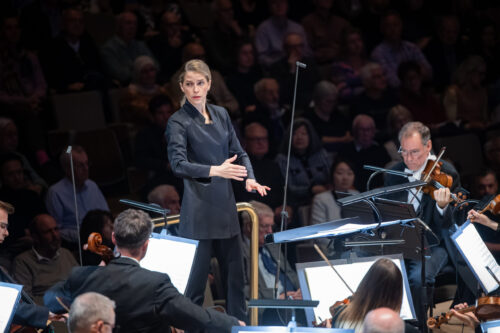
Featured Image: Karina Canellakis conducts pianist Paul Lewis and the London Philharmonic Orchestra © LPO
I must say that I got much more out of the Rachmaninov than AV-E but much enjoyed his very articulate review – and I share his view of the Paul Lewis’s playing in the Concerto. It was the Masonic Funeral Music which bored me to tears but then reading the above might explain that. For the Rachmaninov we were much closer to the cellos and double basses (row K aisle in right hand block) which came through wonderfully. Possibly a clue may lie in your reviewer’s seat. I would never choose the central stalls in the RFH as the acoustic there invariably for me suffers terribly in the bass – both from strings and percussion.
I was privileged to see the same programme a day earlier at Saffron Hall and the Rachmaninov was one of the most thrilling readings I’ve ever seen and heard of any piece, and whilst I won’t have seen anywhere near as many as the reviewer, I’ve still seen a fair few in thirty years. I haven’t been to the RFH for a long while but maybe the acoustics are superior in Saffron Walden as the performance was outstanding.