
 United States Bernstein, Prokofiev, Copland: Yuja Wang (piano), Boston Symphony Orchestra / Domingo Hindoyan (conductor). Boston Symphony Hall, Boston, 24.10.2025. (ES-S)
Bernstein – Three Dance Episodes from On the Town
Prokofiev – Piano Concerto No.2 in G minor, Op.16
Copland – Symphony No.3
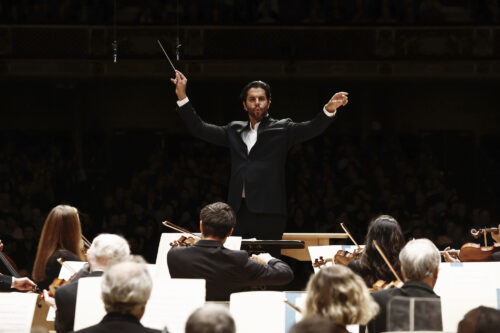
Domingo Hindoyan’s return to the Boston Symphony Orchestra resonated with institutional memory. Bernstein, Prokofiev and Copland are all entangled with the BSO’s past through Serge Koussevitzky, the orchestra’s long-time music director. He conducted the American premiere of Prokofiev’s Piano Concerto No.2, commissioned Copland’s Third Symphony and taught Bernstein at the Berkshire (now Tanglewood) Music Center where Copland led the composition faculty. Yet the evening felt pointedly present-tense: rhythmic, bright-edged and built for contrast.
Bernstein’s Three Dance Episodes from On the Town began with bright, incisive energy. ‘The Great Lover’ strode forward with crisp bass lines and alert percussion, the swing inflection kept taut rather than indulgent. Hindoyan shaped the brass so that their swagger never swamped the texture, letting woodwind asides register clearly. ‘Lonely Town: Pas de deux’ found unexpected tenderness in the strings’ steady arc, the clarinet’s phrasing soft-grained. ‘Times Square: 1944’ pushed the orchestra into a blaze of neon brilliance, a crowded canvas where offbeat accents and piano interjections sparked against one another. The effect was a reminder that Bernstein’s soundworld depends on rhythmic bite as much as gloss.
Yuja Wang took on Prokofiev’s Piano Concerto No.2, a work whose hybrid temperament – austere and sardonic yet charged with inward lyricism – found an ideal match in her control. Following the hesitant, apparently seeking direction, opening, she began to build tension with tensile clarity; as momentum gathered, her articulation turned steely and exact. The extended first-movement cadenza unraveled like a single argument in stages: sonorous bass pillars, quicksilver passagework, then hammer-hard climaxes before yielding to the orchestra’s full return. In the Scherzo, her moto perpetuo glittered with almost clinical precision; each sixteenth sat exactly where it should, but the line had lift not just velocity. The tread of the Intermezzo was heavy without turning coarse, Wang tossing off spiky figures above the orchestra’s dark ostinato as if needling the march from within. The Finale began with drive and ended in near-combustion. What impressed was less the volume than her command of line and pacing – the solo spans always purposeful, the final accelerations emerging naturally. Hindoyan tracked her closely, keeping tuttis lean so that reentries landed seamlessly. With Bernstein’s idiom still lingering in the ears, one could discern in Prokofiev’s rhythmic charge – syncopations sharpened, harmonies pressed to their edge – a premonition of the jazz era to come.
Wang returned for two encores that felt like a continuation of the interbellum mood. She began with Youmans’s ‘Tea for Two’ – in Art Tatum’s arrangement, further reimagined by Wang – a confection of syncopated charm and gleaming precision. The easy swing and clipped accents made explicit the jazz inflections clearly embedded in Bernstein’s music and only hinted at in Prokofiev, her sequined dress catching the light with the same period allure. She followed with her transcription of the Scherzo from Shostakovich’s String Quartet No.8, dispatching its relentless sixteenths with crystalline accuracy and dry brilliance, the composer’s DSCH signature – the four-note cipher of his name – cutting sharply through the texture.
After the intermission came a shift from glitter to granite. Copland’s Symphony No.3, written at the close of the Second World War, is a vision of renewal shadowed by what had been endured. Domingo Hindoyan drew out the work’s spacious geometry with patience, allowing its sonorities to accumulate gradually. The opening movement’s long, ascending lines suggested dawn light spreading across an immense landscape; brass and percussion blended within the texture, never overpowering it. In the second movement, sharply etched rhythms gave the music a rough-hewn vitality, while the slow movement unfolded as a nocturne of quiet radiance, the strings’ barely-vibratoed tone lending transparency to Copland’s harmonies.
When the ‘Fanfare for the Common Man’ theme finally surfaced in the finale – first as an inward murmur in the woodwinds, then blazing through the brass – Hindoyan balanced grandeur with restraint, the climactic affirmation emerging not as bombast but as hard-won belief. Countermelodies were given real profile, inner-string figures riding forward with uncommon clarity. There was no sense of redundancy; the fanfares – or hints of them – that echo through the symphony felt freshly summoned each time, their force cumulative. As it did throughout the evening, the orchestra played with remarkable cohesion, its unified sound giving Hindoyan’s spacious reading both weight and transparency.
Edward Sava-Segal
Featured Image: Domingo Hindoyan conducts pianist Yuja Wang and the Boston Symphony Orchestra © Winslow Townson
This is a marvelously worded review, creating a sound image which not only made me feel sorry for having missed this event, but also happily creating a greater desire to find time for study.