
Gregor Tassie talks to conductor Giancarlo Guerrero about Shostakovich and his opera Lady Macbeth of Mtsensk District
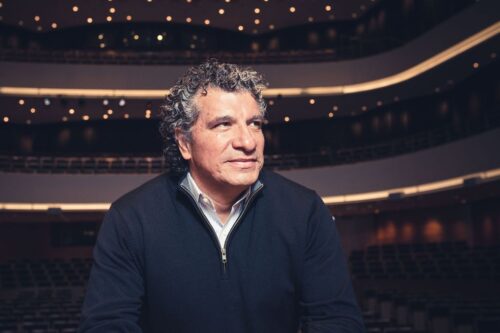
From my review of a recent performance of Shostakovich’s Lady Macbeth of Mtsensk District: ‘Guerrero’s masterly analysis of the score and his authority in guiding this excellent orchestra of Romanian Radio was at the centre of the evening – the orchestra unveiled world class virtuosity with the brass group in particular evincing the often ribald brutality of Shostakovich’s orchestration, with the woodwind matching them with the quirky intonation of the composer’s frequently piquant and satirical score. At significantly dramatic moments, Guerrero brought out the expressive passages on the violas which was another eloquent and impassioned element of Shostakovich’s orchestration.’
‘Towards the end of the final tragedy, the plight of Katerina became clear and ever so deliberately, the outstanding conductor Giancarlo Guerrero brought the terrible final tragedy to a close with a terrifically vehement and grotesque climax – to the end – evincing the brutality of the closing scene. The major credit for this movingly powerful performance must be given to Guerrero – this was a triumph in solving the considerable challenges of the score and manifesting the tragic and terrible indictment of society’s abuse of women.’
Born in Nicaragua, Guerrero immigrated during his childhood to Costa Rica, where he joined the local youth symphony. He studied percussion and conducting at Baylor University in Texas and earned his master’s degree in conducting at Northwestern. Given his beginnings in civic youth orchestras, Guerrero is particularly engaged with conducting training orchestras and has worked with the Curtis School of Music, Colburn School in Los Angeles, The Juilliard School, National Youth Orchestra (NYO2) and Yale Philharmonic, as well as with the Nashville Symphony’s Accelerando program, which provides an intensive music education to promising young students from diverse backgrounds.
2025 marks Guerrero’s first season as Artistic Director and Principal Conductor of the Grant Park Music Festival in Chicago. Guerrero also became Music Director of Sarasota Orchestra in the 2025-26 season, becoming the seventh conductor to hold the appointment since the Orchestra’s founding in 1949. During his sixteen-year tenure as Music Director of the Nashville Symphony – where he is now Music Director Laureate – Guerrero championed contemporary American music. He and the Nashville Symphony commissioned and premiered nearly two dozen pieces – including works by Béla Fleck, Ben Folds, Jennifer Higdon, Hannibal Lokumbe, and Terry Riley – and released twenty-one commercial recordings, which have garnered thirteen GRAMMY® nominations and six GRAMMY® Awards across multiple categories. He also guided the creation of the Symphony’s biannual Composer Lab & Workshop alongside Aaron Jay Kernis.
In the 2025-26 season, Guerrero adds to his extensive discography with the Nashville Symphony with the release of Gabriela Lena Frank’s Conquest Requiem, a recording of concertos by Jennifer Higdon, Brad Warnaar, and Chick Corea, and an album of works by composer Kip Winger, all to be released on Naxos American Classics. He also conducts the Symphony in three programs and a gala concert featuring Renée Fleming. Guerrero’s guest appearances this season include engagements with the Los Angeles Philharmonic, Cincinnati Symphony Orchestra, Atlanta Symphony Orchestra, and the symphonies of Eugene and Grand Rapids, with his international engagements including the Deutsches Symphonie Orchester Berlin, and Gulbenkian Orchestra in Lisbon.
Guerrero has conducted the New York Philharmonic, San Francisco Symphony, Boston Symphony, National Symphony Orchestra, and those of Baltimore, Chicago, Cleveland, Dallas, Detroit, Indianapolis, Los Angeles, Milwaukee, Montréal, Philadelphia, Seattle, Toronto, Vancouver, and Houston. On the international scene, he has worked with the Bilbao Symphony Orchestra, Deutsche Radio Philharmonie in Saarbrücken, Frankfurt Radio Symphony, London Philharmonic, Orchestre National de France, Orchestre Philharmonique de Radio France, Netherlands Philharmonic, NDR Radiophilharmonie, Orquestra Sinfonica do Estado de São Paulo in Brazil, Orquesta Sinfónica de Galicia, Frankfurt Opera and Museum Orchestra, and New Zealand Symphony as well as Sydney Symphony and Queensland Symphony in Australia. Guerrero previously held posts as the Principal Guest Conductor of both the Cleveland Orchestra, Miami Residency and the Gulbenkian Symphony in Lisbon, Music Director of the Eugene Symphony, and Associate Conductor of the Minnesota Orchestra.
Guerrero also conducts the NFM Wrocław Philharmonic this season, where he recently completed a six-season tenure as Music Director, and with whom he made several recordings, including the Billboard chart-topping Bomsori: Violin on Stage on Deutsche Grammophon and albums of repertoire by Szymanowski, Brahms, Poulenc and Jongen.
I met Giancarlo Guerrero on the eve of the concert performance of Lady Macbeth of Mtsensk in Bucharest as part of the George Enescu International Festival.
Gregor Tassie: 2025 marks the 50th anniversary of Shostakovich’s death. What are your thoughts about this composer?
Giancarlo Guerrero: Shostakovich has been very close to me throughout my career. I have done almost all of his symphonies, but this is a work which defines him as a composer, together with the Fourth Symphony. Lady Macbeth is significant because after it was seen by Stalin – and because of the terrible review in Pravda – his reputation changed overnight, from being a national hero to becoming basically a criminal. His life was in danger, and he faced the fate of ending up like his friends in the gulag. It was a time when the brutal purges were ongoing yet when he wrote the opera he must have thought he was safe from this, having had success with two operas staged at the same time in Moscow. Now time caught up with him.
His life was so wrapped up in the history of the Soviet Union that even with the history of this period it is hard to discern if he was a believer in the Soviet Union, or if he was a true Russian, because in the West, he is not liked because of staying in the Soviet Union. He could have come to America when Prokofiev and Rachmaninov did, yet he stayed. We don’t know how’2’ he really was within himself, maybe he had unvoiced disagreements with his government, which would be normal. I wonder ‘what did he think?’ I am still trying to understand him.
GT: I researched the conductor Mravinsky (who conducted most of his symphonies starting with the Fifth Symphony) and they enjoyed a strong relationship. Mravinsky was from an aristocratic family, and he couldn’t enter the conservatoire. His aunt Alexandra Kollontai was a member of the Soviet Government and gave a pledge to Glazunov, the Rector of the Conservatoire, so he was able to become a professional conductor. Despite coming from different backgrounds Mravinsky was able to grasp Shostakovich and what he was writing about in his music. This was despite their different characters; Shostakovich loved jazz and football whereas Mravinsky loved nature and poetry.
GG: I think there is something true about that. I know the relations between Mravinsky and Shostakovich were up and down in his career but at one point they did become friends again. His recordings are different, but I know this man was an enigma.
GT: It is interesting that Mravinsky interpreted the Fifth Symphony very differently from other conductors, and at the end of the Fifth he adopts a very fast tempo on the grand casa drumming which is different from the score.
GG: It’s wrong, wrong, it’s a forced celebration. The Bernstein first recording is how I learned this symphony, but then I listened to Rostropovich’s recording, and I didn’t like it. Then I heard the 1959 Moscow recording by Bernstein, and I know that Shostakovich was there, so I wonder if Shostakovich spoke to him about it.
GT: In my opinion, Shostakovich’s Lady Macbeth of Mtsensk District is one of his most powerful works and is among the great operas of the twentieth century. How do you interpret this work?
GG: It is indeed one of the great operas of the twentieth century and one of his greatest works. Every note is told by the orchestra, all the violence and brutality. At the centre is this very strong woman Katerina, her life is shaped by all these people, and her husband is very weak, she wants more for herself and is bored. It was like a dream idea for Shostakovich, because he wanted to write this trilogy of operas about strong women, and thought he could, but when Stalin heard it and banned the work, he knew he couldn’t survive this. Despite the success of the Fifth, Shostakovich knew he was being watched. In this opera he had the freedom, all he wanted was for the audience to love it.
GT: One aspect of the opera is its bringing out the macabre aspect of life, and some of his music seems to be taking the rise out of people. Do you think this was something in its banning?
GG: Stalin left at the first intermission, and before this was the group rape scene, which must have offended and surprised him.
GT: Mosolov wrote an opera called The Dam which was never staged at the time despite being commissioned by the Mariinsky, but the singers and musicians didn’t like it in 1932. The Communist Party Cultural Committee cancelled it; however, it is a good opera but was trying to expose the political life of the period. It was performed in St Petersburg recently.
GG: I played the Mosolov First Concerto with Daniil Trifonov, and I very much enjoyed bringing out the old mechanical effects in the orchestra.
GT: Shostakovich dedicated his opera to his wife Nina, the only time he dedicated a composition to her, and this is quite significant. He took the theme from Leskov’s novella where the plight of women in Russian society is a central issue. Do you think that in the current world – in the way we treat women in society, and occurrences of violence to women – this opera offers something of relevance?
GG: I read the novel, it is nineteenth-century reality in very rural Russia, before the Soviet Union and of the pre-communist period. It hasn’t changed today, and it is even more relevant now with women being treated like second class [citizens], and in the US now it is not much better. I have two daughters, and I worry about them in this society. It’s difficult and as if we are going backwards. This has been there from the beginning of time; it is nothing new. The music is so relevant, it’s about human nature.
GT: How do you approach this opera; will you introduce some changes to the performance?
GG: Of course this is a concert performance, so it is very different. The video presentation projected behind the orchestra and choir illustrates how the opera is developing without looking at the singers. If you don’t know the language it is difficult – so the movie helps. This is not an easy opera, but the singers do it very well.
GT: Unfortunately, our world has changed with ‘cancel culture’ and our world is becoming a more dangerous place. Russian art and culture suffer from the current war in the Ukraine, and many promoters have stopped performances by Russian musicians in the West. Do you think that we should exclude Russian music and musicians from performances?
GG: I think this is not so. It shouldn’t matter if someone has a Russian passport. This opera suffered from repression, and now we rightly celebrate it. When Beethoven wrote [his music], he wrote about life, and his music is relevant today. Humankind suffers when art is suppressed. This opera is about our life and it’s not just the music and the notes, it is about us as people. In this production, we have Russians, Germans, and Americans; I cannot think of anything better than everyone coming together and playing this music.
GT: You are a celebrated interpreter of contemporary music including multiple GRAMMY awards. Apart from Shostakovich, what other composers are you most attracted to in your work?
GG: What other composers? All of them. I have the best time of my life because I am performing all this great music. There is a connection with the composers and with the public and I cannot live without it. I have been working on this opera for four years and I absolutely love it. I am sad because after tomorrow, the score will go back to my library. If someone asked me what my favourite piece of music is, right now, its Lady Macbeth. And that is the case with all the works I get to perform. When I am working on them, they are all my favourite!
Gregor Tassie
This interview helps greatly in answering some of the mysteries behind this opera. Good insights.