
 Ireland Anna Clyne, Tchaikovsky, Shostakovich: Mairéad Hickey (violin), National Symphony Orchestra Ireland / Anna Rakitina (conductor). National Concert Hall, Dublin, 17.10.2025. (RB)
Anna Clyne – Restless Oceans (Irish première)
Tchaikovsky – Violin Concerto in D major, Op.35
Shostakovich – Symphony No.5 in D minor, Op.47
The National Symphony Orchestra Ireland have played their part this season in commemorating the 50th anniversary of Shostakovich’s death. The commemorations continued in this concert with a truly memorable performance of the composer’s Fifth Symphony under the baton of Russian conductor Anna Rakitina. The orchestra were joined by Irish violinist, Mairéad Hickey, for a virtuosic performance of the Tchaikovsky Volin Concerto.
The concert opened with a stirring performance of Anna Clyne’s, Restless Oceans. Clyne wrote the work for Marin Alsop and the all-female Taki Concordia Orchestra for performance at the World Economic Forum Annual Meeting in Davos. The work was inspired by the poem, A Woman Speaks by Audre Lorde which contains the lines: ‘if you would know me/look into the entrails of Uranus/where the restless oceans pound.’ Clyne’s intention was to write a defiant piece which embraces the power of women. The NSOI gave a highly energetic, rhythmic performance of the work. Clyne stipulates that the orchestra should use vocalisations and foot stomps and the players did not hold back. The piece built to a powerful climax and the orchestra jumped to their feet at the end in a final powerful gesture. This was a powerful upbeat way to start the concert.
Tchaikovsky’s Violin Concerto was written in the aftermath of the break-up of the composer’s disastrous marriage to Antonina Miliukova. Tchaikovsky was whisked away to Switzerland by his brother to recuperate. He was visited there by the young violinist, Iosif Kotek, who was a former pupil and lover. Kotek had brought some recently published scores from Berlin, including Lalo’s Symphonie espagnole, and these inspired the composer to write his own Violin Concerto. Adolph Brodsky premiered the work in 1881 to mixed reviews with the music critic, Eduard Hanslick, notoriously referring to it as ‘music that stinks to the ear’. Since then, it has become one of the cornerstones of the repertoire.
The violin dominates proceedings to an unusual degree in this concerto and the technical demands on the soloist are significant. Mairéad Hickey certainly has the virtuoso firepower to meet those demands and she rose to the occasion. The orchestral introduction to the first movement was gentle and low-key before Hickey entered the fray. She was attuned to the beauty of the melodies and gave a very expressive performance, caressing phrases and playing with a polished poetic sensibility. She negotiated the rapid passagework and double stopping with virtuoso aplomb. Occasionally, the playing sounded a little subdued and I would have welcomed a richer, more Romantic tone. Hickey handled the cadenza well, capturing the free improvisatory quality of the music while negotiating the considerable technical difficulties with ease. Rakitina and the NSOI provided a sensitive and flexible accompaniment while the big orchestral tutti passage was glorious.
The NSOI’s woodwind introduced the second movement Canzonetta with a soulful chorale. Hickey played the initial melancholy melody very softly, creating a warm intimate atmosphere and drawing the audience into the music. She conjured up a wonderful colour change and intense, expressive lyricism in the central major key section; she followed this up with an enchanting duet with the flute. The finale was taken at a blistering pace and provided an opportunity for Hickey to unleash her full technical arsenal. The Cossack dance section was brisk and cleanly articulated, while the drone-like second subject had weight and depth of sound. While Hickey’s technical command was never in doubt, there were occasions when the music felt a little too controlled; in this movement in particular the soloist needs to be off the leash. The coda provided one final adrenaline rush as conductor, orchestra and soloist joined forces to draw the work to a thrilling conclusion.
Shostakovich often found himself at loggerheads with the Soviet establishment who objected to the composer’s increasingly modernist style. He incurred their displeasure in 1936 when his opera, Lady Macbeth of Mtsensk, was decried in Pravda as ‘muddle instead of music’. In response to these criticisms, an article appeared immediately before the premiere of the Fifth Symphony which described the work as ‘a Soviet artist’s creative response to justified criticism’. The work received an ecstatic ovation at its premiere and has remained in the repertoire ever since.
The NSOI were at the top of their game for the Shostakovich and Rakitina did a brilliant job helping them to navigate their way through this brilliant and complex work. The symphony sits on a knife edge between its apparent praise for the Soviet regime and its excoriating criticism of the same. Rakitina highlighted the ambiguity throughout the performance. In the opening movement the NSOI’s strings came to the fore, and they expertly built atmosphere and sustained the tension. Rakitina whipped things up in the development section as the brass and percussion emphasised the increasingly martial character of the music albeit with an element of the grotesque. There was a visceral excitement about the performance, tinged with threat. The music was allowed to recede to a whisper before the ghostly celesta ushered the movement to a close.
The second movement is a Mahlerian Ländler infused with toxicity and repressed rage. The NSOI’s woodwind did a superb job capturing the coarseness and grotesque character of the work. As the movement gathered momentum, Rakitina brought out the savagery and rhythmic bite in the music. The Largo third movement is the still, beating heart of this symphony. Rakitina brought great clarity to the layered string textures, allowing the elegiac quality of the work to shine through. The NSOI’s strings sustained the composer’s long lines beautifully and showed an immense degree of control as the music increased and then receded in intensity. The NSOI got off to a riotous start at the beginning of the finale as the militarised music returned. Rakitina showed great skill in navigating her way through the complex structure while highlighting the ever-present ambiguity. The ending in the major key did come across as a victory celebration, although one achieved at great cost.
This was great playing from Rakitina and the NSOI and they were rewarded with a standing ovation from the audience.
Robert Beattie
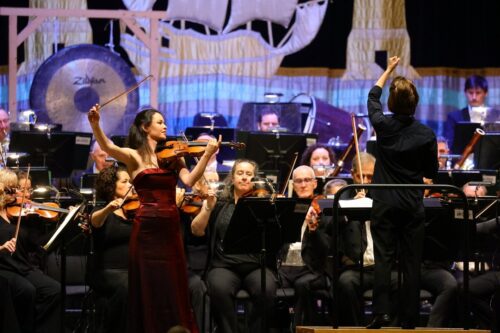
Featured Image: Conductor Anna Rakitina and the NSOI © Joanne Taffe (Cork concert)