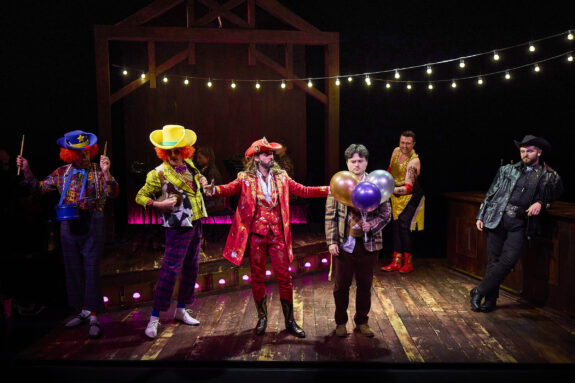
 Ireland Smetana, The Bartered Bride: Soloists, Chorus and Ensemble of Irish National Opera / Richard Peirson (piano, conductor), Garage Theatre, Monaghan, 27.11.2025. (RB)

Irish National Opera’s (INO) new production of The Bartered Bride is a small-scale touring opera production (I watched it at the Garage Theatre in County Monaghan). It features 11 singers and 5 instrumentalists working together to create the energy, zest and good humour of Bedřich Smetana’s great work. It is the first of three Czech operas INO are performing this season (Janáček’s Cunning Little Vixen and Dvořák’s Rusalka are both scheduled for performance early in the New Year). The cast sang in English in a translation which captured perfectly the idiomatic humour of the original.
The Bartered Bride is often regarded as the quintessential Czech opera. Smetana made considerable use of traditional Bohemian dance forms in the score including the polka and the furiant. It is both a celebration of Czech rural life and a gentle satire of its social conventions. The plot revolves around a young couple, Jeník and Mařenka who are devoted to each other. They join forces to outwit the machinations of Mařenka’s parents and the local marriage broker, Kecal, who are trying to marry Mařenka off to Vašek, the son of a wealthy landowner. A travelling circus arrives in the final act to add to the general wackiness and mayhem.
There is sometimes a tension in this work between the high spirited, folksy, comic elements and the detailed plot which centres on greedy parents trying to force their daughter into a marriage she does not want. Some modern productions have focused more on the darker elements injecting a sting into the comic proceedings. This production from INO takes a much more traditional light-hearted approach to the opera where nothing is taken too seriously and there is never any real threat hanging over the characters.
Louisa Muller’s production transfers the action from mid-nineteenth century Bohemia to rural Ireland in the 1970s. Land, money and social standing mattered enormously during this period, and it was not uncommon for parents meet over a pint in the local dance hall to discuss who would be a suitable match for their children. It was a striking and effective analogy, and it provided opportunities to poke well targeted fun at some of the local period conventions. Ciaran Bagnall’s set consisted of the interior of a dance venue with a bar at the side and a raised platform for the instrumentalists who were performing next to the singers. John O’Clery’s costumes were colourful and diverse. The main cast were wearing cowboy hats and wellington boots while the circus troupe were wearing brightly coloured, gaudy clown outfits. The outrageous costumes all added to the sparkle and fun of the piece.
I had mixed feelings about Amy Ní Fhearraigh’s portrayal of Mařenka. She was feisty and resourceful and some of the ensemble work was well executed (I particularly enjoyed her Act I duet with Egor Zhuravskii’s Jeník). In terms of the vocal line, I was not convinced that this role played to her strengths. The tone sounded a little forced and trenchant on occasion and there were minor intonation problems in the upper vocal register. Some of the singing was very fine in the Act III aria but again I would have liked a smoother, richer more lyrical tone. Egor Zhurakskii’s performance moved from strength to strength as the opera progressed. He portrayed Jeník as a likeable, fun-loving character who was determined to outmanoeuvre the opposition to get his girl. He had a light lyrical tenor voice which he used to significant effect. He sang Jeník’s Act III aria with great warmth and beauty of tone and the top notes were dispatched cleanly and with authority. I was also impressed with the clarity of his diction particularly in his Act II duet with Kecal.
John Molloy was the standout performance of the evening, and he stole the show in the role of the scheming marriage broker, Kecal. He dominated every scene he was in and brought impeccable comic timing to the role. There was an over-the-top exuberance to his interactions with other characters as he tried to browbeat them into signing his contract. He negotiated Kecal’s rapid fire patter in his Act I aria with enormously vocal dexterity and his diction was excellent. William Pearson portrayed Vašek as a rather touching figure wanting to make connections and to be loved. I was pleased with his sympathetic and nuanced performance that did not allow the character to tip over into caricature.
The rest of the cast acquitted themselves well. All the singers joined forces to give a rousing rendition of the two wonderful chorus numbers at the beginning and end of the first act (the latter accompanied by some lively dancing). Richard Peirson did a marvellous job arranging the score for 5 instruments. There were a few occasions when I missed the full orchestra, but Peirson’s arrangement ensured the sparkling melodies, infectious folk rhythms and rich colour in the score all shone through. Violinist, Ioana Petcu-Colan, was particularly impressive in the opening Overture and in the ‘Dance of the Comedians’ number in Act III.
Overall, this was a sparkling, delightful production full of zest and energy.
Robert Beattie
Featured Image: INO’s The Bartered Bride (centre, Ben Escorcio as the Master of Ceremonies) © Patricio Cassinoni
Production:
Director – Louisa Muller
Set and Lighting design – Ciaran Bagnall
Costume design – Joan O’Clery
Choreographer – Rebecca Howell
Cast:
Mařenka – Amy Ní Fhearraigh
Jeník – Egor Zhuravskii
Ludmilla – Carolyn Holt
Krušina – David Howes
Kecal – John Molloy
Háta – Rebecca Afonwy-Jones
Míka – Julian Close
Vašek – William Pearson
Esmeralda – Megan O’Neill
Master of Ceremonies – Ben Escorcio
Outlaw – Matthew Mannion
Ensemble:
Violin – Ioana Petcu-Colan
Cello – David Edmonds
Clarinet – Conor Sheil
Horn – Hannah Miller
Piano – Richard Peirson