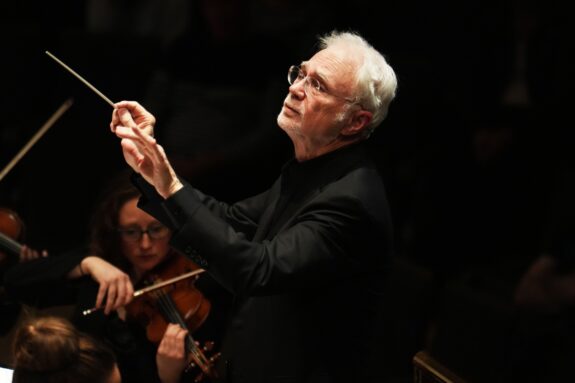
 United Kingdom John Adams in Manchester – Adams Conducts Harmonium: Mary Bevan (soprano), Hallé Choir and Hallé / John Adams (conductor). The Bridgewater Hall, Manchester, 30.10.2025. (MC)

John Adams – Slonimsky’s Earbox; Le Livre de Baudelaire (Debussy arr. Adams); ‘This is Prophetic!’ (Pat Nixon’s aria from Nixon in China); Harmonium
Standing ovations given to contemporary composers must be as rare as hen’s teeth. Celebrated American composer John Adams, with his concert titled Adams Conducts Harmonium, was given one last night. He has made a special trip to North-West England to conduct the Hallé for John Adams in Manchester, a three day celebration of his most admired music. This was the first of two concerts at the Bridgewater Hall, in between there is another at the Royal Northern College of Music.’
My admiration of Adams’s music was certainly not immediate. It proved to be a process helped by attending performances rather than just relying on the many recordings. For a ten-year period, I was fortunate to report from concerts at the annual Musikfest Berlin where Adams’s music was often programmed. My first exposure to Adams was in 2012 attending a semi-staged performance of his opera Nixon in China conducted by the composer at the Philharmonie Berlin. In 2015, also in Berlin, there was a performance of Adams’s Absolute Jest for string quartet and orchestra conducted by Michael Tilson Thomas played by the San Francisco Symphony with the St. Lawrence String Quartet. Then again at the Philharmonie, in 2016 there was an all-Adams concert played by the Berlin Philharmonic and conducted by Adams himself comprising his Harmonielehre for orchestra and Scheherazade.2 a dramatic symphony for violin and orchestra played by soloist Leila Josefowicz.
Adams chose to open this Bridgewater Hall concert of his own music with the orchestral work Slonimsky’s Earbox. Written thirty years ago this was a joint commission between the Hallé and the Oregon Symphony, Portland. It was the Hallé that premiered the work in 1996 conducted by its dedicatee Kent Nagano in this very concert hall.
Giving his name to the work was Russian born emigree Nicholas Slonimsky a talented musicologist who Adams admired and had influenced his writing. Evidently the word ‘Earbox’ is one Slonimsky could easily have used as he liked to create his own vocabulary.
With the Hallé totally engaged and creating an accurate construction of the orchestral sound Adams maintained the pulse of forward momentum expertly. I don’t recall ever noticing the motifs used in the score as clearly as here.
Next Adams conducted Le Livre de Baudelaire his arrangements of Debussy’s Baudelaire settings. In 1887/89 Debussy had composed a song cycle Cinq poèmes de Charles Baudelaire for voice and piano. These were settings of French poems from Charles Baudelaire’s complete collection Fleurs du mal (Flowers of Evil) published 1868. Debussy’s five Baudelaire settings were cooly received and sales were poor.
In 1994 Adams set four of the five songs Le balcon (The balcony), Harmonie du soir (Evening harmony), Le jet d’eau (The Fountain), Recueillement (Meditation) yet didn’t undertake La mort des amants (The Death of Lovers). Le Livre de Baudelaire was premiered in 1994 by Roberta Alexander and the Royal Concertgebouw Orchestra conducted by the composer.
English lyric soprano Mary Bevan entered the stage spectacularly dressed in salmon and in these atmospheric songs Bevan displayed her attractive tone quite effectively although I never felt she was entirely comfortable with these challenging texts. While Adams’s orchestration was moderately lightweight it wasn’t always possible to hear the soprano’s words which is not uncommon for some solo singers in the Bridgwater Hall. My favourite setting was Bevan singing Harmonie du soir a work of shimmering warmth, so sultry it bordered on the airless. (Many of the audience were puzzled why Le Livre de Baudelaire had no surtitles for the text and translations.)
A landmark work for Adams’s his opera Nixon in China harks back to 1972 when U.S. President Richard Nixon during his ground-breaking three-day visit to Beijing in the People’s Republic of China met its leader and founder Mao Tse-tung. As mentioned above in 2012 at Berlin I attended a performance of Nixon in China with stage director by Paul Curran, played by the BBC Symphony Orchestra and BBC Singers, and conducted by the composer. It is such a powerful work and the impact of Alice Goodman’s original libretto is often overlooked.
From the opera Adams selected to conduct the substantial aria ‘This is Prophetic!’ known ‘Pat’s aria’ given by Pat Nixon the First Lady of the United States. During her grand tour of the magnificent Summer Palace a huge estate of Palaces, Pavilions, Lakes and Gardens, Pat in ruminative mood breaks off at a main gate to sing ‘This is Prophetic!’ Looking more assured Mary Bevan seemed much more at home with ‘Pat’s aria’ which needs a higher volume. Bevan flourished as Pat Nixon who overawed by the splendour of the Summer Palace and magnitude of the occasion, naively imagines a world where peace prevails.
A work from 1980 the audience heard Harmonium for chorus and large orchestra. For this Adams had obtained a substantial commission from the San Francisco Symphony to mark the inaugural season at the new Louise M. Davies Symphony Hall, San Francisco where music director Edo de Waart conducted its premiere. Interested in contemporary music De Waart had requested Adams to write a choral symphony for large forces but no vocal soloists.
The Harmonium commission was both fortuitous and a major break for Adams who up to then had only showed promise as a composer. It had come at time when the influential De Waart had put his neck on the line by placing faith in Adams then known as a local composer of small-scale works and electronic pieces. For his text Adams first ‘stumbled’ on the poem Negative Love by English Renaissance writer John Donne. Adams also admired the great poems of Emily Dickinson who he said ‘speaks in the plainest of language’ and chose two Because I could not stop for Death and Wild Nights – Wild Nights!
Commencing Harmonium is Donne’s Negative Love with its gradual, emotional build-up of pulsating sound. The text concerns the paradox of how genuinely enduring love is perplexing and unexplainable rather than practical and reasoned. Such a solemn and deliberate setting Dickinson’s Because I could not stop for Death displays courage with the narrator defiantly staring death in the face. Making quite an impact was the roaring character of Wild Nights – Wild Nights! so boldly energetic, surging forward with the chorus chanting Dickinson’s text. Here one might imagine stormy weather where a sea vessel is looking for the protection of the harbour. Possibly this is a metaphor for the speaker anticipating wildly amorous nights with a returning lover. Standing out was the section where the chorus repeatedly shouted the words ‘Were I with thee Wild Nights shall be our luxury’ as Adams pushed the orchestra pulse forward unremittingly and loudly to a state of near bedlam. Still in my mind’s eye is the sterling playing of the brass section. When the music finally calmed, for this listener it served as a balm.
Congratulations to the Hallé Choir directed by Matthew Hamilton who in the difficult Harmonium demonstrated such durability and poise. Doing full justice to the elevated inspiration of Adams’s works I admired the enthusiasm and committed playing of the Hallé and especially the impressive cohesion achieved between the sections. Many composers have proved to be poor conductors of their own works negating any special insights they could offer into the music. John Adams was – and is – a very different proposition.
Michael Cookson
Featured Image: John Adams conducting the Hallé © Alex Burns/The Hallé
Wow 🤩 that was a spectacular review.