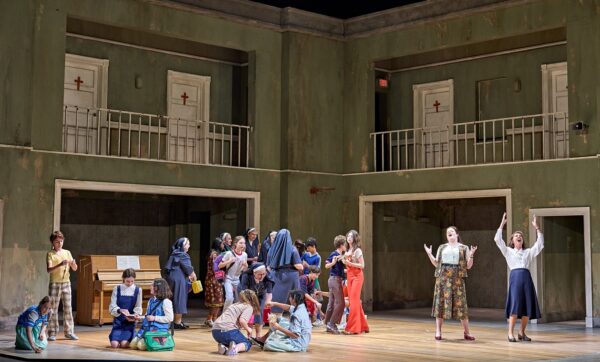
 United Kingdom Jake Heggie, Dead Man Walking: Soloists, Finchley Children’s Music Group, Chorus and Orchestra of the English National Opera / Kerem Hasan (conductor), London Coliseum, 1.11.2025. (AK)
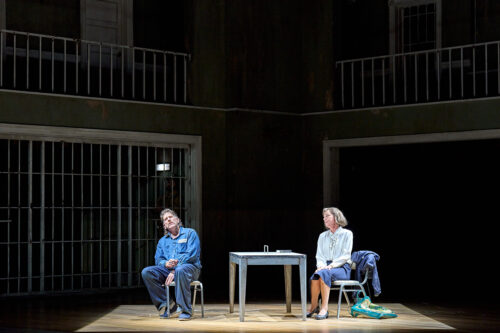
Hats off to English National Opera for being – according to my best knowledge – the first UK opera company to stage Dead Man Walking and for presenting it in such an exemplary production.
Jake Heggie’s opera to Terrence McNally’s libretto was commissioned by San Francisco Opera and then premiered by SFO twenty-five years ago in 2000. Since then, the piece has morphed into the most performed twenty-first century opera, reaching large number of audiences in great opera houses with stellar casts. Metropolitan Opera in New York produced it (with Joyce DiDonato in the female lead) two years ago, so it was not before time for a UK company to take it up. The Royal Opera seems to have missed the chance, but ENO came up trumps in a co-production with Opera North and the Finnish National Opera.
The libretto is based on Sister Helen Prejean’s book Dead Man Walking (published in 1993), describing her experience as a spiritual advisor to condemned men on the death row. In 1995 the book was turned into a film by actor-director-producer Tim Robbins, with Susan Sarandon and Sean Penn in the title roles. Then came Heggie’s opera with very expressive musical tools but whether it is an opera or masterly constructed musical theatre is debatable.
The musical structure has the elements of an opera but the libretto’s real-life story as well as its strong theatricality dominate, thus rendering the experience more as musical theatre than opera. Heggie’s music incorporate elements of spirituals, blues, gospel, jazz, hymns as well as cinematic tools. The overall experience, when presented as well as by the ENO, is breathtaking, hence on the first night the audience’s silent focus was palpable throughout.
The book, the film and the opera are all powerful statements against capital punishment although the sentiment is not spelled out in simplistic terms. However, it is clearly implied that nobody gains from capital punishment, the murdered victims will not come back, and suffering is intensified for all. Furthermore, whether by accident or design, Heggie’s rousing choral during the execution highlights the hypocrisy of the State and religious accomplices.
ENO provided an astonishing cast, with several heavyweights as well as many top-class but lesser-known singers. There was not a single weak spot among the singers; surely this is unusual in an opera house where the chances of things going wrong are always high.
Sister Helen Prejean, age 86 years (born 21st April 1939), is still very active with her projects concerning capital punishment and supporting victims. To portray such a person on the stage is no small task, especially when earlier the role was taken by, for instance, Frederica von Stade and Joyce DiDonato. However, for me, mezzo-soprano Christine Rice is perfection as Helen. Her journey from being a pen pal of the convicted murderer to giving full support during his execution was entirely credible, as was her portrayal of sensitivity towards the families of the victims.
As the convicted man Joseph De Rocher (not the real name of the executed man), baritone Michael Mayes inherits the part in every dimension. This is his 13th production of the opera which he first performed (with Joyce DiDonato) seven years ago. He is not portraying De Rocher, he is De Rocher on stage.
Dame Sarah Connolly is luxury casting for playing De Rocher’s mother although I would have preferred her without the American accent. The tragedy of the mother whose son becomes a murderer and stands to pay for it with his life is universal, no specific accent is needed.
Baritone Jacques Imbrailo – as Owen Hart (father of one of the two murdered teenagers) – gave a deeply moving, magnificent performance of the tragic loss and subsequent futility of De Rocher’s execution.
All solo singers in the large cast were impeccable as was ENO’s chorus and orchestra. Instrumentation for the orchestra is offered in two versions on the composer’s website; the second version is specified as reduced but it still needs large forces: much larger than ENO’s orchestral list in the programme notes and as it appears on ENO’s website.
Praise is also due to Finchley Children’s Music Group whose charming singing and acting brought some relief after the brutal rape and murder scene at the beginning of the opera.
ENO’s artistic director Annilese Miskimmon staged the drama without sentimentality but with utmost sensitivity to all details. We felt that we watched the real event, not a theatrical one. However, bringing onto the stage the two would-be murderer/rapist brothers from the stalls (during the teenage couple’s love-making scene) would most probably have been lost on all the audience seated further away in the London Coliseum. This is a minor quibble, but similar occurrences have irritated me for decades in various opera houses.
Alex Eales’s all-purpose two-level set worked well for all scenes, whether indicating the jail, the nuns’ mission or the Louisiana highway.
It cannot be easy to conduct Heggie’s multi-dimensional score while being faced with the life-like portrayal of harrowing events on the stage. Conductor Kerem Hasan held it together with skills, commitment and with full understanding of the drama.
Heggie’s piece – whether opera or musical theatre – is not an easy watch but should be seen by all. Further performances are on 4, 8, 12, 15 and 18 November.
Agnes Kory
Featured Image: English National Opera’s Dead Man Walking © Manuel Harlan
Production:
Stage director – Annilese Miskimmon
Set designer – Alex Eales
Costume designer – Evie Gurney
Lighting designer – D.M. Wood
Movement and Intimacy director – Imogen Knight
Cast:
Sister Helen Prejean – Christine Rice
Joseph De Rocher – Michael Mayes
Mrs Patrick de Rocher – Dame Sarah Connolly
Sister Rose – Madeline Boreham
Warden George Benton – Andrew Manea
Father Grenville – Ronald Samm
Kitty Hart – Gweneth Ann Rand
Owen Hart – Jacques Imbrailo
Jade Boucher – Catherine Carby
Howard Boucher – Hubert Francis
Motorcycle Cop – Zwakele Tshabalala
Older Brother – Michael Lafferty
Younger Brother – Marcus Swietlicki
Sister Catherine – Olivia Rose Tringham
Sister Lillianne – Amy Holyland
Prison Guard 1 – Alaric Green
Prison Guard 2 – Malachy Frame