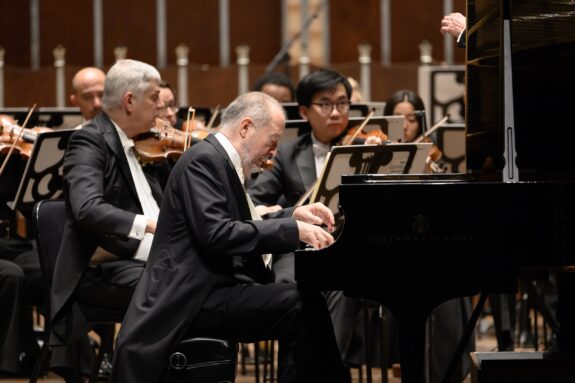
 United States ‘Ohlsson Plays Mozart’: Garrick Ohlsson (piano), Cleveland Orchestra / Franz Welser-Möst (conductor). Mandel Concert Hall at Severance Music Center, Cleveland, 30.10.2025. (MSJ)

Tyler Taylor – Permissions
Mozart – Piano Concerto No.23 in A major, K.488
Encore: Chopin – Waltz No.2 in C-sharp minor, Op.64
R. Schumann – Symphony No.3 in E-flat major, Op.97, ‘Rhenish’
Tyler Taylor almost deleted the email inviting him to become the Cleveland Orchestra’s next Daniel R. Lewis composing fellow. He hadn’t applied for any such position, and he thought that maybe the email was a phishing spam trying to hook a naïve composer. Turns out, it was the real thing. Composers don’t apply for this position; rather, the Cleveland Orchestra conducts a secret search every three years and identifies a composer for the residency after examining the work of many potential figures.
Taylor, still in his early thirties, is an American composer best known for his work with the Louisville Orchestra, though the work receiving its Cleveland premiere in this concert, Permissions, was his dissertation at Indiana University. The composer’s stated purpose was to give the often-subverted parts of the orchestra – wind and percussion – permission to lead from the back of the stage, though the name also applies to how all the orchestral instruments are handled, allowing some inventive touches.
With its first gestural flourish, the listener might be forgiven for thinking that Permissions will be just another in a long line of noisy, high-modernist abstract pieces premiered and then quickly forgotten. What so often goes wrong with this sort of work is that a composer posits him- or herself a mad scientist with the orchestra as laboratory. They throw some random ingredients together, it fails to ignite and then crumples down to a sullen, irritating mass of sound that no one much cares to play or hear again. All longtime listeners have heard dozens of such works.
But what do you do when the mad scientist actually triggers some kind of fusion? That is exactly what happens in Permissions, formidably academic and gestural though it may be. It goes somewhere. Things happen. Though not traditionally tonal, Taylor nonetheless gives long-held pitches that serve as tonal orientation points. Masses of reactions build up and fade, presented here with equal parts fierceness and elegant poise by the players of the Cleveland Orchestra. But as these waves of action rise and fall, it doesn’t feel like the piece is operating in a vacuum. It is progressing through its own world, and the happenings cause reactions that transform the surrounding soundscape. Then the piece punched through to an extraordinary closing section, where conductor Franz Welser-Möst froze, no longer conducting, as the strings slowly, softly slid up and out, as the dissipating sounds were punctured by tightly self-coordinated strikes from the percussion. One could feel the tension rise like a chill on the back of one’s neck, left unresolved at the end. The reception was enthusiastic.
It is interesting that Welser-Möst is making the choice of such a challenging composer for his final selection for the orchestra’s Daniel R. Lewis fellowship, which will last a year beyond Welser-Möst’s tenure. The question has to be asked, is there enough of a musical education structure left in US public schooling to support an experimental composer’s explorations? To that end, Taylor has immediately indicated an interest in undertaking programs to work with local school children during this residency, to offer them the opportunity to permit their imaginations to take flight. And this demonstration of his ability to turn orchestral chemistry experiments into a compelling narrative offers promise of interesting things to come.
Following such a piece with a Mozart concerto makes the grace of the old music feel cleansed and refreshed, particularly with an august soloist such as the great Garrick Ohlsson on hand. I don’t know if it was Ohlsson’s request, but the orchestral strings were intriguingly reduced for this performance of Mozart’s Piano Concerto No.23, contrary to Welser-Möst’s usual practice of using a full brace of strings in classical-period pieces. The reduction worked perfectly for this performance, allowing both woodwind details to percolate up through the string bed and Ohlsson to dialogue with everyone involved without having to beef up his sound to ride over a bank of strings.
Indeed, Ohlsson, fresh off chairing the jury at the XIX International Chopin Piano Competition in Warsaw, was restrained, finding an almost conversational tone in his Mozart, reminiscent of Artur Schnabel’s way with the music. Ohlsson had no interest in calculating charm or swooning over Mozart’s more exquisite moments. Instead, he made his piano speak plainly, letting the music work its magic without begging for attention, the first movement culminating in Mozart’s surviving cadenza, which is as moving as it is virtuosic. Ohlsson’s approach was even more affecting in the second movement Adagio, where his piano line sang. The finale was lithe and flexible, the orchestra under Welser-Möst matching the pianist at every turn.
Coming off that Chopin competition, one might have thought Ohlsson could be tired of Chopin, but he used his encore of the Waltz No.2 in C-sharp minor as a compact textbook on how to explore Chopin. He balanced the sense of dance with the poise of Chopin’s bel canto melodies, delivering every iteration of the whirling second theme in a different manner, one flowing, one staccato, one slower, one finding buried countermelodies in the left hand. Only a minor thumb slip prevented perfection, proving that even greatness is subject to human fallibility.
Speaking of human fallibility, Robert Schumann’s Symphony No.3 is an endearing mixture of bright imagery, uncertain scoring, intimate warmth and troubling shadows. That Schumann intended it to be a picture postcard of the Rhine river valley, where he and his family had moved for Schumann to take a conducting job, was his stated objective. And, on the surface, the piece is brighter and jollier than most of his works. But it has a way of harmonically side-slipping, a way of turning melodically inward, that suggests there is more here than the surface. This duality leads to a wide range of performance approaches, from aggressively bright to somberly restrained.
Characteristically, Franz Welser-Möst embraced neither approach and charted his own path between the extremes. Instead of trying to push the first movement to Beethovenian brusqueness, Welser-Möst kept it relaxed, at times wistful. He didn’t let the frequent tremolo string passages sound manic, nor did he smooth over their nervous judders. It was an approach emphasizing Schumann’s tender warmth without ignoring the frequent shadows that peek around the edges of the brightness. The second movement kept dancing along even as it turned wistful, while the gentle third movement was tender without turning precious. He neither exaggerated nor avoided the somber trombone chorale of the fourth movement, then turned without pause to the finale, embracing its joy without pushing it. Indeed, he offered a flexibility not always heard in this part, allowing it to feel like an escape from the previous movement’s gloom without forgetting where it has been. For the record, Welser-Möst spoke in a pre-concert talk before the beginning of the season as if he had never conducted Schumann’s Third before. While he hasn’t done it previously in Cleveland, he most certainly did conduct it in London many years ago, where he recorded it with the London Philharmonic. That performance, however, pales in comparison with the humane warmth of his handling of Schumann now, so it hardly counts.
Whoever ends up following Welser-Möst as the Cleveland Orchestra’s next music director, let us hope they take note of the intriguing programming, both challenging and beguiling, that has marked the peak years of his tenure. It has built up an audience that can appreciate everything from the grace of Mozart to the pioneering research of Tyler Taylor.
Mark Sebastian Jordan
Featured Image: Garrick Ohlsson plays Mozart with the Cleveland Orchestra © Yevhen Gulenko/Human Artist Photography
I would have love to come to listen to Mozart’s piano concerto but I decided not to because of the new music that was included (namely ‘Permission’) that I do not care for. I do not understand why this kind of noise is mixed with Great Music composed by Geniuses. In the future I will not waste my time to come and listen to noise. Very concerning.
I was impressed by ‘Permission’ and look forward to more from this composer. It can be hard to judge contemporary music at first. I remember a Maazel concert where he opened with Adagio and Streto by the French composer Gilbert Amy, who is rarely heard outside of France, I didn’t care for it at first, but found it fascinating hearing the rebroadcast. It was followed by Stravinsky Violin Concerto and Sibelius 5th Symphony. Now that was impressive programming.
As for the rest of the reviewed concert, the Mozart was good despite a few untidy ensemble moments that appear to be the conductors preference. The Robert Schumann was fine, but a tad short on momentum and grandeur. If a conductor insists on rethinking a score, the results need to be convincing. I have my reservations here, particularly after hearing the last three Cleveland MDs (plus Louis Lane) conduct this piece, but it wasn’t objectionable.
In terms of programming, it was a nice one, but not particularly remarkable (think Dohnányi pairing Ligeti’s ‘Atmosphere’ with the prelude to Wagner’s Lohengrin without interruption). Pairing Prokofiev 7 with Brahms Piano Concerto 2 was uninspiring programming a few weeks ago. And last week’s pairing Sibelius with Beethoven 9? Not convincing.
That said, the Beethoven 9 last week was outstanding in all respects. I didn’t discern an attempt to rethink the score to correct what everyone has done wrong throughout the years (centuries?). It made up for the DG live recording with this conductor.