
 United Kingdom Mozart, Tchaikovsky: Paul Lewis (piano), Bournemouth Symphony Orchestra, Thierry Fischer (conductor). Lighthouse, Poole, 29.10.2025. (CK)
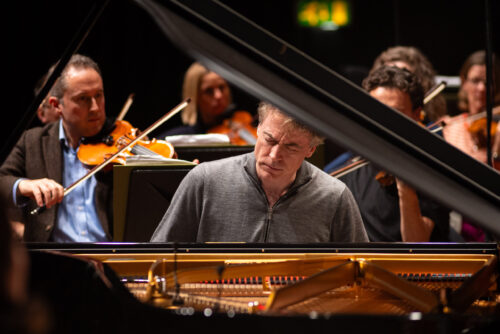
Mozart – Piano Concerto in C, K503
Tchaikovsky – Manfred Symphony
Encountering Mozart’s C major Piano Concerto K503 is rather like meeting someone whose air of reserve, aloofness even, rather discourages us at first; Mozart’s other C major Concerto, K467 is immediately winning (Elvira Madigan and all that), but only on closer acquaintance with K503 do we realise that behind its imposing façade there is wit and feeling, light and shade.
The orchestral introduction to the first movement is so weighty – trumpets and drums to the fore – that we might be embarking on a symphony rather than a concerto. The pianist seems to wonder the same thing: instead of announcing himself confidently he tries a couple of tentative phrases, like someone nervously opening the door just a crack, before committing himself.
Having greatly enjoyed some of Paul Lewis’s recent series of Schubert piano sonatas it was very good to hear his rippling clarity and instinctive sympathy put to the service of Mozart. His playing was a joy: the fact that the music never quite shakes off a sense of sternness is probably due to the orchestra’s insistence on its pre-Beethovenian four-note motto figure, and perhaps to the frequency with which the minor key puts its head in. There is a march-like theme that has apparently been likened to the (not yet composed) Marseillaise: witty, then, to begin the cadenza (Lewis’s own? Mozart didn’t leave one) with another snippet of Rouget de Lisle’s anthem (aux armes, citoyens…).
The Andante has its own air of reserve: ‘formal and a little mysterious’, wrote the American commentator Michael Steinberg, ‘like a knot garden by moonlight’. It has a wonderful poise, the piano’s graceful musings enhanced by a gentle choir of woodwinds (minus clarinets) and horns. The opening of the finale – based on a gavotte from Idomeneo – suggests something more unbuttoned and dance-like, though martial brass and drums ensure that things don’t get too informal. The piano goes on its sparkling, carefree way, Lewis’s right hand spraying us with almost continuous semiquaver runs. Best of all was the arrival – from nowhere – of a warm phrase on the piano accompanied by cellos and double basses, the embryo of a lovely song, taken up by the oboe and extended by the flute and the cellos. The performance was warmly received; it was right that the woodwinds were given a collective bow of their own.
Thierry Fischer is a vastly experienced musician and conductor; best known here, perhaps, for his years at the helm of the Ulster Orchestra and then the BBC National Orchestra of Wales. Kudos to him, and to the orchestra, for giving us this opportunity to hear a Tchaikovsky rarity, the Manfred Symphony. It is not difficult to understand the composer’s affinity with Byron’s tortured hero Manfred: much more difficult to say exactly what the music is. As a programmatic symphony it has been compared to Berlioz’s Symphonie Fantastique and Harold en Italie, and even to Richard Strauss’s Ein Heldenleben: yet despite its four-movement form it seems closer to Tchaikovsky’s Fantasy Overture Romeo and Juliet and his Symphonic Fantasy Francesca da Rimini (brilliantly performed by Kirill Karabits and the orchestra back in March, review here). The second movement brought Rimsky-Korsakov’s Scheherazade to mind.
It is quite a piece: longer than any of the numbered symphonies (he composed it between the Fourth and the Fifth), and for a much larger orchestra: triple woodwind, a pair of cornets added to the brass, percussion requiring five players, two harps and (at the end) an organ.
Conductor and orchestra gave us a spacious and, at times, stunningly dramatic performance, with no holds barred. It took a full hour: longer than Silvestri’s performance with the BSO in 1963 (issued on BBC Legends) by several minutes. The opening Lento lugubre immediately pinned us back in our seats with the extraordinary sound of the idée fixe on bass clarinet and bassoons, the platform-width of strings digging into their passionate lament, the dark, blazing tutti with the horns’ bells raised as if they were playing Mahler.
In the second movement, Vivace con spirito, the woodwind section turns into an aviary – or, more accurately, a wasserspiele – as Tchaikovsky conjures the spray of the waterfall behind which the Alpine Fairy appears to Manfred. The playing here was as scintillating as the composer could have hoped for, as it was in the deliciously lilting melody on strings and harps against the gentle thrumming of cellos and double basses. The Andante showed Tchaikovsky at his most charming: a lovely oboe melody, some fine work from the first horn. The BSO horns are a fine section: I look forward to their playing in Mahler’s Fifth Symphony next March.
The final Allegro brought more beauty and more drama (some mighty gong crashes), but it is a sprawling movement: it goes on too long, it doesn’t hold together. Even the climactic entry of the organ cannot rescue it from a feeling that Tchaikovsky has over-extended his musical resources. I cannot praise too highly the playing of the BSO, expertly directed by Fischer, making the best possible case for the work, maintaining fiery commitment to the last bar: the richness and intensity of the strings in particular will stay with me for a long time.
Chris Kettle
For a little more background on Tchaikovsky’s ‘Manfred’, if interested, see this essay for The Wordsworth Trust: https://wordsworth.org.uk/blog/2017/10/23/becoming-manfred-tchaikovsky-and-byron/.
Thank you for this, David.