 United Kingdom Handel, Partenope: Soloists, Orchestra of English National Opera / William Cole (conductor). London Coliseum, 22.11.2025. (CC)
Production:
Director – Christopher Alden
Set designer – Andrew Leibeman
Costume designer – Jon Morell
Lighting designer – Adam Silverman
Revival Lighting designer – Marc Rosette
Translation – Amanda Holden (ed. Clifford Bartlett)
Cast:
Partenope – Nardus Williams
Arsace – Hugh Cutting
Emilio – Ru Charlesworth
Armindo – Jake Ingbar
Rosmira – Katie Bray
Ormonte – William Thomas
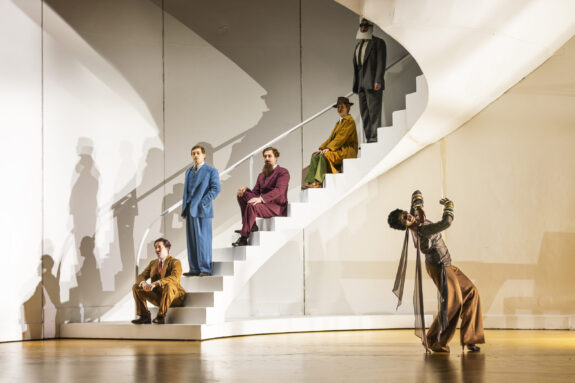
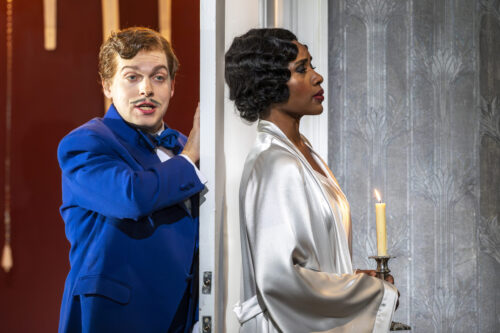
A very welcome revival of Chrisopher Alden’s staging of Handel’s Partenope here: It was first staged at St Martin’s Lane in 2008, and subsequently revised in 2017 (here). The resetting of the plot to 1920s Paris in a stylish, ever-so-white house, with photographic references to Man Ray (in Emilio’s photography) and an ongoing card game, is fascinating: plus, the eternal emotions of this gender-bending comedy, whatever one’s sex(es), work supremely well.
Each cast for each run has included stellar vocal performances, and this was no exception. But here it is worth spending time on the conductor William Cole first who has taken over from the originally-billed Christian Curnyn (who had to bow out at the first night after the first act and Cole, his assistant, stepped into the breach). The English National Opera Orchestra has rarely sounded better: the violin lines at speed were supremely together; rhythms were as tight as can be. This is a comic opera – Handel’s first – and there was a palpable buoyancy from the pit. Some superb wind and horn playing, too; it was a joy, not least because Cole’s tempos seemed absolutely perfect at each and every turn. Cole, who has conducted Albert Herring at Scottish Opera in 2024 and who was Assistant Conductor for ENO’s Rigoletto in late 2024, seemed to live and breathe Handel’s world – here is a major artist in the making.
The singing was pretty much uniformly excellent. But three cast members impressed particularly. First, Nardus Williams, a former ENO Harewood Artist, sang Partenope not only with supreme assurance (she needs to: the plot revolves around her, after all, with her multiple suitors!) but with clarity of diction melded to line that is rarely heard. It was a supreme assumption, dramatically well-contained, and with both extremes of Williams’s register strong, her Act I ‘Both love and fate shall meet’ a masterclass, the final act ‘Joys attend my dearest treasure’ so accurate in its intervallic leaps. Worth noting Williams’s staccato is excellent, too: the variety she is capable of is remarkable, and there was no loss of stamina throughout.
Then there was Hugh Cutting, one of the finest and most consistent countertenors I have ever heard, as the perfect Arsace, characterful (and full toned) in ‘O Eurimene has Rosmira’s Air’ (Act I). He was most affecting in the slower airs, his ‘Love unrelenting’ a high point.
Th third star was Katie Bray, as Rosmira, the stand-out young talent of the cast: she won the Dame Joan Sutherland Audience Prize at the 2019 Cardiff Singer of the World. She too has the full gamut of emotions, her final act aria, ‘This was Arsace’s guilty part’ strong; (Partenope is one of Handel’s most consistent works of genius from first to last, so stand-out arias like this really are outstanding). Bray has to negotiate a dual-persona (few don’t, in this opera) and has the equipment, dramatically, and musically, for the contrasts of Eurimene and Rosmira. Keep an eye out for Bray’s upcoming Kurt Weill Chandos disc (with Murray Grainger, accordion, Marianne Schofield, double bass, and William Vann, piano) – it is a cracker and will be released on January 9, 2026).
After Cutting, the other countertenor is the role of Arminio, here American Jake Ingbar. Heard last year in Barrie Kosky’s production of Agrippina a Dutch National Opera, his sound is stunning, individual, ever the equal of Cutting.
The only tenor role here is Emilio, taken with authority and, dramatically, much elan and stage presence by Ru Charlesworth, his ‘war’ aria (‘Now war shall all my thoughts engage’) strongly taken, especially the accuracy of the angular lines, his second act ‘Yes, Fate, I feel my cruel doom’ similarly blessed.
Which leaves William Thomas’s stalwart Oromonte. Another former ENO Harewood Artist, this time he is the one who has to put up with a silly costume which does seem rather too ridiculous (perhaps that is the point). He was, in the face of adversity, remarkably authoritative.
ENO remains a (soon to be splintered) jewel in English opera. This company has always excelled in Handel, and this Partenope is no exception. This run is dedicated to Sir Charles Mackerras.
Colin Clarke
Featured Image: English National Opera’s Partenope © Lloyd Winters