
 United States Various: Daniil Trifonov (piano), Orchestre National de France / Cristian Măcelaru (conductor). Stern Auditorium, Carnegie Hall, New York, 9.11.2025. (ES-S)
Elsa Barraine – Symphony No.2, ‘Voïna’
Ravel – Piano Concerto in G Major; Daphnis et Chloé Suite No.2; Boléro (encore)
Saint-Saëns – Piano Concerto No.2 in G minor, Op.22
Debussy – ‘Reflets dans l’eau’ from Images, Livre I (encore)
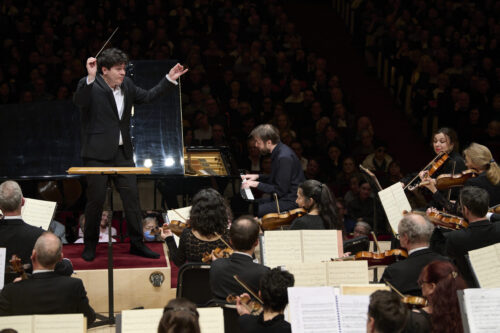
Cristian Măcelaru and the Orchestre National de France arrived at Carnegie Hall with a program that embodied the ensemble’s evolving identity under his direction: a deepening devotion to the French repertoire with its distinctive emphasis on luminous transparency and color in orchestral sound, and a willingness to rescue voices long overshadowed by history. Bookended by Elsa Barraine’s rediscovered Symphony No.2 and Ravel’s Daphnis et Chloé Suite No.2, it placed Saint-Saëns’s Piano Concerto No.2 and Ravel’s Piano Concerto in G major at its center – a journey from resistance-era defiance to radiant sensuality that showed an orchestra equally capable of gravitas and brilliance.
The main draw for a full Stern Auditorium might have been less the prospect of evaluating the visiting French orchestra than the opportunity to hear Daniil Trifonov in the unusual pairing of two concertos on the same evening – neither of which he had performed before in this hall.
The whip-crack introduction of Ravel’s Piano Concerto in G major instantly set the hall aglow. Trifonov’s long-established penchant for jazzy rhythms proved ideally suited to the score’s idiom: freer rhythms without excess, brilliance without exaggeration and a neoclassical composure that kept its sensuality in check. His phrasing in the Adagio assai was unhurried and disarmingly direct, allowing the long melodic arc to unfold with a simplicity that eschewed any sentimentality. The English horn’s answering line floated in perfect equilibrium with the piano’s restrained singing tone while Măcelaru shaped an orchestral palette of pastel delicacy. In the finale, Trifonov’s articulation turned percussive yet playful, and the orchestra matched him with bright-edged verve – a reading that balanced elegance and exuberance.
Saint-Saëns’s Piano Concerto No.2 remains one of the most mercurial works in the nineteenth-century piano repertory, combining prodigious facility with classical restraint and a distinctly Gallic elegance. Composed in just seventeen days in 1868, it straddles eras and aesthetics, much like Saint-Saëns’s own output which spans from the early Romantic age of Schumann and Chopin to that of dodecaphonic Schoenberg and neoclassical Stravinsky.
Trifonov approached the work with poise and lucidity, resisting the temptation to inflate its theatrical contrasts. The long Bachian introduction unfurled with patient grandeur, its phrases breathing like a chorale yet never losing flexibility. The ensuing Allegro scherzando danced with gossamer lightness, Trifonov’s articulation as quicksilver as it was exact. His playing had an insouciance and légèreté that evoked the fragile charm of Mendelssohn’s A Midsummer Night’s Dream, like a will-o’-the-wisp dancing just beyond reach. These qualities extended to his account of the whirlwind finale, free of grandiloquence, the pianist’s rhythmic discipline turning virtuoso bravura into pure momentum. Măcelaru, ever self-effacing, ensured that the orchestra’s replies retained their brightness, lending buoyancy and wit to a score too often dismissed as merely conjuring the facile.
As a single encore, Trifonov offered Debussy’s ‘Reflets dans l’eau’ – a luminous reflection in which the lucidity of Saint-Saëns and the crystalline precision of Ravel dissolved into fluid grace.
Reversing the order of the two piano concertos from the one initially announced, brought both advantages and drawbacks. While it meant that the second half was no longer devoted solely to Ravel, moving the G major Concerto to the first half better clarified the position of Elsa Barraine’s Symphony No.2, situating it more clearly within the continuum of interwar French music. Composed in 1938 under the shadow of fascism, Barraine’s work is concise, harmonically taut and fiercely contrapuntal – a far cry from the decorative stereotypes often attached to French music of the period. Măcelaru drew out its taut, muscular contours: winds entering with clipped insistence, strings coiling into terse rhythmic knots, brass glowering in dark hues. The slow central movement – a funeral march of grim elegance – unfolded with restraint, its mournful flute line and hushed violin solo suspended between lament and resilience. The finale’s motoric drive culminated in a blaze of defiant optimism, timpani and brass proclaiming a fragile hope. For many listeners, this must have been a revelation. A student of Dukas, Barraine forged an idiom that, while rooted in his discipline and Debussy’s chromatic subtlety, shares with Ravel a clarity of line and rhythmic finesse yet speaks in a sterner, more defiant voice. Măcelaru’s advocacy made a persuasive case for its reinstatement in today’s repertory.
As the culmination of their Sunday afternoon performance, Măcelaru and his ensemble offered the Suite No.2 from Ravel’s ballet Daphnis et Chloé, a work that distills the composer’s most sumptuous orchestral writing. In the Lever du jour, the conductor allowed the harmonic mist to lift until the texture shimmered in full daylight. Under his direction, Ravel’s luxuriant orchestration unfolded as a slow blossoming of color, its Dionysiac impulses tempered by a neoclassical vein that anchored even its most opulent moments. The Pantomime flowed with sensuous grace, its modal inflections and suspended tonal center evoking both pastoral calm and the awakening desire at the ballet’s core. The final Danse générale burst forth with buoyant vitality, its syncopated accents and bright propulsion carrying a collective exuberance that conveyed genuine joy. Măcelaru encouraged his players to imprint their own individuality on their contributions – from Adriana Ferreira’s airy and fluid flute to concertmaster Sarah Nemțanu’s supple phrasing – imbuing each passage with a chamber-like intimacy within the vast symphonic canvas. That same spirit of expressive independence carried into the encore, a finely judged Boléro that extended the coloristic arc of Daphnis into a more linear, hypnotic form, its cumulative crescendo, with just a whiff of rhythmic wavering, ultimately both organic and exhilarating.
Edward Sava-Segal
Featured Image: Pianist Daniil Trifonov © Stefan Cohen