
 United States Various, ‘Mozart’s Requiem: A Tapestry’: Sonya Headlam (soprano), Guadalupe Paz (mezzo-soprano), Jacob Perry (tenor), Kevin Deas (bass-baritone), Elora Kares (soprano), Charles Wesley Evans (baritone), Apollo’s Singers, Apollo’s Fire / Jeannette Sorrell (conductor). Mandel Concert Hall at Severance Music Center, Cleveland, 8.11.2025. (MSJ)
Mozart – Requiem in D minor, KV626 (omitting Süssmayr completions)
Eric Gould – 1791: Requiem for the Ancestors (selections)
Damien Geter – An African American Requiem (selections)
Jessie Montgomery – Five Freedom Songs (selections)
Once in a great while, you encounter a concert that could provoke more than a review, more than a self-contained essay. ‘Mozart: A Tapestry’, Jeannette’s Sorrell’s curated Apollo’s Fire program, is one such concert. There are layers here that could be peeled away like an onion, neither all good nor bad. I will do my best to do it justice in order to keep the discussion rolling.
In the words of Mexican poet César A. Cruz, ‘Art should comfort the disturbed and disturb the comfortable’. In her years as founder and director of the period instrument ensemble Apollo’s Fire, Sorrell has proven fiercely committed to both halves of that credo. She has combined piercing, expressive musicianship with an unshakeable commitment to placing her ensemble in relation to the real world, one that has deteriorated into political chaos in the ensemble’s host nation. Whether in political or social questions, Sorrell has regularly taken stands on current events, even when that stance has cost her popularity and performance opportunities. Other major ensembles sought not to rock the boat when the arts world was creeping back from the black hole of the Covid-19 lockdowns, but Sorrell confronted the issue by doing a program about the London plague. As the concept of diversity, equity and inclusion became verboten under a hostile national regime, she launched a specific program, The Mosaic Project, to ensure diversity among the performing artists Apollo’s Fire employs.
Let’s play devil’s advocate. Anyone from a hardcore, right-wing perspective would attack Sorrell as another virtue-signaling white liberal loftily passing judgment on society. They would say she turns Mozart to ‘Woke-zart’. It is to Sorrell’s credit that she does not flinch from her convictions, and there’s not even a chance that a right-wing person would tolerate this kind of program. Apollo’s Fire has gathered a loyal following that appreciates the challenge of Sorrell’s programming, and they largely filled Severance Music Center. But does this concept, interleaving Mozart’s Requiem with modern works by African American composers, amount to more than preaching to the progressive choir? Perhaps not. What the concept ultimately needs is an unanswerable impact, and it is not quite there yet. What intrigues is that the concept does work in places while in other parts it doesn’t quite gel.
One big crack in the foundation is the lack of an explicit connection between Mozart’s Requiem and the unfolding of US history which has led to the racial tensions currently in place. That is a big conceptual gap, one that spans centuries and half the world. To simply say things go together doesn’t necessarily make it so, but it is an intriguing and bold concept to interleave a known (if flawed) masterpiece with modern works, including one specifically commissioned by a period instrument ensemble. If you favor keeping the orchestral repertory as neutral museum pieces, you won’t like Sorrell’s approach because she is fundamentally exploring ways to make the past speak to the present.
Sorrell set her sights on the main crack inherent to the Mozart work which is that the composer died before completing it. The inadequate ‘completion’ usually heard in modern performances is the rather unsatisfactory job done by Mozart’s pupil Franz Xaver Süssmayr. Sorrell omits the movements that lack any claim of authenticity, including the majority of the Lacrimosa, the opening section of which is the last that includes any of Mozart’s handwriting. Cutting that movement off after the opening eight measures vividly matched a gesture that was presented in the Lacrimosa dies ila movement from Damien Geter’s An African American Requiem which opened the second half of the program. concert. For this lament about the history of slavery and race relations in the US, Geter set his text to a minor-key version of Francis Scott Key’s ‘The Star-Spangled Banner’. At the point in the melodic line where the lyrics would reach ‘o’er the land of the free’, Geter suddenly cuts off the phrase just where the word ‘free’ would have landed, introducing a gaping pause before the music continues. In effect, the sudden stop in Mozart’s movement felt the same, forging a strong link between the sections used here.
Starting the second half with one of the modern works also helped frame the concept of this concert. The first half, alas, lacked such a frame, starting immediately with the Introitus of the Mozart, which had the effect of putting the focus on the Mozart work. But that is not the point of this program: Apollo’s Fire could in theory perform that work at any time, but the point here is the interpolated material. Instead of starting with a focus on Mozart, the program needs to immediately introduce the conceptual framework.
Sorrell approximated this by following the Introitus with a section called ‘Voices of 1791’ – the year Mozart wrote his Requiem – which is credited to Sorrell herself. The program offers no further explanation. It consists of modal melodic material in the orchestra (either in evocation of or drawn from spirituals?) with a mixture of recitation and sung material. Only the text is clearly identified as being original and by Sorrell. Whatever the case, following the powerful atmosphere conjured by Mozart, it felt intrusive. Had it preceded the Mozart, it may have made for a better sense of framing the program’s concept.
It would be necessary, however, to have something representing the interpolations between the Introitus and Kyrie of the Mozart. Otherwise, the whole idea of interweaving would collapse before the sheer mastery of Mozart’s opening one-two punch. That may be the reason Sorrell had the interpolation here but, in this position, it was only partially effective. Perhaps an additional insertion is needed. After the Kyrie, sung with the same deft alacrity Apollo’s Singers displayed throughout the program, we heard the first selection from Eric Gould’s 1791: Requiem for the Ancestors, with Sonya Headlam singing the stark, dramatic lament of an assaulted slave woman. While the music was good, I was a little confused by the deployment. The Gould piece is stated to be an Apollo’s Fire commission, and we heard three movements in this program, yet it is described as ‘selections’ from the piece. Will we be hearing the full work at some later point? Were only these sections commissioned and the composer opted to expand it into a full work without plans for a performance? The program did not elaborate, and the music itself makes one want to hear more. It also proves, if there were any question, that new music written for period instruments is just as viable as reviving old music.
The Dies irae of the Mozart in response to the tragic narrative was musically effective. The following Sorrell arrangement of the traditional spiritual ‘Motherless Child’ made sense in the context of the preceding sections, sung richly by bass-baritone Kevin Deas, though on first hearing it didn’t strike me as musically inevitable. It did set the stage, though, for Deas to continue with a resplendent Tuba mirum, as three movements from the Mozart followed, including the majestic Rex tremendae and the gentle Recordare, featuring lovely, intertwining solos from the four featured singers.
Elora Kares stepped out from Apollo’s Singers to solo in ‘Phillis’ Song’, another selection from the Gould piece, setting a text by the African-American colonial-period poet, Phillis Wheatley. Kares sang Gould’s poignant setting with a shimmering soprano voice. The first half closed with an only partially-successful gambit, using Geter’s setting of the traditional spiritual ‘Kum ba yah’ as a Sanctus. Geter’s setting takes the song seriously, giving the song its own sound world, though nothing but can entirely erase the stereotype of ‘Kum ba yah’ as an obligatory campfire singalong in US summer camps back in the day. Jacob Perry’s arching tenor was a delight to hear, but not even the setting’s soft ending made it feel completely convincing in the overall tragic context. Against the dark pairing of Mozart’s Requiem and the long shadow of slavery, some contrast is certainly needed, but ‘Kum ba yah’ and its sense of uplift felt not-quite-right here.
In sum, the first half lacked a self-sufficient musical/narrative justification to make the concept compelling. That was not the case in the second half, where ideal framing made the theme searing, even when the Confutatis maledictis felt marginally underpowered, perhaps a function of it following the growing intensity of the Geter Lacrimosa. Though the ensemble was modest in size, and period instruments do have a less piercing volume than modern instruments, I didn’t notice any lack of heft elsewhere. There were some minor balance issues with the deployment of the chorus in a semi-circle behind the orchestral players, for the sharply cornered stage in Mandel Hall created a natural loudspeaker effect from certain angles, boosting the prominence of the singers on the curves of the risers more than the ones in back or on the sides. Perhaps this imbalance is the very reason the Cleveland Orchestra derived their long-standing choral setup, with the singers in a large square on risers at the back of the stage, essentially forcing the entire stage to work as a loudspeaker for the group. At any rate, the imbalance was minor, and the immediacy of having the singers closer to the audience largely outweighed it.
After the abrupt cutoff of Mozart’s Lacrimosa at the point where he died, we encountered the first of two settings from Jessie Montgomery’s Five Freedom Songs used in this program. Montgomery, one of the most successful young Black composers, shows as much personality in her arrangements of traditional spirituals as she does in her original works. This setting was of ‘My Father, How Long Will Our People Suffer Here?’, and Headlam delivered it with sinewy strength, smoothly incorporating the text’s dialect without exaggeration. The later movements of the Mozart followed, without Süssmayr’s clumsy Sanctus and Benedictus but with an interpolated spiritual, the famous ‘Nobody Knows the Trouble I’ve Seen’, resplendently sung by Apollo’s Singers member Charles Wesley Evans. No arranger was credited.
The program closed with another Geter selection, the ‘Agnus Dei’, and a Montgomery setting of the spiritual ‘The Day of Judgment’. This effectively provided an uplifting ending with many audience members joining in on the singing.
Ultimately, the program must be judged a challenging, thoughtful and invigorating partial success. Had I left after the first half, I might not have thought so, for the first half of the program doesn’t deliver the kind of unanswerable impact that the second half does. Judging from past activities, Sorrell will likely continue to develop the idea before returning with it in the future, which is something to look forward to. There is no question that the pieces were performed well, and the entire concept was received well by an audience that kept interrupting throughout the evening with applause that the performers welcomed.
I appreciate Sorrell’s determination to take a stand in a society where outspokenness is often derided. But I would wager that Jeannette Sorrell and her outstanding stable of true artists did not tackle the difficulty and uncertainty of the creative life in order to play it safe, and that is how they repeatedly prove the relevance of this artform. In the end, you are only really an artist if you are willing to say what needs to be said, and they say it. This particular statement may be a work-in-progress, but it is a significant one.
If that’s ‘woke’, it sure beats being asleep.
Mark Sebastian Jordan
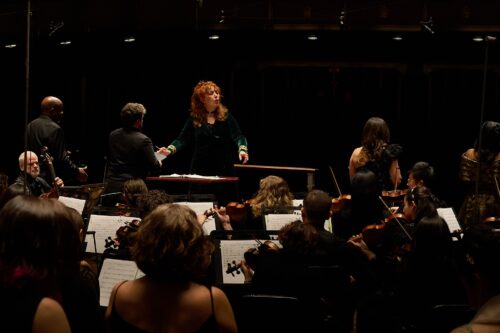
Featured Image: Apollo’s Fire and Apollo’s Singers led by Jeannette Sorrell © Malcolm Henoch
I cannot make a complete judgement because I had to work, but it looks like Mr. Jordan is dead on. It shows that when music is used for politics, it is always ruined. Two unbelievably great composers were featured in this programs, two masterworks: Mozart’s Requiem and Damien Geter’s African American Requiem. Both pieces were taken out of context in order to fit a political purpose, and it is likely that both works suffered from it (again, I cannot really know, I had to work).
I have no objection to artists making a political statement. Really, every performance is a statement, one way or another. But I do think that if a statement is being made, it needs to be compelling. This program has potential to be that compelling, but wasn’t focused enough (yet) to make it preferable to hearing the main works separately.
Music has always been, and always will be, political. It’s dispiriting to read this comment, made by someone who wasn’t even at the concert, and who might benefit from some study of music’s far-reaching intentions and aspirations.