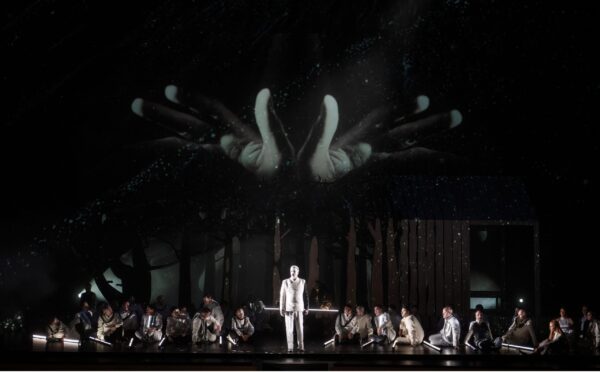
 Germany Wagner, Lohengrin: Soloists, Chorus and Orchestra of Mannheim National Theatre / Roberto Rizzi Brignoli (conductor). Mannheim National Theatre, 23.11.2025. (DM-D)
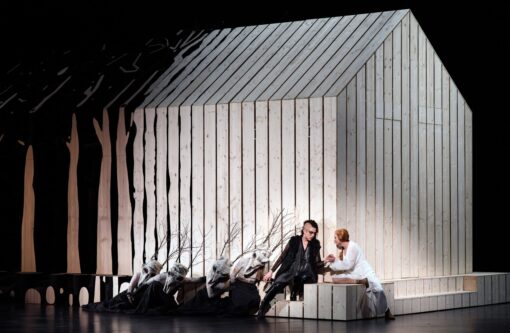
The production and design of this new Lohengrin in Mannheim blended into an intriguingly haunting, consistent retelling of the well-known plot – many of the numerous nuances still linger on in my memory. Roger Vontobel’s production emphasised the clash between old and new values. Old values, dark, sinister, in equal measure haunted and haunting, were represented by Ortrud, and, by implication, Telramund, who had become entranced by this dimension of Ortrud’s life and nature, and was unable to resist. In line with Vontobel’s excellent attention to detail, Telramund was too weak, he did not have the strength to resist; realised this with horror and gave in to the fate that would develop as a result, and which he knew would not be a happy one. Once he had given in, he took up his position in this dark scenario with gusto, a major victory for Ortrud! Ortrud was dressed in leather, with a punk-like hairstyle, and Telramund’s outward appearance came across as an increasingly successful attempt to blend in. Ortrud was surrounded frequently by four sprite-like characters, something like her shadows, who often also gathered around other characters over whom Ortrud sought to exert her evil influence.
Ortrud, Telramund and their shadowy companions were reflected in the stage design. Images of murky growths, emerging from human hands and fingers like the tendrils of creeping plants, yet rising to frightening tree-like heights were projected onto a scrim and ended up populating the actual set. The video worked particularly well with the set design. Each conventional stage element – a room in a house, with white walls, for instance – had a hint of those tendrils lurking in the background, behind the white surface. Lohengrin appeared almost entirely in white, his face painted white as well, although one arm showed clear signs of darker colours. The swan was predominantly off-white, played by the boy extra who ultimately turned into Gottfried. The transition from bird to human had the King and noblemen wiping some of the swan-like facial make-up off his face. The chorus of Brabantians were frequently placed within the physical mesh of tendrils, which restricted their movement considerably, even painfully so.
Much of the production’s visual impression focused on Ortrud. Julia Faylenbogen rose to the challenge of such a central position in terms of her acting, into which she threw herself with glee and abandon. Her vocal achievement was just as outstanding. She was able to differentiate expression and volume and organically combined fully sung and Sprechgesang material into a most passionate rendering of the role. She was, above all, excellent in her outbursts, in particular at the end of the opera, undoubtedly the emotionally shattering vocal highlight of the evening. Thomas Berau was a suitable match as Telramund to Faylenbogen’s Ortrud, combining well-sustained, sonorous vocal arcs with Sprechgesang that did not come across as bellowing or shouting.
On the basis of reviews of his work so far, and the audio and video material available online, I had had high hopes for Jonathan Stoughton as Lohengrin. I was disappointed however, so while the expected beauty of voice came through it was in between a range of problems because he seemed indisposed on the day. Stoughton has come to Lohengrin after notable success as Siegfried and I look forward to hearing him sing the role again when in better vocal health. Astrid Kessler was a thoroughly committed Elsa, a thoughtful young woman deeply affected by all that happened to and around her. She sang with considerable ease and confidence, striking attention to detail in terms of volume, and beautiful bloom. Patrick Zielke is developing into one of the best Wagner singers for the established bass roles. His King Henry was authoritative, sonorous, with a particularly rich tone in the very low register and very impressive breath control to sustain the long arcs of music composed for this role. Nikola Diskić was suitably robust as the Herald.
Robust is also the most appropriate adjective to describe the music emanating from the pit. Only part of that impression may be credited to the acoustics of the temporary Mannheim Opera venue (the main house is undergoing refurbishment). The general music director of Mannheim National Theatre, Roberto Rizzi Brignoli, chose broad brush strokes with an emphasis on the brass, while using the strings efficiently to foreground the mood created by the wind instruments. Rizzi Brignoli was consistent in this approach and the music served to support and enhance the visceral nature of the production overall.
Daniel Meyer-Dinkgräfe
Featured Image: Lohengrin Act III: Jonathan Stoughton (Lohengrin) © Christian Kleiner
Production:
Director – Roger Vontobel
Stage design – Fabian Wendling
Costume design – Martina Lebert
Lighting design – Florian Arnholdt
Video – Clemens Walter, Jonas Dahl
Chorus director – Alistair Lilley
Dramaturgy – Jan Dvořák
Cast included:
Heinrich der Vogler – Patrick Zielke
Lohengrin – Jonathan Stoughton
Elsa von Brabant – Astrid Kessler
Friedrich von Telramund – Thomas Berau
Ortrud – Julia Faylenbogen
The King’s Herald – Nikola Diskić
Four Noblemen – Raphael Wittmer, Dominic Lee, Zacharias Galaviz-Guerra, Jonas Boos
Four Squires – Yejy Nam, Vanessa Diny, Sophia de Otero, Rommie Rochell