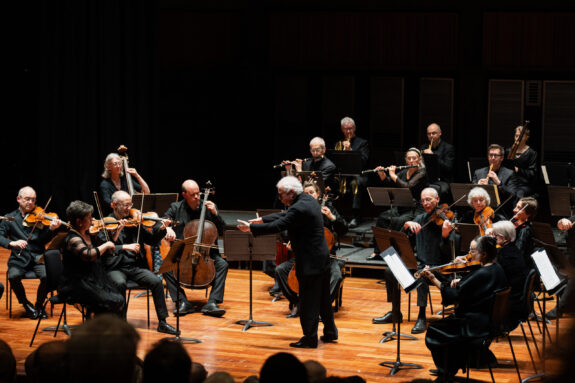
 United Kingdom Haydn: Orchestra of the Age of Enlightenment / Sir András Schiff (fortepiano, director). Queen Elizabeth Hall, London, 27.11.2025. (AK)
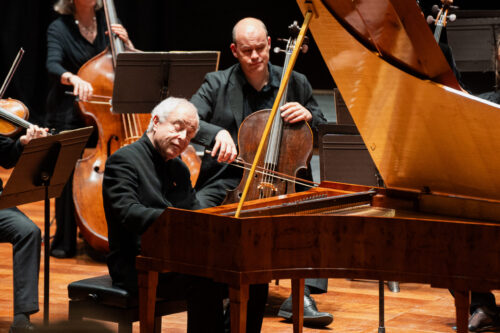
Haydn – Symphonies Nos. 39 and 102, Keyboard Concerto No.11, Sinfonia Concertante
Artistic integrity and high-quality music making were the essence of this excellent concert presented by the Orchestra of the Age of Enlightenment and Sir András Schiff. Furthermore, the free pre-concert talk with OAE violinist Margaret Faultless and musicologist Dr Rachel Stroud, as well as the free programme notes, was meaningful.
The relationship between Schiff and the orchestra is remarkable. The players fully appreciate Schiff’s exceptional qualities; they understand and speak his musical language. In turn, Schiff does not stand on a conducting platform and does not use a conducting baton. He stands among the players and indicates his musical ideas with minimal arm movements – occasionally using none – and facial expressions. Conducting from memory allows Schiff true intimacy with the music and musicians.
During 2025, the OAE celebrates its 40th anniversary. I recall their early concerts and later several more during the past four decades. To my mind, without doubt, the orchestra is at its best right now and may they so continue.
Symphony No.39 in G minor is regarded as from Haydn’s Sturm und Drang period but it is also nicknamed ‘Tempesta di mare’ on account of its last movement which possibly indicates a voyage on a stormy sea. Composed c.1765 in Esterháza (Hungary), hence a long way from any sea, I am not convinced if Haydn had the sea in mind but his use of four horns (two in B-flat, two in G) in addition to the two oboes, a bassoon and strings facilitate a dramatic finale which Schiff and the players took on with gusto on their period instruments.
It shows Schiff’s generosity and confidence (in himself as well as in the players) that he did not conduct the Sinfonia Concertante. According to Jessica Duchen’s article in the programme notes, Schiff would conduct this piece too on the concert. He might have done so on other occasions but this time the OAE was led by leader/violin soloist Kati Debretzeni.
The Concertante was composed at the request of the evidently brilliant violinist and entrepreneur Johann Salomon for his 1792 London season. Set for four soloists (violin, cello, oboe and bassoon) and full orchestra (of flute, two oboes, two bassoons, two horns, two trumpets, timpani, strings), the piece is – in my view – a violin concerto with obligato and orchestral accompaniments. Kati Debretzeni delivered the solo violin part with virtuosity and immense musicality (of the Schiff kind) while she also managed to direct all players on the stage.
I am in awe of solo cellist Luise Buchberger’s virtuosity in the high passages on her baroque cello. Nevertheless, I am not entirely sure if Haydn really meant some of these passages quite so high. He composed the work within a very short time and used a variety of clefs which could have caused misunderstandings. According to contemporary notational customs, cello parts were at times written in the treble clef but were meant to be read an octave lower. I trust Buchberger’s scholarship but surely even great composers like Haydn can make errors when composing in a hurry.
Each player on the stage (soloists as well orchestra players) is due for praise. Delivering horn, trumpet, timpani and other orchestral parts while the director is busy with virtuoso solo violin passages is no mean feat even if there is a supportive second leader (like Rodolfo Richter on this occasion).
With a leader and players like these, who needs a conductor? From what I observed, all participants at this concert could pose this question. However, there is no need: Schiff and the players performed the two symphonies and the keyboard concerto as if they played chamber music.
Schiff is a phenomenal player on any keyboard and, when he gets the opportunity, he is using contemporary instruments (or their copies) for baroque and classical composers. This time he played a copy of the Anton Walter fortepiano of 1795, built by Christoph Kern. Schiff is in full command of the music but also of the instrument. He sings on the instrument, plays with it and conveys his joy to the listeners. Haydn liked a musical joke – see his sudden loud chord in the second movement of his Surprise Symphony (No.94) – and so does Schiff: he included the main motive of the actual surprise movement into his cadenza after the first movement of the Keyboard Concerto No.11.
The third movement of the concerto is titled as a Hungarian rondo, but the music is not Hungarian. However, Haydn composed it in Eszterháza (Hungary) where he might have heard music of this kind performed by travelling Hungarian/Roma musicians. Schiff played it with brilliance and with the appropriate fake Hungarian flavour.
Haydn’s Symphony No.102 belongs to his twelve London symphonies, commissioned by Salomon, and requires a large orchestra with two flutes, two oboes, two bassoons, two horns, two trumpets, timpani and strings. Horns, trumpets and timpani are tuned to B-flat which was among Haydn’s innovations. To make the point absolutely clear, for the first bar of the symphony Haydn writes a long held B-flat note for all instruments. And the symphony is, of course, in B-flat. After the grand opening note, Schiff and the OAE delivered a thoroughly enjoyable performance.
For an encore we had the overture to Haydn’s opera The Desert Island (or The Uninhabited Island). With its 7- or 8-minute length, this was perhaps an over-generous encore. It also jarred a bit as a music stand was brought on stage and Schiff conducted from a score. I have known Sir András Schiff for about sixty years. His memory is phenomenal; his head is full of music. It was a new experience for me to watch Sir András turning pages in a score; I doubt if I will get a second sighting of such kind.
Agnes Kory
Featured Image: Sir András Schiff conducting the Orchestra of the Age of Enlightenment