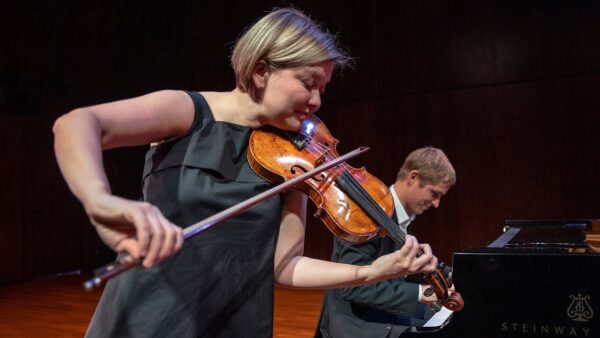
 United Kingdom Beethoven: Alina Ibragimova (violin), Cédric Tiberghien (fortepiano), Wigmore Hall, London, 19.11.2025. (CSa)
Beethoven – Violin Sonata No.4 in A minor, Op.23; Violin Sonata No.6 in A, Op.30 No.1; Violin Sonata No.7 in C minor, Op.30 No.2
Russian-born violinist Alina Ibragimova and French pianist Cédric Tiberghien, both distinguished solo instrumentalists, first met in London in 2005 when they were both part of the BBC Radio 3 New Generation Artists Scheme. They immediately discovered a common musical sensibility and a shared artistic compatibility which over the last 20 years has blossomed into a remarkable collaboration, particularly in their exploration of Beethoven’s sonatas.
They returned to the Wigmore Hall to recreate Beethoven’s soundworld in an historically informed yet vibrantly fresh and emotionally spontaneous recital of three of his ‘middle period’ sonatas: No.4 in A minor, Op.23, No.6 in A, Op.30 No.1, and No.7 in C minor, Op.30 No 2. Although composed in a comparatively short time span (1800-1802) they embody the considerable breadth of Beethoven’s musical development over this period.
We know from contemporary documentation that these sonatas were premiered privately in a grand musical household of one of his patrons. They were invariably performed by the jovial, stout, Ignaz Schuppanzigh, Beethoven ‘s favourite violinist, friend and sparring partner, with the composer himself at the keyboard. We also learn from anecdotal reports that their relationship was somewhat fraught. When Schuppanzigh complained to Beethoven about the complexities he encountered when playing certain passages in the master’s music, the irascible Beethoven responded, ‘Do you believe that I think about your miserable fiddle when the muse strikes me?’ and chided him for his ‘fat fingers’. What we cannot know for certain of course, is precisely how the performance sounded. But it is not wildly speculative to suggest that this recital would have struck a nineteenth-century Viennese audience as entirely authentic.
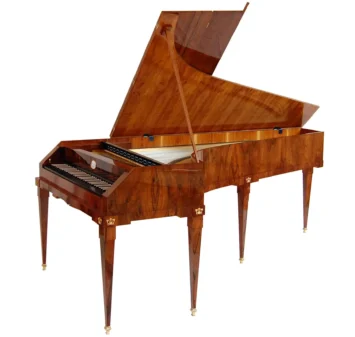
Ibragimova, on this occasion swathed in a black velvet dress, achieved her characteristically rich and cleanly rounded tone on a 1775 Anselmo Bellosio with a classical bow, while Tiberghien, resplendent in a salmon pink three-piece suit, eschewed the Wigmore Hall’s modern concert grand in favour of a reproduction of an original 1805 Walter & Sohn fortepiano. Regrettably there was no mention of this in the one sheet programme note, but research has revealed that this elegant replica was handcrafted by Paul McNulty in his workshop in rural Czechoslovakia. Encased in glowing walnut and far smaller than contemporary pianos, it features a spruce wood soundboard sourced from the nearby Šumava Forest, a shorter keyboard, fewer octaves, and knee levers rather than foot pedals to moderate or sustain sound. These devices are concealed on the underside of the instrument and require players to use their knees to press up, rather than their feet to press down. Tiberghien achieved this complex mechanical manoeuvre almost imperceptibly maintaining his posture throughout. The result was magical – a sparklingly transparent tone, delicate in colour, lightly and incisively articulated. It proved the perfect foil to Ibragimova’s violin and helped to maintain a true partnership which neither instrument dominated.
The recital began or rather exploded with a tightly coordinated account of the Sonata in A minor, Op.23. The dark, turbulent Presto almost grabbed the listener by the throat, while the playful Andante scherzoso consisted of a teasingly intricate musical conversation – some passages played so softly that one could only marvel at the players’ precision and control. It was not long though, before stormy intensity returned in the restless and thrillingly executed finale.
The choice of Sonata No.6 in A, described by musicologist Richard Wigmore as ‘one of Beethoven’s best-kept secrets’, came as a delightful surprise. Pastoral in in mood and luminous in texture, Ibragimova’s ripe, full-blooded account complimented Tiberghien’s refined fingerwork to give a gently lyrical and beautifully blended rendition of the first movement Allegro, and a serene Adagio in which precisely aligned moments of silence spoke as eloquently as the music itself.
The second part of the programme featured one work: Beethoven’s volcanic Sonata No.7 in C minor, which has been described as a symphony for two instruments in four movements. It was written in 1802, the year of the Heiligenstadt Testament, a despairing letter written by Beethoven to his brothers Carl and Johann about his encroaching deafness. The sonata provided yet another opportunity for Ibragimova and Tiberghien to demonstrate how wonderfully matched they are, and to display their total command of tonal colour, rhythmic acuity and finesse. The opening Allegro con brio was ominously dark and threatening, building to a tidal wave of Romantic melody which broke through the walls of eighteenth-century classicism. The Adagio cantabile was lustrous and full-bodied, and the ebullient Finale, an exhilarating roller coaster of a musical journey, brought the formal part of the evening to an end. In an unexpected moment of gentle closure, we were treated to the second movement Adagio from Beethoven’s Violin Sonata No.3 in E-flat, Op.12 No.3. Here, the violin’s soulful cantabile played softly over the fortepiano’s rippling undercurrent. Like everything else on this joyous and restorative programme, it was perfectly judged.
Chris Sallon
Featured Image: Violinist Alina Ibragimova and pianist Cédric Tiberghien