
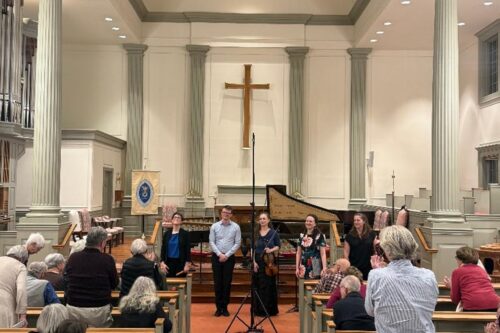
 United States Various, ‘Wild Things’: Les Délices: Elena Mullins Bailey (soprano), Deborah Nagy (oboe and recorder), Shelby Yamin (violin), Rebecca Landell (cello), Mark Edwards (harpsichord). Christ Church Episcopal, Hudson, 23.11.2025. (MSJ)
Telemann – Don Quichotte (selections); ‘Napolitana’; ‘Xantippe’
Couperin – ‘Rondemont’ from Apothéose de Lully; ‘Le Rossignol en Amour’
Biber – Sonata Representativa
John Walsh (arr. Nagy) – Suite from Bird Fancyer’s Delight
Louis-Claude Daquin – ‘Le Coucou’
Arne – ‘Where the Bee Sucks’
Texts of Aesop’s Fables set to French dance music of the 1730s (trans. Larry Rosenwald)
One of the most interesting characteristics of the state of Ohio is how one can travel in a little over an hour from towns settled by people from the southern colony of Virginia up to the Western Reserve, a corner of the state that had been claimed by the colony of Connecticut and was subsequently populated by settlers from New England. This presence is still felt in the architecture of the area and in its cultural development. Music from the Western Reserve is a concert series located in the picturesque village of Hudson, a town that looks more like a quaint New England settlement than an Ohio farm town. The series is currently in its forty-second season.
Les Délices is a baroque chamber group started by Deborah Nagy in 2009. Nagy is familiar to many from her involvement in Apollo’s Fire, the outstanding Cleveland baroque orchestra, and she brings the same enterprising sense of exploration to Les Délices (which has toured nationally to acclaim). The program presented on this occasion was ‘Wild Things’, a precursor to a multi-season project that will explore myth and its impact on society. The wild things here are evocations of birds, insects and animals, united by a thread of settings of Aesop’s Fables using French dances from the early 1700s as the music.
The program opened with (most of) the Don Quichotte suite by Georg Philipp Telemann, reduced by the players from its full string ensemble scoring for this presentation for oboe, violin, cello and harpsichord. Telemann was a German composer depicting a Spanish story by Cervantes, but he was a master of national styles, and this work is more French than anything else, with its strong sense of pictorial evocation, particularly as performed here in flexible French style. Dropping two movements (the love music for Dulcinea and the scene of Sancho Panza getting tossed in a blanket) helped focus the suite on the animal depictions: Don Quixote’s horse and Sancho Panza’s donkey, their unruly charge against windmills and the Don’s dreams of future conquests. Tempos were flexible, allowing the depiction of the old horse’s attempts to gain momentum, depicted by Shelby Yamin’s violin flourishes, and the donkey’s stubbornness, embodied in Rebecca Landell’s boisterous cello playing.
The French nature of the program emerged further with the ‘Rondement’ from François Couperin’s Apothéose de Lully, and later in the same composer’s ‘Le Rossignol en Amour’ from Ordre XIV of his harpsichord suites, cleverly adapted here for Nagy’s nimble recorder to take the melodic twitters alongside the harpsichord. Nagy sat out as Yasmin plunged into the lively animal depictions of Heinrich Biber’s Sonata Representativa with the comic dissonances of its frog and cat movements.
The Aesop settings were a running thread throughout the performance, sung with a balance of elegance and storytelling flair by Elena Mullins Bailey. The songs were done in skillful English translations by Larry Rosenwald, allowing instant comprehension without texts and translations in the program. A few words were lost in the generous acoustic of the church, though Bailey’s storytelling kept it all on course. The French dance tunes were particularly attractive and worked charmingly as vehicles for the texts.
The most unlikely peculiarity of the program was a suite from the book Bird Fancyer’s Delight, a 1708 publication by John Walsh that isn’t a musical score at all. Rather, it is a book with recorder melodies that the user was instructed to play to a pet bird, in hopes of teaching the bird to whistle along. Nagy adapted the tunes to her ensemble, opening with Yamin’s violin ‘teaching’ her recorder one of the melodies.
After a couple more selections from Telemann, including one of his evocations of the shrewish wife Xantippe (a different sort of wild thing!), harpsichordist Mark Edwards had a solo moment with a flexibly French performance of Louis-Claude Daquin’s ‘Le Coucou’. Often performed in a rigid, metronomic manner, the layered evocation of the call of the cuckoo remains charming when given with the kind of flexibility that allows its decorative elements to be savored. Edwards also started each couplet as written without added connective tissue, as is so often heard in modern adaptations.
Before a final fable, Thomas Arne’s setting of Shakespeare’s ‘Where the Bee Sucks’ from The Tempest was heard. Amusingly, Arne’s text bowdlerized the song to ‘where the bee sucks, there lurk I’ instead of the original (and much racier) ‘where the bee sucks, there suck I’. Nonetheless, it was a welcome chance to hear something other than Arne’s greatest hit, ‘Rule Britannia!’, and it fit well with the entertaining program.
Music from the Western Reserve will return 23 February 2026 with an all-Rachmaninoff program from cellist Brendon Phelps and pianist Alexandre Marr.
Mark Sebastian Jordan