
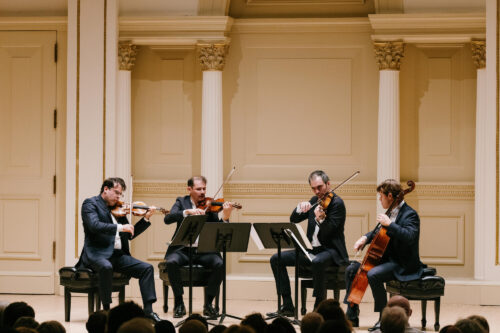
 United States Kurtág, Beethoven, Brahms: Modigliani Quartet (Amaury Coeytaux, Loïc Rio [violins], Laurent Marfaing [viola], François Kieffer [cello]). Weill Recital Hall, Carnegie Hall, New York, 7.11.2025. (ES-S)
Kurtág – Hommage à Mihály András (12 Microludes for String Quartet), Op.13
Beethoven – String Quartet No.1 in F major, Op.18
Brahms – String Quartet No.2 in A minor, Op.51
Formed more than two decades ago and established as one of the foremost European string quartets, the Quatuor Modigliani has been, alas, only rarely present on New York stages. This was only the quartet’s fourth Carnegie Hall appearance in ten years – always in the smallish Weill Recital Hall, ideal for chamber music but allowing only a limited audience.
The program opened with György Kurtág’s Hommage à Mihály András, a work that holds particular significance for the Modigliani Quartet who studied with Kurtág in 2004 and absorbed his exacting sense of phrasing and sonority early in their career. Dedicated to the Hungarian cellist, conductor and composer András Mihály – one of Kurtág’s mentors and a tireless advocate of new music in Budapest – the Hommage belongs to a long line of works through which Kurtág has paid musical tribute to friends and artistic kindred spirits. Each of the twelve miniatures lasts scarcely a minute, yet the ensemble treated them not as self-contained aphoristic pearls but as interdependent cells in a continuously shifting structure, an interplay of tonality and abrasion. Whispered harmonics, brushed sul ponticello effects and sudden flashes of lyric intensity emerged with astonishing concentration. The players’ control of color – especially the way the sound receded into silence without losing tension – made this terse sequence feel both analytical and haunted. If Webern’s influence hovered in the crystalline economy of means, Kurtág’s own voice spoke through the music’s nervous intimacy and its fragile balance, as though each gesture bore the weight of memory.
From the whispered concentration of Kurtág’s world, Beethoven’s String Quartet No.1 opened outward – articulate, spacious and charged with youthful vitality. The Modigliani players favored clarity over contrast: the opening Allegro con brio had buoyant energy yet avoided sharp edges, allowing the motivic play to emerge in clean relief. Their phrasing brought out the quartet’s conversational nature – the cello often prompting responses instead of merely underpinning them – while a supple rhythmic pulse kept the dialogue in motion. The Adagio affettuoso ed appassionato, which Beethoven associated with the tomb scene from Romeo and Juliet, became the emotional center of the performance. First violinist Amaury Coeytaux drew the melodic line with restraint and focus, and the ensemble’s collective breath at key harmonic turns conveyed tragedy through simplicity without pathos – though one occasionally wished for a broader sense of space in phrasing to let the movement’s ardor unfold more freely. The Scherzo, with its quicksilver interplay and sly rhythmic displacements, recalled Haydn’s influence in its good-natured wit, while the finale danced nimbly, affirming the young Beethoven’s sense of proportion and vitality.
After the interval came Brahms’s String Quartet No.2 whose expansive form and dense textures extended that classical inheritance into a more inward and shadowed realm. The Modigliani players deepened their sound, enriching the tone without sacrificing transparency and demonstrating again a great level of cohesiveness. The opening Allegro non troppo began in understatement, its hesitant theme searching for direction before gaining momentum through rhythmic insistence. As the movement unfolded, the quartet’s interplay acquired symphonic breadth, the middle voices lending a burnished depth to the ensemble’s sound. The Andante moderato was shaped as a long, meditative arch, its melody unfolding with warmth yet without indulgence. In the Quasi minuetto, Brahms’s subtle irony – part dance, part recollection – was captured with a flexibility that allowed phrases to ebb and flow naturally. The Finale, rhythmically animated and built from interlocking motives, with accent patterns alive but never overstated, emerged as a vigorous yet disciplined conclusion.
Having named their ensemble after the painter Amedeo Modigliani, the quartet’s members have often described his portraits as embodying an ideal of purity and expressive line and representing a harmony between structure and emotion. That vision found its echo in their reading of Brahms – music suspended between Classical form and Romantic introspection – which the Modigliani Quartet rendered with clarity and warmth, shaping contour and emotion so that feeling deepened not through excess but through precision.
Edward Sava-Segal