
 United States Sarah Kirkland Snider, Hildegard: Soloists, Members of the Orchestra of LA Opera / Gabriel Crouch (conductor). The Wallis Annenberg Center for the Performing Arts, Beverly Hills, 6.11.2025. (JRo)
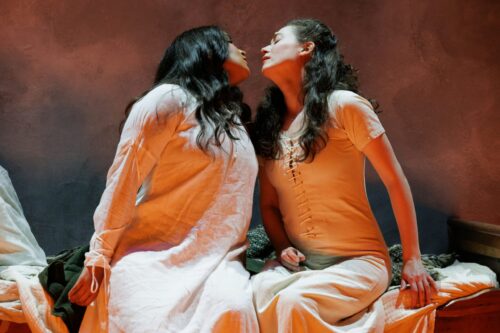
In an exquisitely wrought score, composer Sarah Kirkland Snider brings the soundworld of the medieval polymath Hildegard von Bingen to life on the opera stage. Snider’s previous work included the song cycles Penelope and Unremembered, but this is her first foray into opera – she wrote the music and the libretto. Her music is hypnotic and spiritual, evoking both Hildegard’s compositions and Minimalism. It is an elegant score that at moments blossoms into high drama, defying expectations and creating real pathos.
As Hildegard, soprano Nola Richardson was the centerpiece of the production, focusing the opera with her dramatic presence and the crystalline beauty of her voice. The production was over two hours long, and she was on the stage and singing for most of the evening. With an instrument as beautiful as Richardson’s, I was hard pressed to understand why she and the rest of the cast needed amplification. I longed to hear the purity of her sound without the homogenizing effect of a lavalier microphone. The Wallis is an intimate space with excellent acoustics, which made the decision even more perplexing.
Snider’s instrumentation was superb. Eleven members of the LA Opera Orchestra were fastidiously conducted by Gabriel Crouch. The harp signaled the spiritual, the winds were in dialogue with the voice and the strings enveloped the singers.
If the music was glorious, the concept was less so. Hildegard’s accomplishments in music, medicine, philosophy, writing and natural history were overshadowed by the personal, social and political implications of her life. These included her (perhaps) romantic love for Richardis von Stade, a young nun, and the physical sufferings of the two women (Hildegard with migraine, Richardis with epilepsy). There were Hildegard’s conflicts with the patriarchy in the person of Abbot Cuno, and the rape of Richardis and a subsequent pregnancy. All this contributed to the narrative, but it was overplayed to the detriment of Hildegard the artist.
As the timorous Richardis, Mikaela Bennett’s warm and lustrous soprano was a dramatic counterpart to Richardson’s Hildegard. The supple baritone of David Adam Moore contrasted well with the rigidity of his persona as head of the Abbey where Hildegard and her nuns were sequestered. Roy Hage was a sympathetic Volmar, a monk and Hildegard’s confidant. Mezzo-soprano Blythe Gaissert as Margravine von Stade was a force to be reckoned with both in voice and characterization.
Beth Morrison, a creative producer known for championing new opera and music theatre, has plans to tour the production in a variety of venues. This necessitated the design of an adaptable set to be repurposed for small stages and black box theatres. In the elegant space provided by the Wallis, however, the set felt undersized and flimsy. A more expansive vision was needed to fill the stage – perhaps in the vein of Robert Wilson’s Minimalist aesthetic. Marsha Ginsberg designed a handsome, movable golden box with circular openings that served as a study and scriptorium and two models of German abbeys, but these were dwarfed by the proportions of the stage and proscenium.
The video designs of Deborah Johnson were projected onto a tall rectangular backdrop. Foregoing the use of Richardis’s illustration style (her illuminations can be found in a version of Scivias) or medieval painting of the period, Johnson created an amorphous style of crude, hazy images of saints, objects and landscape. This gave a ‘new age’ quality to the visuals and placed the brilliant twelfth-century Hildegard in a vague environment without specificity to time or place. One image of frolicking nuns in a shower of moondust would have delighted Isadora Duncan.
The direction of Elkhanah Pulitzer was generally sensitive, save for the inclusion of the dancing devils of Hildegard’s nightmare and the clumsy shifting of furniture onstage by the cast (though I did enjoy the machinations of two masked vultures who lent a hand). Costumes by Molly Irelan were simple and harmonious, hand gestures designed by Laurel Jenkins lent poetry to the movement of the characters, and the lighting by Pablo Santiago was subdued and appropriate.
As a first-time librettist, Snider depended on the collaboration of the directorial and production team and, perhaps because of that, the opera felt like a work in progress. As a composer, however, she needed only her unique talent to create a mesmerizing and transcendent score, one that is bound to endure.
Jane Rosenberg
Featured Image: Nola Richardson (Hildegard) and Chloë Engel (Faceless woman) © Angel Origgi
Production:
Libretto – Sarah Kirkland Snider
Director – Elkhanah Pulitzer
Creative producer – Beth Morrison
Sets – Marsha Ginsberg
Costumes – Molly Irelan
Lighting – Pablo Santiago
Projection – Deborah Johnson
Sound – Drew Sensue-Weinstein
Movement – Laurel Jenkins
Dramaturg – Annie Jin Wang
Cast:
Hildegard von Bingen – Nola Richardson
Richardis von Stade – Mikaela Bennett
Abbot Cuno – David Adam Moore
Volmar – Roy Hage
Angel – Raha Mirzadegan
Margravine von Stade / Clementia – Blythe Gaissert
Mechthild – Patrick Bessenbacher
Otto – Paul Chwe MinChul
Faceless woman – Chloe Engel
This is an excellent and full review with a sense of the beauty and tone of the production as well as a capture of the history of Hildegard and her era.
Thank you, Jane.
Thanks for taking the time to read and then write a comment, Gayle. Much appreciated!
I attended last evening’s performance in NYC and, even though very familiar with Hildegard’s contributions, was deeply moved by this opera. So much so that it was one of the most moving opera performances I’ve ever experienced.
I congratulate all who brought this to us.