
 United States Dvořák, Prokofiev, Sibelius: Alexandre Kantorow (piano), San Francisco Symphony / Karina Canellakis (conductor). Davies Symphony Hall, San Francisco, 6.11.2025. (HS)
Dvořák – Scherzo capriccioso
Prokofiev – Piano Concerto No.3 in C major
Sibelius – Four Legends from the Kalevala
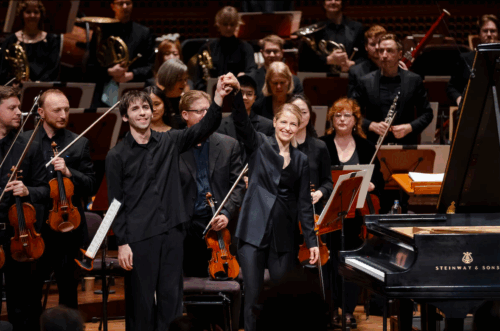
Karina Canellakis is becoming a regular guest conductor with the San Francisco Symphony – four times in recent seasons – and the results keep buoying audiences. Her latest program spanned Sibelius’s collection of tone poems, Four Legends from the Kalevala, a Prokofiev piano concerto and a seldom-heard Dvořák scherzo, and it was filled with zing despite the nearly two-and-a-half-hour length.
The energetic, athletic Canellakis only took up conducting a little more than a decade ago, but she can propel an accelerando with intensity, encourage spacious sonorities and find ideal balances in the most complex scores. Precision and clarity were the hallmarks of the performance on Thursday evening in Davies Symphony Hall (the first of three for this program), spotlighting the kinds of details that make music connect when the ideas for interpretation are abundant.
Most appealing was the 50-minute Sibelius journey. Written a few years before his Symphony No.1, it stemmed from an opera on the Finnish legend of Lemminkäinen that the composer abandoned. The four episodes are models of nature scene-setting, the most often heard being the second one (in the order performed here), ‘The Swan of Tuonela’. The whole suite was last heard in San Francisco in 2019, led by Esa-Pekka Salonen in his first performance with this orchestra as music director-designate.
Comparisons are appropriate: both Canellakis and Salonen go for precision and shape details for drama without indulging in excess. Climaxes are earned and slower, quieter passages can convey a sense of bottled-up energy under the tranquility. Those aspects were in play from the opening measures, with the distant horn calls responding hauntingly against string harmonies, underlined by the rumble of a quiet bass drum roll (which becomes a recurring aspect of the work’s arc). The first legend, ‘Lemminkäinen and the Maidens of the Island’, wended its way to a strong finish.
Russ de Luna crafted the famous English horn solo in ‘The Swan of Tuonela’ with soulful legato and poignant tone, the strings flowing underneath with a gentle pulse. ‘Lemminkäinen in Tuonela’ built gradually into an anguished finish and led to the finale, ‘Lemminkäinen’s Homeward Journey’, which marched in brightly only to broaden into an expansive, gripping finish.
San Francisco audience members may have encountered the 28-year-old French pianist Alexandre Kantorow if they watched his performance of Ravel’s Jeux in the rain at the opening ceremonies of the 2024 Olympics in Paris. Prokofiev’s ebullient Piano Concerto No.3 posed a different challenge, and Kantorow’s fluid technique and admirable attention to detail made for a performance that was kind to the ear but perhaps a bit too genteel.
The concerto has an American pedigree: it got its premiere at the Chicago Symphony in December 1921 (with Prokofiev on piano) in the same month as the Chicago Opera presented the premiere of his satirical opera, The Love for Three Oranges. (Historical note: Prokofiev also played the first San Francisco performances of this concerto in 1930 under Alfred Hertz.)
In Kantorow’s hands, the pungent harmonic punches that permeate the concerto emerged softer than ideal, and his articulation of the rapid-fire pianistic flourishes could have benefited from a crisper attack. Even so, the concerto bounced along nicely. Canellakis set lively tempos in the outer movements and revved up orchestral climaxes that let the piano’s sound come through as needed.
The best part of the concerto was the give-and-take between orchestra and piano in the Finale. Even better was the encore, an especially expansive and beautifully articulated rendering of Wagner’s ‘Liebestod’ in Liszt’s transcription. Kantorow captured the orchestral sonorities with impressive style and let the ecstatic music flow beautifully.
The concert’s opener was Dvořák’s early Scherzo capriccioso, a piece the composer wrote to honor his mother at her death. It is no dirge. In fact, it pinballs nervously from one brief idea to another until it finally settles on an almost heroic expression. Canellakis caught the shifts in mood and held them together up to a satisfying ending.
Harvey Steiman
Featured Image: Karina Canellakis conducts the San Francisco Symphony © Brittany Hosea-Small