
 United Kingdom Janáček, Bruckner: Bavarian Radio Symphony Orchestra / Sir Simon Rattle (conductor). Barbican Hall, London, 12.11.2025. (AV-E)
Janáček – Taras Bulba (Rhapsody for Orchestra)
Bruckner – Seventh Symphony in E major
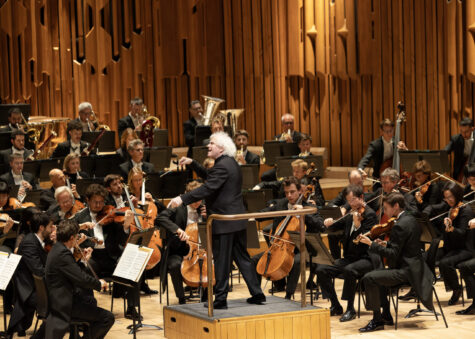
The Bavarian Radio Symphony Orchestra, under their chief conductor Sir Simon Rattle, gave us a mesmerising evening of astonishing music-making of the highest calibre: it was a privilege to be able to hear them live for they are arguably one of the greatest orchestras in the world.
I was totally transfixed by the conducting and playing of Janáček’s Taras Bulba for both orchestra and conductor know the score backwards (and Rafael Kubelík’s Bavarian Radio Symphony Orchestra recording still remains a ‘benchmark’ for the work).
The elegant and exquisite playing executed sounds so thrilling and chilling that made the blood-lusting-blood-letting narrative feel redundantly insignificant. For I was certainly not thinking about what the music meant when being delightfully pierced by the E-flat clarinet’s death-cry in The Death of Ostap!
What was an odd anomaly was a different than usual timpani passage in The Prophecy and Death of Taras Bulba. For the customary six-spaced timpani thuds were replaced by speeded up timpani emendation which sounded really awful. Anyone familiar with this infamous passage will know what I mean from the celebrated Ancerl and Kubelík recordings (as well as from the 1983 Philharmonia Orchestra rendition with Rattle himself). However, the timpanist was incisive in the conclusion of the work, as were the bells and brass.
Conducting Bruckner’s Seventh Symphony without a score, Rattle gave us an idiosyncratic interpretation which was wonderfully insightful and instinctive as if one was hearing it for the very first time afresh; a rare feat for an old warhorse.
Rattle integrated the Allegro and the Adagio as an ebbing flow of an organic whole with brisk tempos without ever sounding rushed, whilst planting some pianissimos on the way to creates a sense of sedate distance and subdued contemplation as well as an introspective evanescence which worked wonderfully well (but would upset the ‘purist’ pundits for ‘not following the score’ for sounding so quiet). Yet such soft playing from the strings evoked a sensation of dissolving distance and a spaced-out spaciousness.
What made the strings sound so superlative was that they were able to play extremely quietly whilst still carrying great weight and presence: I have never heard the strings of a London orchestra being able to do this.
These two majestic movements sounded far more spiritual, sombre, tranquil, reserved, melancholic, subterranean than usual; for even the climactical (and ‘controversial’) cymbal crash had a halo of spirit about it, never sounding meritorious; and which was accompanied by two timpanists playing in perfect unison: watching and hearing them was mesmerising.
The concluding coda, with the solemnly sumptuous Wagner tubas and haunting horns (an elegy to Wagner), was the most sublime moment of the evening.
The concluding Scherzo and Finale often sound hectic, manic, sporadic and bombastic, but remarkably Rattle somehow made them convincingly cohere and connect with perfectly judge tempos and dynamics with his hyper-sensitive players never sounding loud or forceful.
Rattle’s revelatory reading brought the house down with repeated calls for him to come back in the anticipation of an encore; but what encore could possibly come after such a transcending performance?
The hallmark of a commanding concert is one becomes transformed as I had myself through the transcending conducting of the Bruckner Seventh. Thank you, Sir Simon Rattle.
Alexander Verney-Elliott
Featured Image: Sir Simon Rattle conducting the BRSO in the Barbican Hall © Astrid Ackermann