
 Germany Wagner, Tristan und Isolde: Soloists, Chorus of Theater Münster, Münster Symphony Orchestra / Golo Berg (conductor). Theater Münster, 22.11.2025. (DM-D)
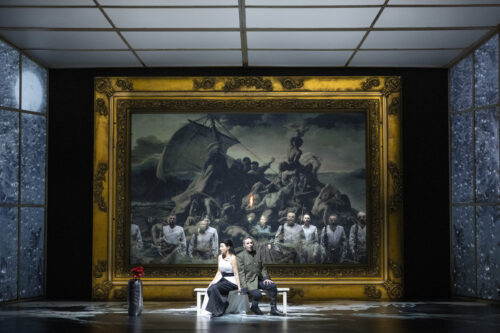
Strong images, projected onto the curtain or a scrim, and represented in the set itself, dominated this new production of Tristan und Isolde in Münster. They were minor, for example, black and white images of Isolde’s face, at first glance still images but in due course revealed as film (the eyes were blinking) were seen on entering the auditorium, at the start and during the intervals. A further intriguing minor visual aspect occurred at the opening of Act III: Isolde tended to a boy in a bed, she disappeared, the boy hid under the bed and Tristan emerged from underneath the bed.
The painting Le Radeau de la Méduse (The Raft of the Medusa) by French painter Théodor Géricault (1791–1824), took on a major role in the visual rendering of the opera. For the production, the painting’s empty huge golden frame was hanging at the top of the stage in parallel with the ceiling for the opening of Act I. It was lowered and hung precariously over the stage when Tristan and Isolde drank the love potion, and the frame with painting covered the entire back wall of the stage for Act II. The frame was large enough for characters to climb into and rest on the frame. The painting itself allowed for characters to emerge behind it, for example Brangäne warning the lovers, and King Marke and his men observing the lovers, respectively, in Act II. The painting depicts a number of people on board a raft, stranded at sea after a shipwreck, some two weeks into their desperate voyage, with some dead already. Strikingly, the way the dead bodies were arranged around Tristan’s bed in Act III (Marke and Brangäne killed themselves as well, by drinking poison), resembled the arrangement of bodies in the painting.
For these visual effects, Dieter Richter’s set worked well in conjunction with the lighting design by Ingo Jooss and Katarina Eckold’s video. The attention director Clara Kalus placed on detailed characterisation fitted in well with the overall sensitive and thoughtful approach – which was reflected also in the way Münster general music director Golo Berg interpreted the score. His tempos tended to be on the slower side, but without ever abandoning or losing sight of the music’s inherent tensions. Rather, he took care of minutely chiselling the arcs, allowing occasionally striking emphases of the different parts of the orchestra in relation to each other.
Golo Berg proved a conductor sensitive to the singers. Kristiane Kaiser has a very strong voice across registers, beautifully soaring, with excellent breath control to sustain long arcs. With her, Berg was able to bring out the music as an equal partner, never a competitor. Brad Cooper had already sung Siegmund in a concert performance of the first act of Die Walküre in Münster in 2023 under Berg, as well as Siegfried to great acclaim (see review here). His voice may not be big enough for larger houses, but Münster is not a large one and thus the voice was perfect here. It was well focused, even, secure and mellifluous across the entire range and for the duration of the opera, without fail. He never gave the impression of holding back or saving his voice for later. This is all so much better than listening to a ‘larger’ voice hampered by notable endurance issues. Wioletta Hebrowska was very strong as Brangäne, presenting her as a woman torn, and in the end broken by the sorrow over the events she has unleashed. Her voice was suitably passionate and warm. Johan Hyunbong Choi was very melodious as Kurwenal, sustaining a noble line of singing. Wilfried Staber brought much professional experience to his portrayal of King Marke, impressing with a rich voice which he wielded with ease. Ramon Karolan, Youn-Seong Shim and Yoogeon Hyeon did full justice to their roles as Melot, Shepherd and Voice of a Sailor, and Helmsman, respectively. For a medium-sized German municipal theatre like Münster’s, putting on an opera such as Tristan und Isolde is a major endeavour both in artistic and financial terms. Taking the risk paid off fully on this occasion!
Daniel Meyer-Dinkgräfe
Featured Image: Theater Münster’s Tristan und Isolde Act I © Thilo Beu
Production:
Director – Clara Kalus
Set design – Dieter Richter
Costume design – Katharina Weissenborn
Lighting design – Ingo Jooss
Video – Katarina Eckold
Chorus director – Anton Tremmel
Dramaturgy – Giulia Fornasier
Cast:
Tristan – Brad Cooper
Isolde – Kristiane Kaiser
Kurwenal – Johan Hyunbong Choi
King Marke – Wilfried Staber
Brangäne – Wioletta Hebrowska
Melot – Ramon Karolan
A Shepherd / Voice of a Sailor – Youn-Seong Shim
A Helmsman – Yoogeon Hyeon