
 United Kingdom Sibelius, Say, Dvořák: Fazil Say (piano), Philharmonia Orchestra / Santtu-Matias Rouvali (conductor). Royal Festival Hall, London, 30.11.2025. (AV-E)
Sibelius – En Saga (1891)
Fazil Say – Piano Concerto (Mother Earth) (UK premiere, 2025)
Dvořák – Symphony No.8 (1889)
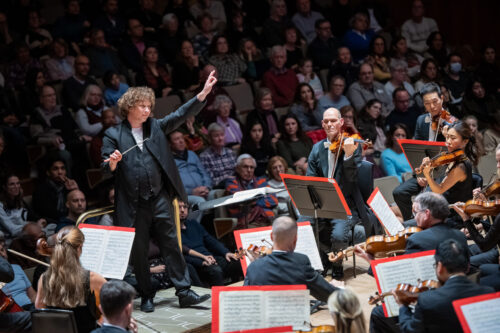
In the concluding concert of the Philharmonia Orchestra’s 80th Birthday, I looked forward to hearing El Amor Brugo Suite by de Falla but it was withdrawn and substituted with En Saga by Jean Sibelius. Yet this change in programming perfectly complemented the scores scheduled by Fazil Say and Antonin Dvořák with its portraying of Nature in all of its boom, bloom, gloom, vroom and doom. Having his ‘fingers on the pulse’, and baton in hand, Santtu-Matias Rouvali conducted a spellbinding performance of En Saga with the Philharmonia Orchestra playing immaculately and eloquently.
We heard wonderland woodwinds, borderland brass, shrubland strings, timberland timpani and a badlands bass drum; the later sounding like the bass drum heard in Anthony Collins’s Decca En Saga: dry and hard. Santtu-Matias Rouvali revealed himself to be a first-rate Sibelius conductor.
Fazil Say was the soloist in his seven-movement Piano Concerto (Mother Earth) which was composed as: ‘a dramatic wake-up call in the fight to avoid a climate crisis’. Awarded the International Beethoven Prize for Human Rights and Freedom in 2016, Say says that he sees himself as ‘a bridge-builder between cultures.’ Fay certainly was a ‘bridge-builder’ between soloist and his audience for there was an oscillating ‘osmosis’ operating between them. Indeed, I found myself transfixed and hypnotised by his often demonic demeanour and became frozen and held captive by the intensity, immensity, and humanity of his planetarium playing from beginning to end.
Say often cupped his right hand as a welcoming gesture and then would place it inside the piano plucking at its inner strings to create sounds suggesting cracks opening up from an earthquake; and yet the sounds were simply sounds in themselves beyond the banality of any literal reference.
Indeed, I found Say’s cryptic composition far more subtle and nuanced than Richard Strauss’s overtly literal Alpine Symphony with its obvious ‘onomatopoeia’ (instruments imitating the sounds of nature). Whilst Strauss’s score merely ‘mimicked’ nature, Say’s score ‘manufactured’ nature, where climate change is ‘man-made’, ‘man-manufactured’, if you will. Say’s subterranean sounds put Strauss’s ‘Disneyesque’ film-score to shame.
For the Bird Whistle, Frog Guiro and Ocean Drums were scored in such a way that transcended their standard ‘usual’ use, as if we were hearing hybrid lifeforms mutated from climate change; their ‘SOS’ sounds were really eerie, creepy and unsettling and not ‘nice’. Music cannot change the world: but music can make us aware of the world that is changing, and that was exactly what Say has done in this devastating masterpiece of organoleptic orchestration. Considering that this was the UK premiere of Mother Earth, it surely should have been broadcast: shame on the BBC.
Santtu-Matias Rouvali gave us a perfect performance of the Dvořák’s Eighth Symphony, conducting it with a buoyantly balletic up-lifting lilting-grace, such was the elegant economy of his exemplary conducting. After hearing Rouvali’s boondocks ‘back of beyond’ bucolic rendition, it could very well have been named as Dvořák’s Pastoral Symphony; and it could even be dubbed as Dvořák’s Timpani Symphony; for the scoring for the ‘timps’ are prominent throughout the symphony and were incisively and meticulously played by an animated Antoine Bedewi.
In this afternoon concert, the Philharmonia Orchestra showed itself to be London’s premier orchestra despite my recently proclaiming that the London Philharmonic Orchestra was ‘the UK’s premier orchestra’ when reviewing Gardner’s all-Elgar concert! But then both statements are true, as London now has two premier orchestras with both being first rank).
Alexander Verney-Elliott
Featured Image: Santtu-Matias Rouvali conducts pianist Fazil Say and the Philharmonia Orchestra © PO/Marc Gascoigne
I know Say from many years ago and I never then imagined he would become enmeshed in political issues. It appears, judging from this (florid) review, that Say has become somewhat of a radical composer, like Schoenberg – whose music is now just explained rather than played – and Cage, and Boulez, and so many other contemporary, noisy, non-musical composers. Nevertheless, I’ll try to find the piece on the internet. By the way, British orchestras have always been my favorite orchestras, bar none. Thank you!!