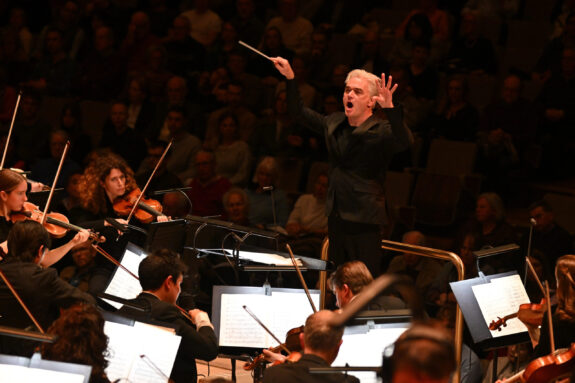
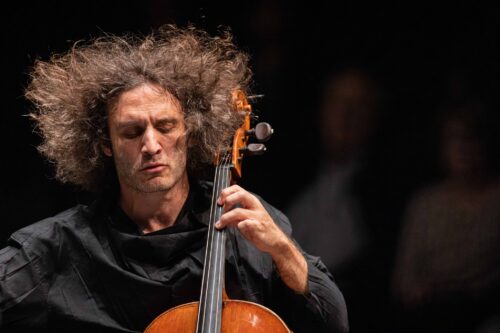
 United Kingdom Laidlow, Bloch, Rachmaninov: Nicolas Altstaedt (cello), London Philharmonic Orchestra / Edward Gardner (conductor). Royal Festival Hall, London, 29.11.2025. (CK)
Robert Laidlow – Exoplanets (world premiere)
Bloch – Schelomo
Rachmaninov – Symphony No.3
I was drawn to this concert by two twentieth century works I had never heard performed live and a world premiere, and also by my increasing admiration for the Edward Gardner/London Philharmonic Orchestra team. My curiosity was amply rewarded.
I will never comprehend the astrophysics behind Robert Laidlow’s Exoplanets, any more than I do the mathematics behind the music of Xenakis. Does it matter? I don’t think so. The music concerns planets outside our solar system – ‘strange, beautiful and wild beyond anything we might have dreamed of ourselves’, in Laidlow’s words: and the immediately likeable aspect of the piece is that, for all the sophisticated interaction between music and advanced technology in Laidlow’s creative process, in performance he relies on the physical properties of musical instruments alone: there is no recourse to synthesisers or other electronic gizmos (once fashionable, now démodé) to impress upon us the otherness of space.
Laidlow’s orchestra mutates into weird and wonderful forms: but it is done without gimmickry. There is an extended quiet preamble for tuned percussion: we have heard gongs and bell plates being lowered into water to bend their sounds before, but here they served a precise purpose, to evoke worlds that move seamlessly from gas to liquid. The passage also served to acclimatise us – much as the opening of a Bruckner symphony does – before the space around us began slowly to fill up with sound, like water into a bowl.
Clouds of small particles flew around the orchestra like solar winds; fusillades of drumming suggested the colliding of larger cosmic forces. Strings engaged in strange, mysterious activity by drawing their bows across the strings so slowly that only a multifarious scratching was audible. Paul Beniston’s trumpet etched a series of widely spaced notes against a repeating harp figure and quietly sustained strings, evoking a passing memory of Ives’s The Unanswered Question. A loud tintinnabulation against glowing brass chords suggested an apotheosis, but Laidlow’s sounds do not obey the laws of goal-directed music; on we went, until those bell plates slowly faded into silence.
Space is a fertile field for composers. Next February Marin Alsop conducts the Philharmonia in Holst and John Williams; Adès’s Polaris and Saariaho’s Orion were played in the Barbican a year ago; those with longer memories may remember BBC Prom performances of George Crumb’s Star-Child and Rued Langgaard’s Music of the Spheres – and, perhaps, David Bedford’s wonderfully named Star Clusters, Nebulae & Places in Devon. I live in hope of a Prom performance of Poul Ruders’s Solar Trilogy. Laidlow’s music stands apart from all of them, with an integrity of its own.
A portion of the large audience may have been there for Sheku Kanneh-Mason: but there can be few who remained disappointed with the cellist who replaced him at short notice (an injury having forced him to cancel). I had not previously heard Nicolas Altstaedt, but I look forward to hearing him again. Hard to find the right words for his performance of Bloch’s Schelomo: I don’t think it was the recent memory of Exoplanets that gave his playing an otherworldly quality, and an inwardness – rather than overt passion – recalling Wordsworth’s thoughts that lie too deep for tears.
Nor was I prepared for the unsettling mixture of opulence and unease in Bloch’s writing for the large and colourful orchestra. There was much telling instrumental detail too: solos for bassoon and a stuttering oboe against quietly sustained violins; an ominous timpani figure behind the solo cello; an assuaging passage for violins against rippling woodwind (a flavour of Janáček here). This brief glint of major-key music was soon swept away by orchestral anguish and protest before the cello returned and the music sank into profound gloom.
I have dealt with this performance briefly and inadequately: but it may well be my concerto (if I may call it so) performance of the year. Altstaedt’s Bach encore seemed weightless, floating in space: it made me eager to hear him play the Cello Suites in toto.
Rachmaninov’s Third Symphony has had a lukewarm press: neither a (belated) critical success like the First, nor a popular one like the Second. Nor does it come off well in comparison with that other three-movement late work, the Symphonic Dances. But even if those who maintain that Rachmaninov’s creative urge finally deserted him are to be believed, he retained his brilliance as an orchestrator: and the old master can still be heard here and there, not least in the supple ardour of the cello theme in the first movement. Edward Gardner and his orchestra gave us a coruscating performance, thrilling in its corporate and individual virtuosity: a performance to set beside their magnificent Symphonic Dances at the 2024 BBC Proms (review here).
My senior Seen and Heard colleague John Rhodes spotted a Swiss connection: Laidlow’s scientific collaborators include the Swiss NCCR PlanetS research centre, Bloch was himself Swiss, and Rachmaninov wrote most of the symphony in his villa on Lake Lucerne. Perhaps that is one reason why this concert programme, so disparate on paper, worked so splendidly.
Chris Kettle
Featured Image: Edward Gardner conducts the London Philharmonic Orchestra © Mark Allan