
 Germany Giordano, Fedora: Soloists, Chorus and Orchestra of the Deutsche Oper Berlin / John Fiore (conductor). Broadcast live (directed by Nele Mϋnchmeyer) from the Deutsche Oper Berlin on medici.tv, 2.12.2025. (JPr)
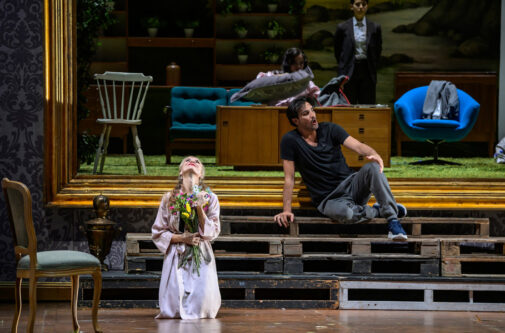
The sets had a slightly distressed look to them, so it was clear they had come from somewhere else. Christof Loy’s staging of Giordano’s Fedora was first seen at the Royal Swedish Opera in 2016 and repeated at Oper Frankfurt in 2022 with Jonathan Tetelman singing, as in Berlin, Count Loris Ipanov. This run of performances at the Deutsche Oper Berlin marks the return – after 95 years – of Fedora to a major stage in the German capital; the opera apparently more popular in Italy than anywhere else.
Commenting on a Met Live in HD broadcast in 2023, that was (typically) long and drawn out, I wrote: ‘There is a reasonable one-act opera to be exhumed from all the melodramatic hokum of Fedora’ and in the title of the review concluded ‘Fedora was worth seeing once but never again’. Thanks to the German efficiency of Christof Loy, Giordano’s three acts were indeed presented as one in a single unifying set (from Herbert Murauer) and, in fact, I actually enjoyed seeing and hearing Fedora again.
It remains ‘melodramatic hokum’ despite a libretto by Arturo Colautti from the play Fedora by Victorien Sardou famous for another of his plays, Tosca. Indeed, Giordano’s music for Fedora is constantly reminding you of something else you will have heard which the composer might have recycled himself, or others certainly did following the opera’s 1898 premiere. Fedora predates Mascagni’s Cavalleria rusticana and Puccini’s Tosca, Madama Butterfly, Gianni Schicchi (listen for the music accompanying the search for a letter in Act I) and Turandot. Admittedly, you may hear some of Puccini’s Manon Lescaut and La bohème, as well as Verdi’s La traviata and Johann Strauss II’s Die Fledermaus, which of course had been premiered before Giordano’s opera.
The rich widow Princess Fedora Romazov is engaged to a debt-ridden count who she is supposedly madly in love with, though she doesn’t yet know he has betrayed her with another woman. At the sound of sleighbells, he is carried in mortally wounded and Count Loris Ipanov is accused of the crime and the police set out after him: Fedora swears on the cross around her neck to revenge her fiancé’s death. She follows Loris to Paris and at a party he declares his love for her: he is in despair because she is returning to Russia while he is still exiled. Loris confesses to the crime and Fedora wants to hear the whole story later the same evening; meanwhile she informs the police about his confession. Later, Loris reveals how he killed the count – not from a political motive as Fedora assumed – but because he had seduced his wife: in fact, the count fired first and it was simply self-defence. Fedora now realises how deeply she loves Loris. Living happily ever after – or so they believe – the lovers are in Switzerland when Fedora learns to her dismay that the letter she wrote about Loris’s guilt has resulted in the death of his brother and subsequently their mother who dies from a stroke brought on by the news. Fedora confesses to Loris, but he refuses to forgive her until it is too late when she dies having drunk some poison concealed in that cross she always wears.
We begin in ‘St Petersburg in Winter’ and get acquainted with the basic mise-en-scène of a narrow reception room with damask wallpaper and doors at either end. It is bare apart from a small table and three chairs, with the mid-stage dominated by a huge empty picture frame. Fedora enters exclaiming ‘So many flowers! So many precious things!’ but there is nothing there. Though there is Christof Loy’s familiar onstage camerawork from the beginning, and we have seen Fedora in white fur hat and coat and projected inside the frame will be live or recorded events happening through the doors and even images of Vida Miknevičiūtė (Fedora) backstage drinking water or having her makeup touched up. Murauer’s costumes are contemporary and Fedora has couture creations for the first two acts (mauve/red and then black) before being in black negligee and white satin dressing gown for most of Act III. Interestingly Loy’s Fedora changes her hair colour from black to red to ash blonde over the course of the opera. The frame allows us to view events simultaneous to those happening at the front of the stage; so during Act II’s ‘Paris in Spring’ we see Fedora’s black-tie partygoers being entertained by Lazinski (the virtuosic Chris Reynolds), a Polish pianist who is the protégé of Olga, Fedora’s cousin and confidante. For Act III’s ‘Bernese Oberland, Switzerland in Summer’ we see inside a simply furnished chalet, notably featuring a couch (for the sleeping Olga) and a bed for Fedora and Loris (now in black tee shirt, slacks and wearing trainers).
The two best scenes of Fedora are at the end of Acts II and III, however performed all the way through (in just under two hours) there was more dramatic coherence to what we saw than if the short acts were interrupted by intervals. Even though, the opera does stop from time to time simply to allow for extended arias such as the sleigh driver Cirillo’s ‘Egli mi disse’ in Act I and the show-stopping, operetta-like singing from the diplomat De Siriex about Russian women (‘La donna russa è femmina due volte’) with Olga responding with her aria comparing Parisian men with Veuve Clicquot champagne (‘Eccone un altro più somigliante ancor’). Then in the third act there is Olga’s bicycling aria (not cut this time) and a duet for her and De Siriex about cycling in the mountains. Finally, there is the opera’s fatal denouement as Fedora wants forgiveness and all Loris wants is revenge on the woman who betrayed him, not knowing at first that it was Fedora. At the end Loy does not have her die in Loris’s arms; but with a La traviata-like resurrection Fedora wanders from the front to the back and then off the stage, with her projected face being the last thing we see.
I was listening online but Fedora sounded as if it was well played by the Orchestra of the Deutsche Oper Berlin, and conductor John Fiore clearly respects Giordano’s score (maybe more than it deserves?) and brought swelling passion to all the pivotal moments of heightened emotion which punctuate the opera. Julia Muzychenko was a high-spirited, flirtatious Olga whose champagne aria – that Johann Strauss II would have been proud of – suitably sparkled and fizzed. I suspect there have been more charismatic portrayals of De Siriex than Navasard Hakobyan’s who has a supple, if rather stolid, baritone voice. Amongst a reliable ensemble cast and enthusiastic chorus, there was one standout performance in the more minor roles: Artur Garbas revealed a baritone voice of significant potential as Cirillo, even if he seemed to make the uppermost of his moment in the spotlight.
Fedora demands two full-throated singers with palpable chemistry if it is to succeed and it got that in Berlin. Jonathan Tetelman’s Loris always seemed haunted by all that had befallen him until he found what he thought was true love with Fedora. Tetelman’s tenor has thrilling, if somewhat insistent, power and clarion tone and Loris’s famous – and rather brief – declaration of love (‘Amor ti vieta’) was impassioned, yet lyrical and Italianate, as all his singing was when it mattered most. Vida Miknevičiūtė is clearly a challenger to Asmik Grigorian as the leading singer-actor of this generation. Her Fedora was genuinely heartbroken by the death of the count and she sought retribution with a vengeance. The role is a voice-shredding one, but I now realised it actually is the lesser of the two leading roles. Nevertheless, Miknevičiūtė sang with complete abandon in bringing Fedora alive and was at her most dramatically and vocally convincing in her two intense duets with Loris: when she ardently asks him to spend the night with her at the close of the second act and in the heart-rending tragedy of her self-inflicted death at the end of the opera.
Jim Pritchard
Featured Image: Deutsche Oper Berlin’s Fedora Act II © Bettina Stöss
Production:
Director – Christof Loy
Scenic rehearsal – Anna Tomson
Stage design, Costumes – Herbert Murauer
Light design – Olaf Winter
Video – Velourfilm AB
Chorus master – Thomas Richter
Dramaturgy – Konstantin Parnian
Cast included:
Princess Fedora Romazov – Vida Miknevičiūtė
Countess Olga Sukarev – Julia Muzychenko
Count Loris Ipanov – Jonathan Tetelman
De Siriex – Navasard Hakobyan
Dimitri – Arianna Manganello
Desiré – Matthew Peña
Baron Rouvel – Michael Dimovski
Cirillo – Artur Garbas
Borov – Volodymyr Morozov
Gretch – Tobias Kehrer
Lorek – Michael Bachtadze
Boleslao Lazinski (pianist) – Chris Reynolds
A small Savoyard – Soloist of the Children’s Chorus of the Deutsche Oper Berlin