
 Hungary Haydn: Nikola Hillebrand (soprano), Mauro Peter (tenor), Andreas Bauer Kanabas (bass), Arnold Schoenberg Choir (chorus master: Erwin Ortner), Danish Chamber Orchestra / Ádám Fischer (conductor). Müpa Budapest, 1.1.2026. (LJ)
Haydn – Die Schöpfung (1798)
Haydn’s grand oratorio, Die Schöpfung (The Creation), was inspired by Handel’s Messiah and Israel in Egypt, which he heard performed in 1791 at Westminster Abbey when he was fifty-nine years old. It took a while, however, for Haydn to develop a piece comparable to Handel’s much-loved works. Shortly before Haydn left England in the summer of 1795, violinist Johann Peter Salomon handed him an English libretto on the subject of the Creation. This was the very libretto that Handel had previously turned down. By contrast, Haydn saw potential in this text which derived inspiration from the Book of Genesis, John Milton’s epic poem Paradise Lost (especially the animal descriptions in what became Part Two of the oratorio, and the hymn and love duet in Part Three), as well as Psalms 19 and 104 for the choruses of praise.
When Haydn returned to Vienna, therefore, he asked Baron Gottfried van Swieten, the Imperial Court Librarian, for his input on the libretto. Whilst Swieten may have had more confidence than ability concerning his English-German translation skills, he made one impactful suggestion that the word ‘light’ should only appear at one moment of the piece. During the performance of this work for Budapest’s New Year’s Concert at Müpa, the lines ‘Let there be Light / And there was Light’ (sung in German) radiated. The Danish Chamber Orchestra achieved a moment of sheer clarity through Haydn’s spellbinding pause after the first mention of ‘light’, followed by a colossal C major chord. The Arnold Schoenberg Choir sang very well, obtaining a good balance between the orchestra and soloists. And, as the piece progressed, they forged greater unity with the other musicians, truly embodying their role as the ‘angelic host’.
With the libretto finished by the end of 1796, Haydn could set to work on the composition. He structured it in three parts for sopranos, tenor, and bass soloists, chorus, and orchestra. In Parts One and Two, the archangels Raphael (bass), Uriel (tenor), and Gabriel (soprano) were performed by Andreas Bauer Kanabas, Mauro Peter, and Nikola Hillebrand respectively. In Part Three, Bauer Kanabas and Hillebrand represented Adam and Eve.
Part One opens with the so-called ‘Representation of Chaos’, Haydn’s interpretation of what Milton called ‘The Vast Immeasurable Abyss’ (Paradise Lost, VII: 211), and what is referred to in the Bible as ‘The Earth without Form, and Void’ (Genesis, 1:2). It is a movement that persistently resists completion, conveying a sense of something indefinite and incomplete. This is, after all, only the first day of the Creation: there is still work to be done. Haydn, after playing this movement at the piano for the Swedish Chargé-d’Affaires, explained this compositional decision as follows: ‘you have certainly noticed how I avoided the resolutions that you would most readily expect. The reason is, that there is no form in anything in the universe yet.’ Throughout Part One, the Danish Chamber Orchestra played excellently, evoking the tension Haydn alluded to when he mentioned ‘avoiding resolutions’, but not sounding heavy-handed or melodramatic. Indeed, their timing was precise, and Ádám Fischer’s infectious energy was especially palpable amongst the woodwind section which has a significant role in this piece.
Part Two is a pastoral invocation of the animal kingdom evoked through onomatopoeic gestures that audiences now find charming but were once deemed too naïve. During the Romantic era, Die Schöpfung was derided for this descriptive tone-painting. The French Romantic composer, Hector Berlioz, never one to put things lightly in words nor in music, describes his ‘profound antipathy for this work’ as stemming from ‘its lowing oxen, its buzzing insects, its light in C, which dazzles like a Carcel lamp; and then its Adam, Uriel, Gabriel, and the flute solos and all the amiabilities really shrivel me up – they make me want to murder someone.’ In the same letter from 8 February 1859, he continues: ‘the English love a pudding surrounded with a layer of suet; I detest it. Suet is exactly what surrounds the musical pudding of Papa Haydn. Naïveté is all very fine, but too much of it we don’t need!’
Whilst humorous, many contemporaries of Berlioz shared his feelings of distaste for this piece. But they were missing the very point. For Haydn, the Creation is precisely ‘light in C’. This spiritual positivity that radiated within Enlightenment thinking must have been hard to swallow for someone like Berlioz who inhabited an altogether heavier, minor-key, Romantic world. If appreciated and performed on its own terms, Die Schöpfung can offer audiences a unique opportunity to engage in the ideals that encompassed Enlightenment society. Here, the revelations of science complemented the prophecies of religion. As such, new forms of creativity were facilitated by scientific advancements but conceptualised as a form of devotion. With the right direction, an energetic orchestra, and bright voices, Die Schöpfung can leave audiences openly committing to values of truth, nature, and reason that see progress in science and morality as positive bastions of a new and enlightened worldview.
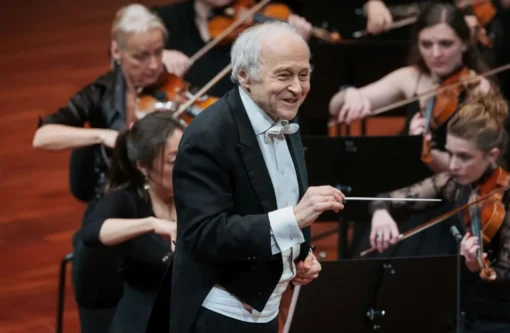
In this performance, the ebullience of Haydn’s take on the Enlightenment spirit was delivered superbly by Fischer who certainly nullified any potential Berlioz-like sentiments amongst the audience. Fischer conducted the entire piece from memory, mouthing nearly all of the words as he did so. From my vantage point, which was to the side of the orchestra, I could see this intimate knowledge of the score and his enthusiasm for the piece. His aim was clear: to bring out the spiritual levity that runs through the heart of the score. Indeed, this worked particularly well with flutes and timpani. The offstage flute solo during Part Two, which depicts a nightingale in duet with Gabriel, was a particularly pleasurable moment for the audience as both performers were lyrical and light. The bassoons as cooing doves also raised a smile.
Part Three of Haydn’s oratorio depicts the first morning in Eden, with Adam and Eve’s praise of all creation and their love. The two climactic choruses in this section are examples of the sublime in music, where Haydn’s symphonic and contrapuntal skills recall those of Handel. More than this, Haydn’s sublime entails a sense of nature as untamed and inspiring philosophical transcendence. The orchestra took their finger off the pulse ever so slightly during this section, losing their grasp of the audience and therefore not entirely translating the more philosophical qualities of this section. But this comment should not detract entirely from their otherwise excellent performance, especially during Parts One and Two when they brought renewed energy to the piece via Fischer’s characteristic surprises with dynamics and tempo.
Tenor Mauro Peter was fresh and full of character. His voice has a youthfulness and slightly earthy timbre that suited the part and counterbalanced the fuller, more rounded voices of both soprano and bass. Nikola Hillebrand’s voice was replete with colour and dexterity, making her a superb fit for Haydn. She sang with clarity and charming (but not excessive) coloratura. Hillebrand’s voice was fairly well controlled in the lower notes but took full effect in the higher notes which seemed effortless – a quality that Haydn seemed to strive for within the music itself. Andreas Bauer Kanabas’s voice had rich, strong, and silky qualities. His diction was clearer than that of his fellow soloists (all of whom are fluent in German), but one could not help thinking that he is more suited to the weightier and lyrically grounded parts of Wagner’s operas. Indeed, Bauer Kanabas is much better known for his roles as King Marke, King Heinrich, Landgraf Hermann, Veit Pogner, and Daland from across Wagner’s oeuvre. This said, his expressivity and clarity made him a very good Raphael and Adam, if not entirely suited to singing Haydn’s wittier repertoire.
As for the Fall, this is referred to only briefly before the final chorus. Die Schöpfung is optimistic; it is not sanctimonious or moralistic. Rather, this is music to enjoy with its resounding Alleluias. It is designed to raise a smile and inspire good feeling, and this is what the Danish Chamber Orchestra, Arnold Schoenberg Choir, and soloists achieved to a high degree. On the first day of 2026, Haydn’s music felt as fresh and energising as I imagine he intended it always to be.
Lucy Jeffery