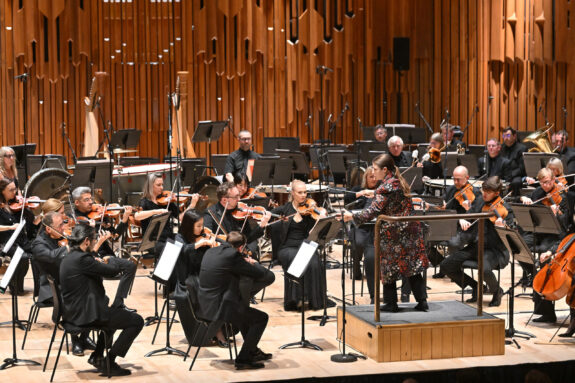
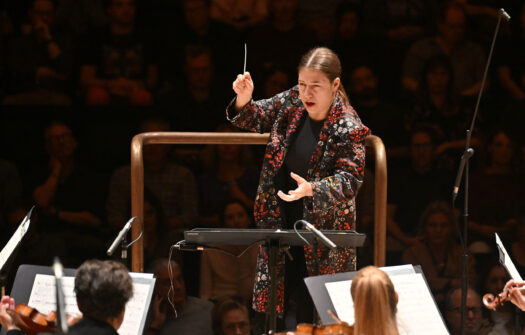
 United Kingdom Thorvaldsdottir, Ligeti, John Luther Adams: BBC Symphony Orchestra / Dalia Stasevska (conductor). Barbican Hall, London, 8.10.2025. (CC)
Thovaldsdottir – ANCORA (2022)
Ligeti – Atmosphères (1961)
John Luther Adams – Become Ocean (2013)
An extraordinary concert, but perhaps not in the way one might immediately think: to have three works that rely mainly on texture is certainly out of the (i.e. ‘extra’) ordinary. To connect them via an interval-less concert, though, resulted in a surfeit of shifting textures, and we cannot live by texture alone. Too much of a good thing, one might possibly say. But in a sense, also a pity as by the time we got to the John Luther Adams, the ear was already a little tired. There are melodic scraps in the Thorvaldsdottir it is true but scraps they remain. And it was the Thorvaldsdottir that emerged as the piece that lingered on the most in the memory.
In August (and therefore at the BBC Proms), we heard the UK premiere of Thorvaldsdottir’s Before We Fall (review here); a useful bridging post.to ARCHORA, as the Proms concert was conducted by Eva Ollikainen – who has herself also recoded ARCHORA with the Iceland Symphony Orchestra for the Sono Luminus label.
ARCHORA is a meditation on planes of existence: ‘a primordial energy, and the idea of an omnipresent parallel realm – a world both familiar and strange, static and transforming, nowhere and everywhere at the same time’. There are therefore two plateaux, but there is also another dichotomy: between the primordial matter and its ‘afterglow’ and how these two interact. The composer speaks of ‘dark-matter halos’ emerging from ‘primordial density field’.
If this sounds somewhat akin to Birtwistle and his Earth Dances, the parallel at least initially has legs given Thovaldsdottir’s uncompromising beginning and the prevailing chthonic darkness. But she has the ‘glow’ that Birtwistle consciously eschews. Thorvaldsdottir is not averse to the odd consonance as part of her vocabulary, too; but most of all it is the remarkable command of harmony and of the orchestra that impresses
ARCHORA was a nomination for the 2023 The Ivors, incidentally, in the Best Orchestral Composition category (the actual winner of that category was Brett Dean, for his Cello Concerto). Dalia Stasevska seemed to understand Thorvaldsdottir’s conception perfectly.
There was a stage rearrangement after the Thorvaldsdottir, but the Ligeti and Adams were performed without break. Atmosphères is one of Ligeti’s more famous works thanks to its use in the film 2001: A Space Odyssey, but it remains typical of this composer in its uncompromising outlook and in its use of micropolyphony. There are timbral contrasts here, too: the gossamer BBC Symphony Orchestra strings against the brass, a quiet wall of sound. Ligeti’s imagination is, like Thovaldsdottir’s, vast: muted trumpet against col legno violins, piccolo against double bass; unforgettable sounds. This was the shortest piece, less than ten minutes, but it holds such transfixing power.
John Luther Adams (b.1953) has been much influenced by the American composer Lou Harrison; in fact, my introduction to his composer was via a New World Records release of Adams’s For Lou Harrison (2003/4). The wide-open spaces of Adams’s adopted Alaska are audible not only there, but (applied to watery space) in Become Ocean. The difference is that For Lou Harrison is an infinitely slow processional, while Becoming Ocean proceeds in waves. Another parallel, though, is the use of percussion in Become Ocean which, as in For Lou Harrison, can invoke Harrison’s beloved gamelan.
Adams says he composed Become Ocean as a 40-minute ‘meditation on the vast, deep and mysterious tides of existence’. He wants it to sit between beauty and terror, so there is a dichotomy, as in the Thorvaldsdottir. The orchestra is divided into three, to create different ’waves’. The whole is in one tempo, a vast visa that holds these huge waves within it. As Adams says,
‘Life on this earth first emerged from the sea. Today, as the polar ice melts and sea level rises, we humans face the prospect that we may once again, quite literally, become ocean.’
The title comes from a mesostic verse written by John Cage in honour of Lou Harrison’s birthday (‘mesostic’ refers to the interaction between horizonal and vertical in poetry, here achieved via capitals, which, discounting the opening letter of the poem, suggests ‘SOON,’ reflecting the urgency of Adams’s message to mankind and its relationship to the environment):
LiStening to it
we becOme
oceaN
Glacial slippages from brass, chaotic wave forms, percussion thunder: all are part of Adams’s vocabulary here that are used to portray at once the gentleness of the ocean and its majesty. To portray the latter, Adams creates a remarkable inner glow achieved both via harmony and orchestration. The strings, woodwind and double bass portray much beauty, while the percussion (harps, five-octave marimba and vibraphone) become something like the music’s engine in their more mobile demeanour. At one remarkable moment, harps imitate bells, superbly; at another, double bass and percussion threaten to envelop all else (also included in the kitchen department are three bass drums, tam-tam, and suspended cymbal).
Become Ocean won the 2014 Pulitzer Prize; it is a truly remarkable piece. It is part of a ‘Become’ trilogy, along with Become River (2014) and Become Desert (2018), all of which have been recorded by Canteloupe with the Seattle Symphony Orchestra under Ludovic Morlot.
It is difficult to understate the BBC SO’s achievement in this performance of Become Ocean, and re-listening to the live relay via BBC Sounds. I wonder if it would have been even more impressive in different company? Whatever the case, Become Ocean is a cautionary masterpiece: music that stands on the shoulders of giants, proudly, and yet carries a vital message. Do hear it. And a reminder: it is testament to the power of Anna Thorvaldsdottir’s music that it was her voice which emerged the loudest and clearest.
Colin Clarke
Featured Image: Dalia Stasevska conducting the BBC Symphony Orchestra © BBC/Mark Allan