
 United States Bernstein, Tchaikovsky, Stravinsky: Yuja Wang (piano/director), NYO-USA All-Stars / Daniel Harding (conductor). Carnegie Hall, New York, 7.10.2025. (RP)
Bernstein – Selections from Symphonic Dances from West Side Story
Tchaikovsky – Piano Concerto No.1 in B-flat minor, Op.23
Stravinsky – The Firebird Suite (1919 version)
Carnegie Hall celebrated the future with its season opener. Instead of the usual gala showcasing one of the world’s top orchestras, it presented the NYO-USA All-Stars conducted by Daniel Harding. The players are alumni of the National Youth Orchestra of the United States of America, the free training program for talented young musicians from across the country sponsored by Carnegie Hall’s Weill Music Institute. It was a concert of sure-fire, popular favorites, but what’s wrong with that?
The concert opened with three selections from the Symphonic Dances from West Side Story, which were first performed at Carnegie Hall by the New York Philharmonic on 13 February 1961. The first was ‘Somewhere’, in which Harding and the young players summoned the hope tinged with the bittersweet that Bernstein captured in its pure, haunting melody. The tune was heard first in the solo strings and then reprised by the solo horn with equal expressiveness and eloquence.
‘Somewhere’ segued without pause into the lively ‘Scherzo’, following the same progression as in the suite. The music is fun and playful, but it finishes with a poignant reprise of the two notes that end ‘Somewhere’. Harding didn’t go into autopilot for ‘Mambo’, but he could have. No one does energy and excitement quite like the NYO-USA. The double basses spun their instruments, the trumpet solos wowed and the brass and percussion emitted sparks as they played Bernstein’s fast-paced, exhilarating rhythms.
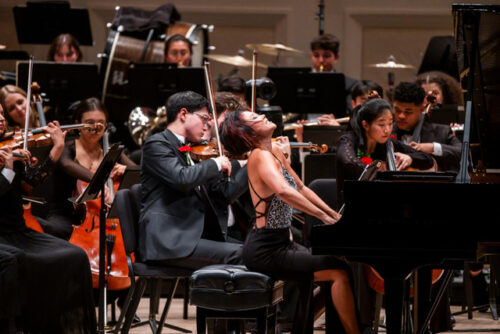
When it comes to wow factor, few solo artists are Yuja Wang’s equal with her blazing, virtuosic playing and flair for fashion. To up the ante, she not only appeared as the soloist in Tchaikovsky’s Piano Concerto No.1, she also directed it. There was little conducting involved, just some crucial downbeats and the occasional sinuous arm movements. They were enough for Wang to express her intentions to the orchestra and draw deeply expressive playing from them.
Multi-tasking in no way diminished Wang’s brilliance at the piano. Indeed, it seemed to inspire her to new heights of daring. She played the unforgettable opening chords with resounding majesty as well as the shattering climax that came later. Even more amazing were the bell-like sounds that coursed through the dazzling passage in the final section of the first movement. The emotion generated by the delicacy and simplicity of her playing in the Andantino was spellbinding. In the Allegro con fuoco, Wang played with unsurpassable passion and bravura, leaving the audience yearning for an encore, but there was none.
The orchestra took the absence of a conductor in their collective stride. Whatever rehearsal time Wang had with them was enough for her to convey her musical intentions and for the players to internalize them. The result was truly an organic musical experience in which soloist and players performed as a single unit. Their playing was precise at any tempo, and when Wang leaned into the fast and furious, their expressiveness was equal to hers.
Particularly impressive were the brass punching out the opening chords, the lush, vibrant sound of the strings and the grumblings from the contrabasses that underpinned the finesse of Wang’s playing at its most delicate. The burnished sound of cellos and horns and of the solo flute passages added to the dreamlike quality of the Andantino. In the finale, the orchestra equaled Wang’s performance with the passion and sweep of their playing.
Stravinsky created three concert versions of music from the score for The Firebird. Harding returned to lead the NYO-USA All-Stars in the 1919 version, the second of the three, which has proven to be the most popular. His approach was restrained, as if he were content to permit the orchestra to shape the performance. Harding only had to give the signal, and the opulent colors of Stravinsky’s score bloomed and its melodies soared.
Those colors were wonderful. The low strings and trombones conjured the mystery with which the suite opens, while the violins responded with gossamer playing to depict the more subtle beauties of the magical realm. The frenzied dances caught fire, and the solo bassoon cast a spell of beauty and serenity in a gentle lullaby. The solo horn announced the arrival of the sunlight with glowing, glorious tones. After that came the brilliant ending, charged with thrills, just as you would expect from the NYO-USA, let alone its All-Stars.
During the following ovation, Harding walked to the rear of the orchestra with the bouquet of bright pink flowers that he had been given. The recipient was Wang, who had joined the orchestra as pianist in the Stravinsky.
Rick Perdian
Featured Image: Daniel Harding conducting the NYO-USA All-Stars at Carnegie Hall © Chris Lee
I was there on Tuesday and it was a glorious experience. I attended the reception, which was attended by hundreds of patrons. The anticipation of Yuja Wang was in the air and the excitement that was in store for us was surpassed by the orchestra, the conductor and of course by Yuja Wang. Being able to view her hands as she played added a new dimension to my listening experience. Tchaikovsky’s First may be familiar to classical lovers but it seemed new and thrilling to hear her play it. Her signature bow and dazzling gown just adds to the majesty of her skills. It was an evening I will not forget…it was my gift to myself for a birthday on October 7th. The date is etched in my mind for the arrival of any hostages and the existence of peace in the region.
I watch the performance on Stage+. That gave me the advantage at looking at Yuja from the orchestra’s point of view. Being a former orchestra member myself, a violinist, I found Yuja’s way of conducting extremely effective. She uses her facial expressions and body language to clearly indicate the coloration she wanted from the music. There are many far more experienced conductors you sometimes see just wave their arms around to the beat. Not very helpful for the musicians! While rhythm is certainly important, at the point of performance the coloration is more important. The orchestra should be fully aware of the intended rhythm from the other orchestra members as well as the conductor.