
 United States R. Strauss, Arabella: Soloists, Chorus and Orchestra of the Metropolitan Opera / Nicholas Carter (conductor). Metropolitan Opera, New York, 10.11.2025. (ES-S)
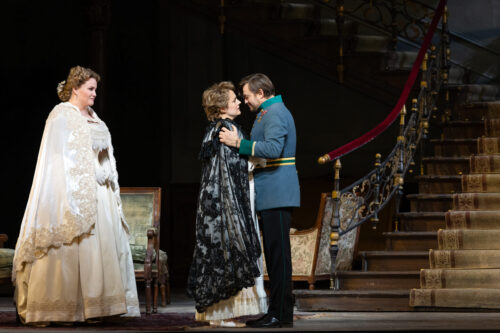
When Otto Schenk’s Arabella first graced the Metropolitan Opera stage in 1983, its world of chandeliers, carriages and wallpapered salons seemed to offer a wistful refuge from modernity. Four decades later, Günther Schneider-Siemssen’s opulently painted interiors, Milena Canonero’s sumptuous Biedermeier costumes and Gil Wechsler’s warm lighting still preserve their soft amber glow, suspended between charm and obsolescence. The staging, created in conscious resistance to the rise of Regietheater, retains a double melancholy. One is rooted in Richard Strauss and Hugo von Hofmannsthal’s portrait of a mannered society whose tensions are either repressed or gently ironized. The other evokes an operatic world untouched by the relentless search for directorial reinterpretation.
In Nicholas Carter’s hands, Strauss’s score was both sumptuous and transparent. The opening waltz rhythms of Act I had an easy Viennese lilt, never overly sweet, and the intricate web of counterpoint came through cleanly within the orchestral texture. Only the orchestral prelude to Act III drew unwanted attention, with a few lapses in coordination in the pit. Overall, this was an engaged and sensitive reading, Carter allowing the music’s lyricism to breathe while remaining careful not to overwhelm his singers.
The first performance of Arabella this season was distinguished by a felicitous series of debuts. Chief among them was Rachel Willis-Sørensen’s first stage performance of the title role, portrayed with warmth and dignity rather than overt glamour. She began somewhat tentatively, mirroring Arabella’s own initial uncertainty, but as the opera unfolded her singing acquired a surer sense of purpose, tracing the character’s passage from doubt to self-possession calm. Willis-Sørensen’s soprano, even and unforced across its range, projected easily through the house, and her phrasing in ‘Mein Elemer!’ revealed genuine introspection. She sang not as the flirtatious ingénue of tradition but as a young woman quietly testing the limits of her resolve.
Making her company debut as Zdenka, Louise Alder was arguably the performance’s freshest presence. Disguised as ‘Zdenko’, she sustained a boyish timbre that bloomed into radiant lyricism once her secret was revealed. Her voice, bright yet pliant, carried easily and blended beautifully with Willis-Sørensen’s in their Act I duet, where Strauss’s writing for paired sopranos found rare balance and intimacy. Alder shaped her lines with intelligence and immediacy, projecting both the youthful impulsiveness and the underlying sincerity of a character caught between disguise and desire.
Also appearing for the first time on the Metropolitan stage, the up-and-coming French soprano Julie Roset shone as the Fiakermilli, with the crystalline precision and unaffected charm of an experienced Baroque-opera singer. In a role often treated as decorative, she projected personality and ease, her gleaming high notes and easy vivacity enlivening ‘Die Wiener Herrn verstehen sich’. The ball scene found her teasing Arabella’s three suitors – Counts Elemer (tenor Evan LeRoy Johnson), Dominik (baritone Ricardo José Rivera) and Lamoral (bass-baritone Ben Brady). All three singers, making lively and confident debuts of their own, matched her spirit and added a youthful swagger to the scene’s effervescent textures.
Tomasz Konieczny’s commanding assurance might have seemed ill-suited to Mandryka, a provincial outsider insinuating himself into the glittering world of Viennese ballrooms. Occasionally reminiscent of his lauded Wotan, his stentorian bass-baritone – dark in timbre, edged with metallic inflections – together with an unforced authority on the stage lent the character unexpected complexity. What could have been merely bravado became, at moments, disarmingly vulnerable, especially in his early exchanges with Arabella when the tenderness behind his directness surfaced in the simple, self-effacing admission, ‘Ich habe eine Frau gehabt’. Konieczny traced Mandryka’s shifting moods – from openness to jealousy, from self-doubt to fury – with an instinctive feel for Strauss’s mercurial phrasing. The role’s wide emotional compass was most evident in the Act III reconciliation duet with Arabella, ‘Und du wirst mein Gebet erhören’, where his expansive phrasing and suddenly softened tone revealed genuine warmth. Framed by Carter’s orchestral halo, the moment drew together Mandryka’s unpredictability and vulnerability with touching clarity.
Tenor Pavol Breslik (Matteo) brought vocal brightness and nervous energy to the role of the lovesick officer caught between Arabella and Zdenka. His portrayal captured the character’s mixture of ardor and confusion – the impulsiveness of a man led more by idealized desire than by understanding. Breslik’s lyric tenor carried clearly above the score’s complex orchestral tapestry, and his diction remained incisive even in moments of agitation. The voice occasionally tightened under pressure but musicality never faltered, and the Act III realization scene had a sincerity that offset the contrivances of Hofmannsthal’s plot.
As Count and Countess Waldner, Brindley Sherratt and Karen Cargill added depth and polish to the opera’s comic parentage. Sherratt’s resonant bass and immaculate diction made every line of the gambling, debt-ridden Count land with clarity and wry timing. Cargill, singing with rich tone and supple phrasing, conveyed both maternal concern and coquetry, suggesting a woman who has learned to navigate life’s follies with ironic detachment. Their scenes together had a weary elegance that grounded the opera’s youthful intrigues in something recognizably human.
This revival of Arabella – which might seem dusty for all its mirrors and chandeliers – spoke less of vanished manners than of an enduring longing for sincerity, a yearning that, like the fragile negotiation between desire and restraint, persists in every age.
Edward Sava-Segal
Featured Image: Evan LeRoy Johnson (Count Elemer), Julie Roset (Fiakermilli), Ben Brady (Count Lamoral) and Ricardo José Rivera (Count Dominik) © Marty Sohl/Met Opera
Production:
Production – Otto Schenk
Sets – Günther Schneider-Siemssen
Costumes – Milena Canonero
Lighting – Gil Wechsler
Revival Stage director – Dylan Evans
Chorus director – Tilman Michael
Cast:
Arabella – Rachel Willis-Sørensen
Zdenka – Louise Alder
Mandryka – Tomasz Konieczny
Matteo – Pavol Breslik
Count Waldner – Brindley Sherratt
Countess Adelaide – Karen Cargill
Fiakermilli – Julie Roset
Count Elemer – Evan LeRoy Johnson
Count Dominik – Ricardo José Rivera
Count Lamoral – Ben Brady
Fortune Teller – Eve Gigliotti
This is one of the most beautiful music reviews l have ever read!!!