
 Sweden Weber, Der Freischütz: Soloists, Chorus and Orchestra of Gothenburg Opera / Francesco Angelico (conductor). Gothhenburg Opera main stage, 14.11.2025. (NS)
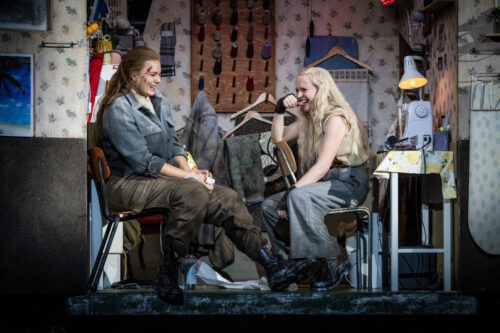
The Gothenburg Opera last staged Der Freischütz in 1928 (with Kirsten Flagstad as Agathe) so a new chance to experience this great work on the stage was not to be missed. Director Philipp Rosendahl sets his production in the near past in an isolated community in Sweden’s frozen far North with an aesthetic inspired by ‘Nordic noir’. Daniel Roskamp’s thoughtfully designed rotating set is very effective, marrying the oppressive closeness of a self-contained community with the sense of open frozen spaces outside. Sascha Zauner’s lighting was atmospheric and breathtakingly beautiful when aurora pulsed in the night sky, and thrilling during the beginning of the Wolf’s Glen scene.
Unfortunately for a concept inspired by television, the ever-present video projections were of much more variable quality. The film projected during the overture was more distracting than atmospheric, and I was secretly pleased when the projection during the prelude to Act III failed, leaving the music to speak for itself. The production employed two camera operators to film live on the stage, often projecting on the backdrop. This was dramatic and effective when Max was alone outside and the video showed Kuno telling the story of the shooting test to a throng in the village pub and when it showed Kaspar spying on Agathe, but more often the video projections were pointless and distracting when other characters were singing and acting.
Stefan Berkieta excelled in the small role of Kilian, giving a colourful sense of his character. His rich bass was perfect for the sly and mocking tone when Kilian teases Max for being a worse shot than a farmer. Erik Rosenius as the Stranger (the Hermit in the original libretto) made a noble impression with his beautifully projected bass even though he started singing his part standing in the midst of the audience in the stalls. But because all mention of the Hermit, and his gift to Agathe of protective white roses, has been removed from the dialogue in this production his sudden appearance makes no sense in the plot, effectively becoming a rather random deus ex machina to stop Max from being banished by a furious Ottokar.
Mats Almgren’s Kuno was believable as an anxious father and community leader and had a nicely judged relationship with Ottokar in the third act. Ottokar’s costume and tendency to wave a handgun about made him look more like a gang leader than a prince, but Orhan Yildiz’s noble baritone suited the role well. The four bridesmaids were confidently performed by four students from the Gothenburg University Academy of Music and Drama.
Rosendahl writes in the programme that he wants to give the characters more psychological depth than they have in the libretto, which is clearly demonstrated in his conception of Ännchen’s role. She is not merely a happy soubrette but seems to have dark secrets including some kind of relationship with Kaspar, trading moonshine with him for drugs. She possibly provides drugs to Agathe as well; if so this might explain the more bizarre elements of the staging of Act III as some kind of hallucination. Kerstin Avemo carries all this baggage lightly, her mature but agile soprano perfectly giving the impression of a worldly-wise but loving best friend to Agathe.
Adam Frandsen’s Max also has some strange stage business to deal with, but he is believable in his torment about his run of bad luck and fear of losing Agathe. His tenor combined expressive colour with an open and attractive high register. His complex relationship with Kaspar is well-judged, starting ‘Hier im ird’schen Jammerthal’ with a rather prissy refusal to drink but ending up drunk and receptive to Kaspar’s wiles. His performance was particularly moving in his trio with Agathe and Ännchen ‘Wie? Wo? Entsetzen!’.
Kristian Lindroos gave a stand-out performance as Kaspar, clearly relishing the many sides of this manipulative character. In his case the staging and video projections served to heighten the sense of mystery around Kaspar, and the choice to have Kaspar also speak Samiel’s lines (as a voice inside his head) worked brilliantly together with the spooky silent dancer (Alessia Ruffolo) who represents a visual manifestation of the Black Hunter as a black deer. Lindroos’s baritone was impressively flexible, from a rollicking drinking song in ‘Hier im ird’schen Jammerthal’ to jealousy and darkness in a chilling ‘Schweig’! damit dich niemand warnt’ and a spine-tingling Wolf’s Glen scene.
The second stand-out performance was Matilda Sterby, who was breathtaking as Agathe. Her soprano was beautiful through her whole range and combining dramatic power with lyrical expression. Her aria ‘Leise, leise’ as she waits for Max to visit her started with quiet beauty and blossomed to an expressive climax, and her Act III aria ‘Und ob die Wolke sie verhülle’ had a real sense of faith and hope despite a bizarre staging where she, Ännchen, Max and Kaspar all stagger round the stage wearing bloody wedding dresses. With Sterby’s singing the strength and beauty of Agathe’s character always shone through.
Francesco Angelico and the Gothenburg Opera Orchestra showed a sensitive understanding of the score and had wonderful range of expression, from a gentle beginning to the overture to the vividness of the music to the Wolf’s Glen. The Gothenburg Opera Chorus were also superb, singing with great verve when in celebrations such as the opening scene and the Hunters’ Chorus, but also with beautiful prayerful expression in ‘O diese Sonne’. My reservations about this production come down to the director seeming to be reluctant to let Weber’s wonderful music speak for itself; but for me the musical magic of the ensemble and orchestra convincingly outweighed the oddities of the staging.
Niklas Smith
Playing until 4 December 2025. For tickets and more information click here. Swedish Radio P2 broadcast the premiere live on 8 November, available for streaming from the Swedish Radio website (here) or SR Play app until 8 December. For this broadcast Matilda Sterby was indisposed so the role of Agathe was sung by Susanne Serfling.
Featured Image: Max (l, Adam Frandsen) and Kaspar (Kristian Lindroos) in the Wolf’s Glen © Håkan Larsson
Production:
Director – Philipp Rosendahl
Choreographer – Alessia Ruffolo
Set design – Daniel Roskamp
Costume design – Philipp Basener
Lighting design – Sascha Zauner
Video design – Florian Schaumberger
Cast:
Ottokar – Orhan Yildiz
Kuno – Mats Almgren
Agathe – Matilda Sterby
Ännchen – Kerstin Avemo
Kaspar – Kristian Lindroos
Max – Adam Frandsen
The Stranger – Erik Rosenius
Kilian – Stefan Berkieta
Four bridesmaids – Eden Benguigui, Cornelia Granquist, Linnéa Hesselstrand, Marika Larsson
Deersire – Alessia Ruffolo