
 Switzerland Verdi, La forza del destino: Soloists, Zurich Opera Children’s Choir, Zurich Opera Choir and SoprAlti, Extras Association of Zurich Opera, Zurich Opera Orchestra / Gianandrea Noseda (conductor). Zurich Opera, 12.11.2025. (MF)
Grazie Gianandrea! Zurich’s General Music Director Gianandrea Noseda and the Zurich Opera Orchestra, together with an outstanding cast, treat the audience to a musically magnificent moment, a Sternstunde as the locals would put it. Noseda lives and breathes Verdi’s score, the orchestra follows him with laser precision, with depth and emphasis, forceful yet light, with playful vigour. But they are never rushed. Conductor and orchestra are in perfect balance with the on-stage cast who make the most of the instrumental foundation supporting them from the pit.
The three main characters form a phenomenal trio, soprano Anna Netrebko as an expressive and touching Donna Leonora, George Petean as her lover Don Carlo di Vargas and Yusif Eyvazov as their opponent Don Alvaro. Their emotional triangle maintains the tension all through the performance. The clergymen couple, with Michele Pertusi as Padre Guardiano and Roberto Frontali as Fra Melitone, bring some levity into an otherwise all too sombre plot. Annalisa Stroppa gives her debut as an energetic war-crazed Preziosilla, her famous ‘Rataplan’ in daunting rhythmic unity with the fabulous choir prepared by Klaas-Jan de Groot.
A particular mention also for the four members of Zurich Opera’s inhouse talent academy, the International Opera Studio (IOS): Natália Tuznik as Curra, Lobel Barun as the Mayor, Tomislav Jucik as Mastro Trabuco and Max Bell as the Surgeon.
Argentinian director Valentina Carrasco makes the most of this libretto which, although specifically written at Verdi’s instruction, would hardly have made it through the ages without the composer’s grand music. At the height of his artistic power, Verdi felt that the three Aristotelian unities of theatre were for mere mortals to comply with. The multi-threaded narrative of La forza spans close to a decade and extends over several countries.
Leonora and Don Alvaro, whose relation is not approved of by Leonora’s father the Marchese di Calatrava, plan to elope but have to flee separately when Alvaro accidentally kills the Marchese (according to the stage direction the gun simply goes off by itself). Don Carlo, Leonora’s brother, chases Alvaro to avenge his father’s death. Throughout the evening, we find ourselves in various places in Spain and Italy. Alvaro and Don Carlo repeatedly face each other until two of the three protagonists die. In the course of the grand finale, Alvaro kills first Carlo and then Leonora. Fate hits with a vengeance – la forza del destino.
War, flight, hatred and revenge are this piece’s main topics. Director Carrasco’s challenge was to bring them to Zurich, a place in a country whose collective identity was not shaped by war and devastation, but rather by an absence thereof and the conviction the Swiss were spared thanks to political acumen.
Carrasco conjures up a what if: she sets the plot in a war-torn Switzerland. The opening is dominated by video sequences (Massimiliano Volpini) of military troupes moving in from the East and slowly taking over the country. News snippets, including an animated map displaying the westward shifting of the invaders, are combined with live footage of soldiers breaking into a television studio and taking the hostages. These are chilling images.
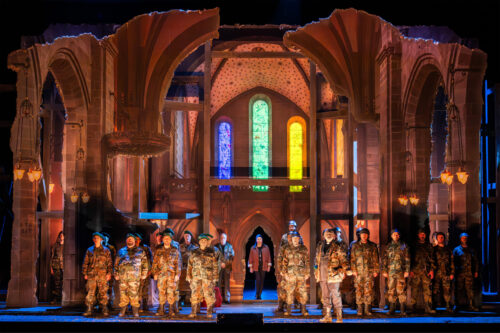
The action does not take place in realistic settings. Instead, fully aware that military destruction cannot be adequately represented on the stage, Carrasco opts for artificiality. Her representations of the locations, a bombed out Fraumünster, one of the three main Zurich churches, a besieged Palais des Nations, the UN headquarters in Geneva and a half-burnt Congress Centre in Davos, which hosts the WEF (renamed War Economic Forum) stake no claim to naturalism. Set on a revolving stage, the scenery is made of photographic pictures mounted on wooden scaffolding. We have an alternating front and rear view of the scenery, reminding us that we are in a theatre.
Carrasco has worked extensively with the Spanish theatrical group La Fura dels Baus renowned for their unconventional physical performative style. And it shows as she masters modern dance choreographies of mass scenes as well as striking images of introspective solitude, such as Netrebko performing Leonora’s final Pace, pace mio dio wrapped in a blanket standing against the ruins.
The costumes (Silvia Aymonino) are contemporary, varied and reflect the chaos of war and conflict. Next to Hamid Karzai and Bolsonaro lookalikes in the Geneva UN crowd, there is plenty of military apparel and weaponry too. Drones, stinger missiles, rifles and other guns in all sizes and even knife fights abound.
La forza del destino is a challenge for any production team. This Zurich ensemble has run the gauntlet to great effect. Still, in the end it was the music that carried the evening for me. I am still humming.
Michael Fischer
Performances run to 21 December 2025.
Featured Image: Anna Netrebko (Leonora) © Monika Rittershaus
Production:
Director – Valentina Carrasco
Set – Carles Berga
Assistance Set – Mariangela Mazzeo
Costumes – Silvia Aymonino
ighting – Fabrice Kébour
Video – Massimiliano Volpini
Chorus master – Klaas-Jan de Groot
Dramaturgy – Fabio Dietsche
Cast
I Marchese di Calatrava – Stanislav Vorobyov
Donna Leonora – Anna Netrebko
Don Carlo di Vargas – George Petean
Don Alvaro – Yusif Eyvazov
Preziosilla – Annalisa Stroppa
Padre Guardiano – Michele Pertusi
Fra Melitone – Roberto Frontali
Curra – Natália Tuznik
Mayor – Lobel Barun
Maestro Trabuco – Tomislav Jukić
Surgeon – Max Bell