
 United States Various: Alexi Kenney (violin and conductor), Yubeen Kim (flute), Jonathon Dimmock (harpsichord), members of San Francisco Symphony. Davies Symphony Hall, San Francisco, 21.11.2025. (HS)
Olli Mustonen – Nonetto II for String Orchestra
Barbara Strozzi (arr. Kenney) – ‘Che si può fare’, Op.8, No.6
J. S. Bach – Brandenburg Concerto No.5 in D major
Vivaldi – The Four Seasons
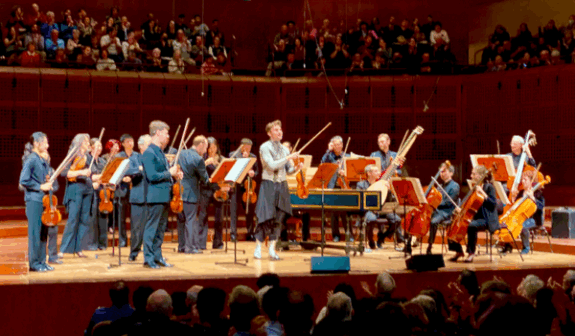
Alexi Kenney doesn’t just play the violin, he cajoles it, savors it and makes it yield a dazzling array of emotions, all while playing with precision. In Baroque music, he can make a special occasion out of familiar works such as Vivaldi’s The Four Seasons and J. S. Bach’s Brandenburg Concerto No.5. His program in the Davies Symphony Hall, in which he played and conducted members of the San Francisco Symphony, included a modern expression of Baroque style in Olli Mustonen’s twenty-first century Nonetto II and his own distinctly modern arrangement of an obscure seventeenth-century opera aria by one of the few women known to compose music in those days. Fascinating comparisons and connections could be made but, most of all, the program displayed a tradition-breaking star musician at work.
Only nine years ago, Kenney was playing in the San Francisco Symphony’s youth orchestra, including a concert that featured him in the Sibelius Violin Concerto. Since then, he has soloed with an A-list of orchestras and invented programs like this one. Mustonen’s Nonetto. written in 2000, opened the concert. Modern harmonies and unexpected string textures enlivened a standard Baroque framework of zippy intertwining melodies and swift changes of pace, and its fifteen minutes never flagged. Kenney conducted from the concertmaster’s stand and kept the 21 string players sounding like they were dancing with the rhythms.
Kenney’s treatment of Venetian singer and composer Barbara Strozzi’s ‘Che si può fare’, a five-minute aria from her last opera, opens with eerie high harmonics and soft dissonances. Jonathan Dimmock, the orchestra’s regular organist and harpsichordist, and associate principal cellist Anne Richardson laid down the continuo, the foundation, and principal flutist Yubeen Kim spun out the melody as Kenney turned it into an appealing duet.
As the aria faded out, the players moved without pause into the Brandenburg Concerto, which uses the same instrumentation. The change of tempo came off as refreshing. The performance skipped along a bit more aggressively than what we usually hear, and the notoriously difficult harpsichord cadenza, often a fountain of energy, was technically accurate but did not quite flower. Kenney’s playing, however, was lovely.
The biggest revelation was The Four Seasons. The way that Kenney treated the many references to nature in the score invigorated the four violin concertos. The crunch of boots in snow in winter, birdsong in spring, the buzzing of insects and crash of thunder in summer, the dancing and jolly hunt of autumn – all emerged almost cinematically. These were articulated faithfully, but they aimed at reproducing nature’s sounds and were not played for elegance.
With a full-body athletic approach to playing the violin Kenney drew stomping rhythms from the ensemble. Most impressively, he got everyone standing (all but the cellos) to join him in not making every note sound pretty, instead creating a sonic picture that was enticingly scenic. The slow movements and slow sections of the outer movements flowed with sustained grace, a nice contrast. He did all this without having to mess with the score, an approach to ‘updating’ others have done recently by adding extra music, among them Max Richter in his The Four Seasons Recomposed, championed by the violinist Daniel Hope with the New Century Orchestra here in San Francisco in 2012. Instead, Kenney played what Vivaldi wrote, only he did it with an ear for reality and theatricality that brought an enthusiastic response from the audience.
Adding to the musical audacity, the violinist presented himself with flair. He played the first half in an all-black ensemble of waistcoat over a skirt, standing in black boots. In the second half, he wore a skintight, ruffled gray shirt and silvery boots. Somehow, it all felt completely appropriate.
Moving with the music helped convey the meaning of the already energizing approach and, if anything, the musical qualities benefited. The only departure from the score was what is now a fairly common addition of theorbo to the harpsichord in the continuo. The player switched to guitar for charmingly appropriate guitar licks on ‘Spring’.
For an encore, Kenney quieted things down with subtle, elegantly executed, rapid arpeggios of the ‘Alia fantasia’ in A minor by Nicola Matteis, probably written around the same time as the concertos. It was blissful.
Harvey Steiman