
 United States Revueltas, Dvořák: Cleveland Orchestra / Dalia Stasevska (conductor). Mandel Concert Hall at Severance Music Center, Cleveland, 20.11.2025. (MSJ)
Revueltas – La Noche de los Mayas (suite arranged by José Yves Limantour)
Dvořák – Symphony No.9 in E minor, Op.95, ‘From the New World’
In the early 1980s, Christoph von Dohnányi – then little known in the US – came to Cleveland and delivered a performance of Dvořák’s Eighth Symphony that blew away memories of past performances and pretty much declared his ownership of the work. It is often said that it was the concert that clinched the music directorship of the orchestra for Dohnányi. Today, the orchestra is again searching for a future chief. Only time will tell if Dalia Stasevska will have done something similar with this vital and volatile performance of Dvořák’s Ninth, the famous ‘New World’. The competition for the directorship is fierce, with many significant visitors yet to be heard this season. The quality of the candidates bodes well for Cleveland’s future, and Stasevska (currently principal guest conductor of the BBC Symphony Orchestra) is clearly in the running.
It was a joy to hear the great Cleveland Orchestra revel in this work, something that was not possible the last two times it was programmed. In 2023, current music director Franz Welser-Möst sprinted through it at rigid top speed with blinders on. Before that, at the 2021 Blossom Music Festival, Rafael Payare made many fanciful curlicues in midair with his baton while the orchestra largely ignored him and played on autopilot. Prior to this concert, the only worthy performance of the score heard recently in Cleveland had come in 2023 from the touring Lviv National Philharmonic led by Theodore Kuchar. (And, incidentally, to ruffle a lot of feathers, why has Kuchar – one of the finest conductors in the business – not been invited to guest-conduct the Cleveland Orchestra? He is intense and driven and prickly, but he is a giant compared to some of the nonentities who have passed through.) As giants go, the diminutive Dalia Stasevska stood eye to eye with the mighty Kuchar.
Dvořák’s final symphony is surprisingly turbulent, but I think that is one of the reasons so many listeners have taken it to heart. You can hear the composer’s disintegrating patience with classical form as the closing pages of the Finale rocket from one extreme to the other before closing with a radiant E major chord. Before that, Stasevska made sure that no corner of the score was forgotten. The first movement all too often becomes a succession of themes played metronomically. This rendition was instead a casebook example of how to bring music to life. Stasevska used subtle rubato and tempo adjustments to allow every passage to find its own character while still standing in relation to the main pace. In particular, the second theme felt entirely new because of the way Stasevska had the Cleveland violins cradle the theme more tenderly than in any other performance I have heard.
The second movement seemed to start too slowly, causing some minor alignment issues, but this turned out to be just a dramatic handling of the introductory chords: the main tempo of this heartfelt Largo was perfectly flowing and flexible, giving Robert Walters room to play the famous English horn solo with tenderness and nobility without ever letting the forward momentum disappear. The middle section of the Largo was haunting. The dynamic level remained hypnotically soft, but the intense rubato allowed the players to dive deeply into the inconsolable sadness of the passage. It was an electrifying moment, the kind of thing we go to live concerts to experience.
The Scherzo was very fast for the main theme, but Stasevska relaxed and encouraged full, colorful sound for the brighter trios. Indeed, one of the outstanding features of this performance was the warm and rich palette of orchestral sound Stasevska encouraged, which came again to the fore in the second theme of the Finale, a moment of glowing sun in an otherwise stormy movement. And Stasevska savored the storms, made them visceral, without ever driving the orchestra harshly. Indeed, it was refreshing to see a conductor capable of grand gestures, but who never deployed them without good reason: she made no gesture that didn’t result in a direct response from the orchestra. This was not grandstanding nor playing to the gallery – it was bold, clear leadership. Her crackling sense of drama and narrative would make her a fine opera conductor as well.
The first half of the concert was no less thrilling. Silvestre Revueltas, an outstanding Mexican composer of the early twentieth century who, sadly, died young, penned a number of works that effectively united Mexican folkloric elements with the harmonic idioms of modern classical music. Little known outside of Mexico in his lifetime, the undeniable excellence of his music is slowly but surely drawing him into the pantheon of great composers. La Noche de los Mayas (The Night of the Mayas) is a good entry point to his work: it tempers his thorniest gestures with the popular elements required for a film score.
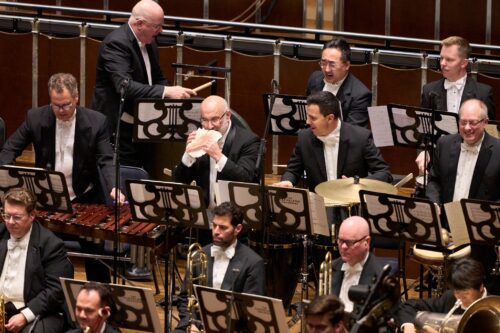
The film that it was composed for contrasted scenes of ancient Mayan native life with shots of a modern explorer searching through archaeological ruins. Revueltas wrote numerous cues for the soundtrack, but he left them in uncompiled form at the time of his death in 1940 at the age of forty. In 1959, Mexican conductor José Yves Limantour arranged some of the numbers into a symphonic suite, with significant alterations including a written-out ‘improvisation’ for the extensive battery of Mexican percussion instruments included in the score. Not having heard the written-out Limantour passage, I can only assume that, like most modern performances, this one gave the percussionists space to do their own improvisation, for Stasevska stopped beating time and let the players shine. The battery of fourteen instruments included everything from a güiro to a conch shell, and they made a thrilling sound.
The work wasn’t only picturesque percussion. The stern first movement’s powerful statements in the strings might strike Cleveland season ticket holders as influenced by Honegger’s harrowing Third Symphony which we heard a few weeks ago. That is, until you do the math and realize that the Revueltas piece preceded Honegger’s Third by over half a decade. The second movement was a witty scherzo in irregular meter that showed off the woodwinds and brass, provoking a round of laughter in response to its comic closing. The third movement brought string playing with a luminous warmth not heard here since Stéphane Denève’s last visit. The final movement, a succession of percussion-driven variations, could easily turn into hectoring noise, but Stasevska shrewdly judged where to restrain it – without throttling it in a gross show of control like last week’s strange display by Tugan Sokhiev (review here) – and where to let it rip.
The Cleveland Orchestra has one more season before music director Franz Welser-Möst leaves and, if time permits, it would be good to have a return engagement so we can hear if Stasevska has the same level of achievement in early classical repertoire as she clearly does in later music. She is a strong contender, along with Elim Chan, Antonello Manacorda, Daniel Harding, Petr Popelka and . . . name your favorite.
Mark Sebastian Jordan
Featured Image: Dalia Stasevska conducts the Cleveland Orchestra © Roger Mastroianni/TCO