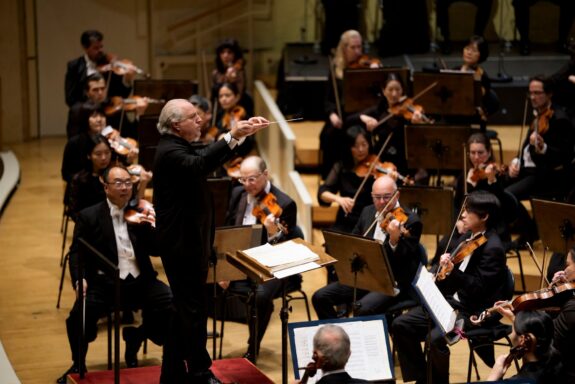
 United States Beethoven, Haydn, Mozart: Jeanine De Bique (soprano), Avery Amereau (mezzo-soprano), Ben Bliss (tenor), Stephano Park (bass), Chicago Symphony Chorus and Orchestra / Manfred Honeck (conductor). Orchestra Hall, Chicago, 23.11.2025. (ZC)
Beethoven – Coriolan Overture
Haydn – Symphony No.93 in D major
Mozart – Masonic Funeral Music; ‘Laudate Dominum’ from Vesperae solennes de confessore; Requiem in D Minor; ‘Ave verum corpus’
Classical music’s great monuments often arrive in the concert hall trailing histories behind them, along with layers of interpretation and expectations that no performance can meet. Mozart’s Requiem is undoubtedly one of those works. It gathers some of the composer’s most stirring music and binds it with a spiritual character weighted by lore surrounding Mozart’s final days. The piece’s fragmentary nature allowed later composers to supply completions of varying character, adding an almost philosophical dimension on which are the most or least ‘Mozart’.
The murky antecedents, spiritual impact and mythological status leave Mozart’s Requiem almost in a state of suspension. For all its beauty, it is a piece that can inspire more promise than fulfillment. I have long thought that it thrives more readily on recordings than in performance, where the scale and pacing create challenges for modern orchestras.
The problem begins with the length. The Requiem is too short to constitute a full program but too distinctive to sit comfortably beside other repertory. There are solutions: one program I heard paired it with Karl Amadeus Hartmann’s Concerto funebre, an interesting and conceptually sound choice that offered musical contrasts as well as shared questions of mortality. Still, the perennial difficulty remains: How do you stage a work shaped by sacred ritual in a secular concert format?
Austrian conductor Manfred Honeck devised a compelling solution, nesting the Requiem within a broader liturgical meditation on mortality. The novel approach transforms the work from a mere concert piece into both a tribute to the artist and a universal contemplation on life and death. I first encountered this intelligent and creative conception in 2014 at the final Spring for Music festival. It has since been recorded by the Pittsburgh Symphony, and Honeck recently brought a more concise version to Chicago.
Honeck has said that his arrangement is meant to achieve two aims. The first is a portrait of Mozart at the end of his life: a composer who, even while dying, created music of startling clarity and compassion. The second is far less specific. By beginning and ending the expanded work with three bell tolls – and in between shifting among chant, familiar movements of the Requiem and other religious or spiritual works by the great composer – Honeck creates an invitation for listeners to contemplate human mortality while thinking about the sacred as an emotional stage.
Honeck’s recent Chicago performance of this – for lack of a better term – ‘enhanced’ Requiem made the most of that emotional stage. The chorus, prepared by Donald Palumbo, maneuvered the extremes of Honeck’s arrangement with precision. In the Dies irae they summoned a fierce, urgent sound, yet they could just as easily thin their voices to a thread for the chant passages. The orchestra brought with it a crisp articulation, as well as a sense of proportion that kept the evening from drifting into sentimentality. The quartet of soloists – Jeanine De Bique, Avery Amereau, Ben Bliss and Stephano Park – were a balanced and responsive team. Their contributions felt integrated, emerging from the texture at moments that suggested prayer rather than declaration.
Reactions to Honeck’s arrangement will depend on listeners’ openness to devotional framing in the concert hall. For my part, I have never minded when the Requiem is placed in explicitly sacred settings. Some of the most affecting performances I have heard occurred within the structure of a Catholic Mass, where Mozart’s music could serve the liturgy it was meant to illuminate. Honeck’s approach maintains that instinct, thanks in no small part to his inspired decision to include Mozart’s Masonic Funeral Music, ‘Laudate Dominum’ and ‘Ave verum corpus’ among the scaffolding for the Requiem. The work breathes differently when it is allowed to move within its spiritual vocabulary, not as a museum piece but as a gesture toward the ineffable.
The program also offered two Classical-era works that showed the Chicago Symphony in fine form. Beethoven’s Coriolan Overture opened the evening with its restless volatility. Honeck allowed the work’s contrasts to stand out; the music surged and retreated with a sense of tension that felt true to its theatrical origins. If Coriolan is all storm and fracture, the other featured work, Haydn’s Symphony No.93, provided a genial counterweight. Honeck drew out the nobility of Haydn’s first so-called ‘London’ symphony while keeping its wit intact. The orchestra played with the kind of effortless refinement that comes from long familiarity with this repertory.
In the end, it was the Requiem, re-framed and re-imagined, that gave the evening its shape. Honeck’s conception does not solve every challenge – or opportunity– that the piece presents. But it charts a course into the music that feels honest to its origins while also open to its mysteries.
Zach Carstensen
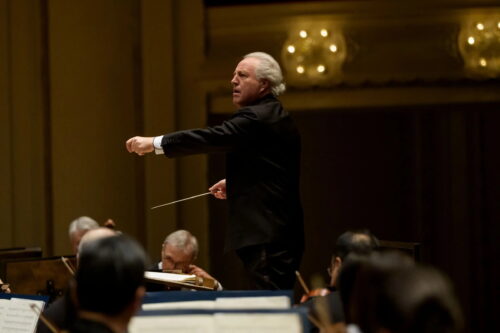
Featured Image: Manfred Honeck conducts the Chicago Symphony Orchestra © Todd Rosenberg