 United Kingdom Sir Peter Wright’s The Nutcracker: Dancers of The Royal Ballet, Students of The Royal Ballet School, The Schola Cantorum of The London Oratory School, London Oratory Junior Choir (director: Charles Cole), Orchestra of the Royal Opera House / Charlotte Politi (conductor). Broadcast live (directed by Peter Jones) for the Royal Opera House, Covent Garden, to Cineworld Basildon, Essex, 10.12.2025. (JPr)
It’s Christmas at Covent Garden so it must be Sir Peter Wright’s The Nutcracker; well not every year actually, as last year it gave way to a new Cinderella and avoiding the clash with the English National Ballet’s revisionist new version (review here). Back in 2025 the opening night of the current run of performances celebrated the 99th birthday of the choreographer (with the company looking forward to his hundredth), as well as the recent fortieth anniversary of Sir Peter Wright’s production itself! The sold-out performances are justification enough for the endless revivals of this ‘Festive tradition’; though it does not advance the art form in any way. Also, as the Director of The Royal Ballet, Kevin O’Hare, revealed ‘it’s the most amount of new audiences coming to this performance than any other production we do. So, whether it is in the cinema or whether it is here in the Royal Opera House, there are so many people coming to see it for the first time.’
An intriguing 2016 film I recently caught up with on Sky Arts, ENB in Paris, from Michael Nunn and William Trevitt concludes with a hilarious sequence involving some of those seen in the documentary trying – and failing! – to outline the story of their Le Corsaire ballet. Equally, who really knows what’s going on in this almost plot-less version of The Nutcracker with its Act I Stalbaums’s Christmas party and Act II divertissements in the Sugar Garden of the Kingdom of Sweets; apart from that it provides – for all the differing casts in any revival – a glittery and snowy showcase for the entire company, as well as students of The Royal Ballet School.
Once more I can only refer to Wright’s own synopsis: ‘The wicked Queen of the Mice cast a spell over Drosselmeyer’s nephew, Hans-Peter, which transformed him into an ugly Nutcracker Doll. The only way to break the spell was for the Nutcracker to defeat the Mouse King, thereby committing an act of great bravery, and for a young girl to love and care for him despite his awful appearance.’ And that is basically it, though – as I have written before – Hoffmann’s original The Nutcracker and the Mouse King is much darker and open to reinterpretation; possibly as the stuff of nightmares, or in a Freudian way, as for example, the psychoanalytic dimension Rudolf Nureyev brought to his Nutcracker (review here).
Julia Trevelyan Oman’s designs for this Nutcracker take us to the Christmas party in ye olde Nuremberg in those far-off days when children were still allowed to be children. There is a touch of anarchy to the twee domesticity when the St Nicholas Eve parade invades the house. Drosselmeyer is at the centre of everything which happens at the party; from entertaining the guests with his magic tricks, to attempting to orchestrate the rescue of his nephew from his fate as the Nutcracker. The Christmas tree grows to a dazzling height, as Drosselmeyer draws Clara – shrunk Alice-like – into her surreal, dreamlike adventures. She battles sinister toys and evil mice, vanquishes the Mouse King (beating him over the head with one of her slippers) and thus proves her bravery and love for the Nutcracker she has rescued, and this allows Clara to grow up. The forces of good, Drosselmeyer and the Christmas Angel he made, conjure up falling snowflakes and the transporting of Clara and the Nutcracker from the Land of Snow to the Kingdom of Sweets – which was the cake at the party – and all the set-piece choreographic treats we have been eagerly awaiting.
French-Italian Charlotte Politi – currently the Constant Lambert Conducting Fellow with The Royal Ballet and Birmingham Royal Ballet – conducted a very youthful account of some of Tchaikovsky’s most vivid and sumptuous music; that, however wonderfully it was played by the excellent Orchestra of the Royal Opera House, rushed headlong through the ballet. Too many significant moments just flashed by and occasionally the dancers looked a little rushed in their footwork (especially in Peter Jones’s impeccable close-up camerawork for the cinema).
James Hay is a new Drosselmeyer and as a dancer he has been performing in this production for 25 years since the age of 11. Hay has been a toy soldier, Fritz, cavalier and Hans-Peter/Nutcracker. Now Hay was the arch-manipulator Drosselmeyer who was less avuncular than some, and – to be honest – seemed slightly demonic and a whirling dervish who looked as if he was second cousin to Von Rothbart in Swan Lake.
Marianna Tsembenhoi – an emerging talent to keep a close eye on – was an engaging Clara with totally natural, fleet-footed movement as she skipped through the story with a totally believable sense of wonder: as if genuinely experiencing everything for the very first time, especially the falling snow and the prepubescent stirrings of love. As Hans-Peter/Nutcracker Taisuke Nakao was more of a blank canvas as an actor but a very exciting spring-heeled dancer and sensitive partner.
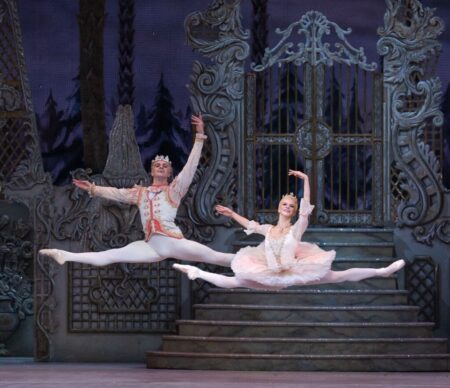
The Nutcracker has several solo roles and standards and energy levels were very high throughout the performance: notably in the second act when Tsembenhoi and Nakao inveigle themselves throughout the divertissements. Nadia Mullova-Barley and Harris Bell were particularly slinky in Gary Avis’s revised Arabian Dance, even if the Chinese Dance (the athletic Martin Diaz and Harrison Lee) is looking increasingly anachronistic. The corps de ballet were in particularly scintillating form for the Waltz of the Snowflakes, arching and swaying with their fingers fluttering to mimic falling flakes. At a certain point in the music, snow does descend accompanied by the atmospherically otherworldly singing of the London Oratory Junior Choir and The Schola Cantorum of the London Oratory School offstage. The corps de ballet also shone in the Waltz of the Flowers with Claire Calvert as a fragrant Rose Fairy.
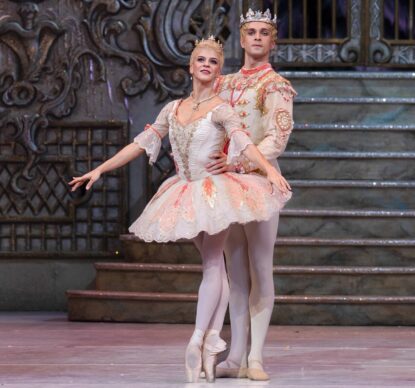
Finally, it was time for the Sugar Plum Fairy and her Prince’s pas de deux and there was no doubting the technical perfection of the refined Mayara Magri and the stiff-backed Reece Clarke who towered over her as the stalwart Prince. Magri was all smiley grace and musicality whilst Reece’s dancing was tidy, though – for me – lacked some élan and charisma.
So, this box office-winner of a Nutcracker has passed forty and I suspect it will return again next Christmas since The Royal Ballet’s attitude remains ‘if it ain’t broke, don’t fix it’.
Jim Pritchard
Featured Image: Mayara Magri (Sugar Plum Fairy) and Reece Clarke (Prince) © Andrej Uspenski
Creatives:
Music – Pyotr Il’yich Tchaikovsky
Choreography – Peter Wright after Lev Ivanov
Scenario – Marius Petipa after E.T.A. Hoffmann
Production and Scenario – Peter Wright
Designer – Julia Trevelyan Oman
Lighting designer – Mark Henderson
Production Consultant – Roland John Wiley
Staging – Christopher Carr, Samantha Raine
Arabian Dance adapted by Gary Avis
Cast included:
The Sugar Plum Fairy – Mayara Magri
The Prince – Reece Clarke
Herr Drosselmeyer – James Hay
Clara – Marianna Tsembenhoi
Hans-Peter/The Nutcracker – Taisuke Nakao
Drosselmeyer’s assistant – Caspar Lench
Dr Stahlbaum – Thomas Whitehead
Mrs Stahlbaum = Christina Arestis
Captain – Téo Dubreuil
Harlequin – Marco Masciari
Columbine – Mica Bradbury
Soldier – Harrison Lee
Mouse King – Francisco Serrano
Spanish Dance – Isabel Lubach, Olivia Findlay, Maddison Pritchard, Giacomo Rovero, James Large, Blake Smith
Arabian dance – Nadia Mullova-Barley, Harris Bell
Chinese dance – Martin Diaz, Harrison Lee
Russian Dance – Francisco Serrano, Joshua Junker
Dance of the Mirlitons – Ella Newton Severgnini, Viola Pantuso, Amelia Townsend, Yu Hang
Rose Fairy – Claire Calvert
Rose Fairy Escorts – Leo Dixon, Téo Dubreuil, Aiden O’Brien, Joonhyuk Jun
Leading Flowers – Mica Bradbury, Hannah Grennell, Chisato Katsura, Charlotte Tonkinson
Magical production, soaring dancers, everything was superb.
I thought the production was breath-taking.
Fantastic performance. This was the first time I had been to see a ballet performance. It was totally magical and touched my heart strings.
YES! I was there live on the 5th December and I was so disappointed in Reece Clarke, I couldn’t work out why he was so lacking in emotion and so stiff, maybe nerves as they were filming but no excuse when I spent £195. when he was in a pair, he was better when dancing alone, but I would not now buy a ticket with him as one of the main principals from now on. Also saw the ENB and whilst they are the poor relation in showmanship, and I begrudge spending £125 for long spades of a child Clara, their Sugar Plum Prince was far better.
I loved the Royal Ballet’s Drosselmeyer, James Hay was fantastic, the ENB version was like a magic Dracula with the red black cloak. The costumes of the ENB need to be improved.