
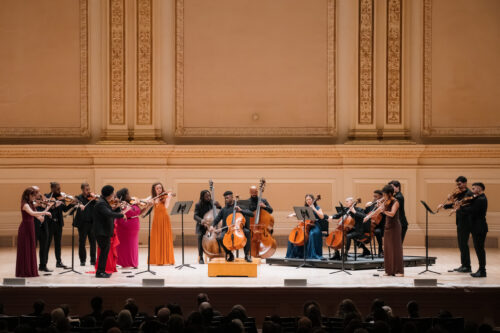
 United States Various, ‘Visions of Peace’: Sterling Elliott (cello), Sphinx Virtuosi. Carnegie Hall, New York, 17.10.2025. (DS)
Clarice Assad – ‘Precision: Perpetual Motion’ from Impressions
José White Lafitte – ‘La Bella Cubana’
Prokofiev – Precipitato from Piano Sonata No.7 (arr. Rubén Rengel)
Quenton Xavier Blache – Visions of Peace
Still – ‘African Dancer’, ‘Mother and Child’, ‘Gamin’ from Suite for Violin & Piano (arr. for Cello & String Orchestra by Randall Goosby)
Ginastera – Finale furioso from Concerto for Strings
Every autumn at their annual string concert, the Sphinx Virtuosi attracts a diverse audience who fill the rows of Carnegie Hall. Refreshingly, this means a full range of age groups – listeners from their teen years to well into retirement.
The program also did its part in shaking up traditional classical programming. To open, the Sphinx ensemble, which is self-conducted, glistened in a fervent yet dreamy performance of ‘Precision: Perpetual Motion’ by Clarise Assad. They shifted with agility to a 1910 Cuban work, ‘La Bella Cubana’ by José White Lafitte, whose complex blend of different Caribbean rhythms mesmerized with swooning lilts and melodic turns. The Sphinx players’ courageous pizzicato game also added a delicious stinging clarity to the piece.
The display of talent in both composition and performance continued with a particularly dramatic string ensemble arrangement by a Sphinx alum, violinist Rubén Rengel, of the Precipitato movement from Prokofiev’s Piano Sonata No.7. (To my surprise, its texture and mood pulled me back to thoughts of the opening Assad.) Next, Sphinx cellist and composer Quenton Xavier Blache premiered his Visions of Peace on which the title of the evening’s concert was based. Drawing on different modal scales, Blache’s work captured a reflective mood, one that breathed hope rather than melancholy and proved to be an ideal match for the Sphinx players’ dazzling style. They handled the work’s exchange of warm and fiery contrapuntal material with nothing short of hardy expression.
Without an intermission, the evening developed a pleasant momentum, and the brief informative talks given by players between the works were seamlessly integrated. Nearing the close of the concert, Afa S. Dworkin of the Sphinx Organization came to the podium where she firmly and unapologetically called upon society to work towards peace. She also highlighted the necessity of recognizing the extraordinary spectrum of backgrounds that exist in America thanks to a long history of immigration. Her argument showed that music and foundations like the Sphinx Organization can lead us towards redemption.
In a New York premiere, Sphinx cellist Sterling Elliot performed three movements from William Grant Still’s Suite for Violin & Piano, arranged for Cello & String Orchestra by Sphinx artist Randall Goosby. It confirmed Elliot’s exceptional talent: he was both captivating and impressively versatile as he moved through Still’s complex mixture of jazz, blues, folk and mid-twentieth- century classical forms and textures.
The ending of the concert proved once again their enduring virtuosity. With an unleashing of dark, deep sounds in a seriously speedy tempo, the Sphinx Virtuosi left us with Ginastera’s Finale furioso and its sense of urgency. It was not to be mistaken for foreboding but rather to be seen as a release of youthful energy that might just marry power with peace.
Daniele Sahr