 Ireland Wexford Festival Opera 2025 [3] – Handel, Deidamia: Soloists, Chorus and Orchestra of Wexford Festival Opera / George Petrou (conductor). O’Reilly Theatre, Wexford, 26.10.2925. (RB)

The final opera to be staged at this year’s Wexford Opera Festival was Handel’s Deidamia. The first performance was in 1741 in London, and it enjoyed a short run of just three performances. It proved to be Handel’s final opera, and it was not revived again until the middle of the twentieth century. The work is an opera seria given that it is principally concerned with the inexorable nature of fate and the inevitability of death. However, it contains many buffa elements which revolve around cross-dressing, scheming and disguises.
The opera takes place against the backdrop of the Greco-Trojan War. The Oracle predicted that Achilles would die if he fought in the Trojan War. To prevent this fate, his father Peleus disguises him as a girl and sends him to live in the palace of his friend Lycomedes on the island of Skyros. While at the palace he becomes the lover of Lycomedes’s eldest daughter, Deidamia. As the Greeks prepare for their war against Troy, the priest Calchas reveals that the city cannot be taken without Achilles’s help. Ulysses, Phönix and Nestor are dispatched to Skyros to convince him to join them in the war. The opera opens with the arrival of these three men on the island of Skyros. It gradually turns into a game of wits as the three men deploy various wiles and ruses to try to unmask Achilles while Deidamia and her confidante, Nerea try to block them.
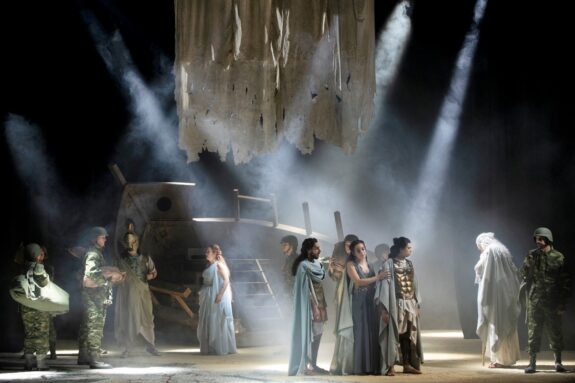
George Petrou had the dual role of conductor and stage director for this opera. His production is one of the most inventive and spectacular I have seen. Petrou used a mixture of elaborate set designs, drawings and ingenious visual projections to bring the drama to life. During the Overture the stage was covered in billowing swirling mists, and it was possible to see the outline of mythic figures. In the opening scene, the set consisted of a large boat moored on the sand against a scenic backdrop of the Aegean Sea. The sea tended to predominate in subsequent set changes. Petrou then introduced a dual narrative with two separate timelines. While the mythical characters of the Trojan War remained in their ancient guise, a modern-day holiday party arrived on the island of Skyros. The two sets of characters initially do not appear to see or acknowledge each other but gradually they start to interact. In some scenes the ancient characters struck or disrupted the activities of their modern-day counterparts, and this resulted in some physical comedy. In other scenes the modern-day characters performed choreographed routines with umbrellas or provided a backdrop to war with their army camouflage outfits. The production showed how the events of Greece’s mythic past continue to permeate and influence the present day.
Arnim Freiss’s designs, using AI, were highly imaginative and they complemented the action brilliantly. At the end of the first act, Lycomedes sang his aria underwater as fish and a modern diver floated by. While Deidamia was singing her famous ‘nightingale’ aria, silhouettes of white birds fluttered against a dark screen. In another of Deidamia’s minor key arias, one could see flowers coming into bloom and then fading. Petrou and Freiss included a mock trailer for the film ‘Ulysses’ just before the end of the opera which showed all the principals and creative artists involved with the production. There was also a highly disturbing montage of war scenes right at the end. At one point I wondered if the dazzling array of visual effects might overwhelm the narrative and events happening on stage. However, the effects complemented and enhanced the action perfectly and one could not help but be won over by such a such a dazzling visual display.
The performers were all at the top of their game. Sophie Junker was enormously impressive in the role of Deidamia. She captured the conflicted nature of the character and went through a rollercoaster of emotions as she worked to save Achilles from his fate. She was on top of Handel’s vocal pyrotechnics, while also bringing great poignancy and depth to the minor key arias. ‘Nasconde l‘usignol’ was a dazzling display of vocal agility which saw Junker executing a succession of trills and embellishments with cut-glass refinement at speed. She sang ‘Se Il timore’ with great poignancy and exquisite colouring. Sarah Gilford was also impressive in the role of Nerea, Deidamia’s quick witted and loyal confidante. She too did a superb job executing Handel’s vocal fireworks while her Act I aria reflecting on the power of feminine wiles was a huge success.
Achilles and Ulysses were portrayed by Brazilian male soprano Bruno de Sá and Italian countertenor Nicolò Balducci. De Sá’s Achilles was impulsive and boisterous, and he seemed to enjoy the game of wits being played before being outmanoeuvred by Ulysses. He handled the dazzling vocal line with virtuoso aplomb, and I liked the clear ringing tone and brilliance he brought to Handel’s arias. Balducci’s Ulysses was a shrewd, cunning character clearly focused on his mission. He successfully blended moments of comedy with high drama and Balducci’s vocal agility was never in doubt.
Greek bass, Petros Magoulas, was the voice of sanity in the opera. He tried to steer a choppy path between loyalty to friends and family and his obligations to his country. He brought vocal heft and depth of sound to the vocal line while expertly negotiating Handel’s tricky writing. He appeared submerged in an enchanting underwater kingdom when he sang his aria about the need for contentment – an extraordinary coup de théâtre. Rory Musgrave was convincing in the role of Ulysses’s comrade Phönix. He worked with Ulysses to achieve his mission while simultaneously falling in love with Nerea. He sang with authority and conviction, although some of the phrases got lost in his initial aria and he did not always seem completely comfortable with Handel’s elaborate vocal demands.
George Petrou conducted an authentic Baroque orchestra for this production. The Overture opened in sombre mode with the strings creating rich sonorities before engaging with the woodwind in an intricate contrapuntal display. The WFO brought dynamism and energy to the piece and Petrou did an excellent job in maintaining the dramatic momentum. The players were alert to the shifting moods in the score and moved from pageantry to moments of high comedy, drama and plangent soul-searching. Petrou maintained an excellent balance of sound with the singers and the WFO provided a flexible, rich accompaniment.
Overall, this was an outstanding production that shows exactly how Baroque operas should be performed. It makes a strong case for Deidamia to be staged much more widely.
Robert Beattie
Featured Image: Wexford Festival Opera’s Deidamia © Pádraig Grant
Production:
Stage director – George Petrou
Set and Costume designer – Giorgina Germanou
Production designer – Arnim Freiss
Co-Lighting designers – Daniele Naldi, Paolo Bonapace
Chorus master – Andrew Synnott
Cast:
Deidamia – Sophie Junker
Nerea – Sarah Gilford
Achilles – Bruno de Sá
Odysseus (Ulysses) – Nicolò Balducci
Phönix – Rory Musgrave
Lycomedes – Petros Magoulas