
 United States Various: Stern Auditorium, Carnegie Hall, New York, 28-29.10.2025. (ES-S)
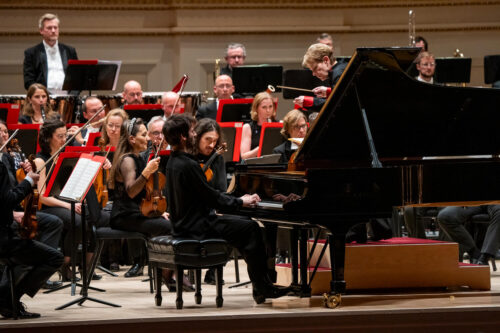
Celebrating eight decades since its founding, the Philharmonia Orchestra came to Carnegie Hall for two consecutive nights of performances led by Marin Alsop (Principal Guest Conductor) and Santtu-Matias Rouvali (Principal Conductor). The pairing offered more than a showcase for the orchestra’s reach: it framed a dialogue between two sharply contrasted musical sensibilities. The juxtaposition of Alsop’s clarity and control – her disciplined architecture and finely calibrated balance – with Rouvali’s instinctive, physically-shaped lyricism, not to mention the distinct temperaments of the two pianists (Alexandre Kantorow, volatile and imaginative; Víkingur Ólafsson, self-assured and intent on pointing his own way), promised to reveal the Philharmonia’s adaptability and range.
On the first night, Alsop’s program, though thoughtfully constructed to trace a path from late-Romantic fervor through early-twentieth-century modernism, proved more admirable in conception than in execution.
Tchaikovsky’s Romeo and Juliet began more tentatively than expected. From the first bars, rhythmic unevenness between sections and several tentative brass entries suggested an ensemble still adjusting to Alsop’s pacing. The performance lacked spontaneity, its momentum constrained and its climaxes short on panache. The Montague–Capulet confrontations never quite ignited, while the love theme sounded more melancholic than impassioned. Yet there were passages sensitively molded, imbued with natural phrasing and carefully-judged dynamic shading – moments that hinted at the performance Alsop seemed to be striving for.
Prokofiev would later compose his own celebrated reinterpretation of the Shakespearean myth in his Romeo and Juliet ballet, and one could already discern the suave, bittersweet lyricism of that world in his much earlier Piano Concerto No.3. The soloist was the young French pianist Alexandre Kantorow, a virtuoso whose playing is full of sensitivity and imagination. He proved it eloquently in his rendition of the concerto, revealing a rare blend of command and poetic spirit. From the first bars of the opening movement, Kantorow established a strong narrative line, the clarinet’s dreamy phrase echoed by the gleaming clarity of the piano lines. His touch was alert yet never hard, his phrasing supple, the tone shifting effortlessly from satin to steel, from grace to acerbic irony. In the central Tema con variazioni, he brought out the work’s lyrical core: each episode had its own hue and character, the filigree never ostentatious, the line always intelligible.
The finale combined precision with fire, its rhythmic propulsion finely honed. Alsop, long regarded as a sensitive accompanist, mostly sustained the pianist’s exploits with care and precision, though there were moments when their tracks seemed to run parallel. As an encore, Kantorow offered Isoldes Liebestod, Liszt’s piano transcription of Wagner’s symphonic pages – a reading whose unhurried arc revealed once more the combination of insight, imagination and fidelity to the score that underpinned everything he played.
Alsop’s precise gestures and feel for structure found their fullest expression in Bartók’s Concerto for Orchestra. The long first movement unfolded with clarity and cohesion, the balances cleanly judged, the rhythmic transitions deftly handled. The Giuoco della coppie moved with alert discipline, though its earthy humor felt somewhat restrained and none of the instrumental pairs that define the movement truly stepped forward. In the Elegia, Alsop drew a finely blended sonority from the Philharmonia strings, shaping the eerie ‘night music’ landscape with poise if not much mystery. But it was the Finale that brought the evening’s most convincing playing – incisive, purposeful and animated by a sense of release that had been missing earlier on.
The transformative thread running through Bartók’s Concerto for Orchestra became the governing metaphor for the Philharmonia’s second program. It began with a New York premiere – Gabriela Ortiz’s Si el oxígeno fuera verde (If Oxygen Were Green) – a dozen-minute-long score where one could detect traces of Bartók’s flickering percussion and asymmetrical rhythmic cells besides reminiscences of Stravinsky and minimalism. In the composer’s own words, the work in four sections ‘imagines particles of oxygen as sonic fractals ringing in the atmosphere, celebrating life in its purest, most essential form’. Nature, in Ortiz’s soundworld, becomes both metaphor and process: patterns evolve, recur and regenerate in ever-shifting loops, rendered with transparency by Rouvali and his musicians. Nevertheless, the iridescently orchestrated, rhythmically pulsing meditation on nature’s Brownian motion felt at times static and repetitive.
Beethoven’s ‘Emperor’ Concerto brought Víkingur Ólafsson to the stage. A pianist of formidable intellect, refinement and technique, he approached the score less as a vehicle for heroism than as a field for personal exploration. In the opening movement, his phrasing was lucid, the tone silvery rather than grand, though the liberal use of pedal occasionally blurred articulation. The Adagio un poco mosso unfolded with inward concentration, its long lines suspended in a kind of meditative stillness that avoided sentimentality. In the finale, buoyed by Rouvali’s rhythmic precision, soloist and orchestra found a more spontaneous accord; textures brightened and the interplay gained an almost improvisatory vitality. Throughout, Rouvali provided alert and flexible support, maintaining transparency in the orchestral tuttis and responding sensitively to the soloist’s mercurial shifts.
There were moments when Ólafsson’s determination to distinguish his interpretation on almost every turn of phrase disrupted the music’s natural rhetoric – rubato pressed a little too far, dynamics shaded for effect rather than structure. Yet his thought-provoking interpretation of the familiar concerto acquired a freshness that felt entirely the work of this outstanding pianist, as did Bach’s spirit-lifting Andante from Organ Sonata No.4 in his adaptation, played as an encore.
Those who left after Beethoven missed a radiant account of Sibelius’s Fifth Symphony, which crowned the program and, indeed, the ensemble’s two-night residency. Rouvali has, understandably, a predilection for his compatriot’s music, and under his assured direction the symphony’s vast architecture became a fitting culmination to the performance’s assumed theme of transformation. From the quiet tremors of its opening to the blazing affirmation of the finale, Rouvali emphasized the music’s own process of becoming, balancing structural clarity with distinctive detail. Tempos were spacious yet full of inner motion, the climaxes shaped for maximum impact without excess. Contrasting sonorities – glowing brass against hushed strings, the shimmer of winds over grounded bass lines – evoked the Nordic expanse that Sibelius rendered with such poetic vision, the long silences between the final chords seeming like a collective breath before release.
Edward Sava-Segal
Featured Image: Pianist Víkingur Ólafsson with Santtu-Matias Rouvali conducting the Philharmonia Orchestra © Fadi Kheir
28.10.2025 – Alexandre Kantorow (Piano), Philharmonia Orchestra / Marin Alsop (conductor)
Tchaikovsky – Romeo and Juliet (Fantasy Overture)
Prokofiev – Piano Concerto No.3 in C major, Op.26
Encore: Wagner (arr. Liszt) – Isoldes Liebestod from Tristan und Isolde, S447
Bartók – Concerto for Orchestra
29.10.2025 – Víkingur Ólafsson (Piano), Philharmonia Orchestra / Santtu-Matias Rouvali (conductor)
Gabriela Ortiz – Si el oxígeno fuera verde
Beethoven – Piano Concerto No.5 in E-flat major, Op.73, ‘Emperor’
Encore: Bach – Organ Sonata No.4, Andante
Sibelius – Symphony No.5 in E-flat major, Op.82
I wrote the program notes for this concert, and was so pleased by this precise, accurate, well written review. More from Mr Sava-Segal, please!