
Gregor Tassie talks to visual artist Grégoire Pont
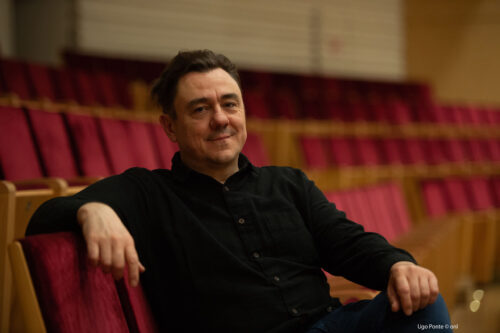
One of the unexpected highlights of the George Enescu International Festival was a Sunday matinee concert of French music for children at the charming Odeon Hall (review here). If the music by Poulenc and Ravel was well known, the artwork by the French illustrator Grégoire Pont was a pleasant surprise. An exceptional artistic talent already as a young child, Pont attended the Animation Workshop in Paris where he studied Norman McLaren’s techniques of animation dynamics. He graduated from the Penninghen School of Graphic Arts (ESAG) in 1992 and shortly after directed his first animated film, Le concerto du chat, presenting abstract shapes dancing to the sounds of the Orchestre de Paris at Salle Pleyel. A great lover of classical music, Pont has always been passionate about making it more popular and accessible to both children and adults by means of animation. He developed a new performance concept called ‘Cinesthetics’ where he draws and animates live to a musical performance.
Among his most successful collaborations have been with the British director James Bonas in a production at Opéra de Lyon of Ravel’s L’enfant et les sortilèges and L’heure espagnole. Their unique approach has led to these productions being presented by houses around the world, including Dresden Opera, Opéra de Lille, Royal Opera House, Muscat, and San Francisco and Cincinnati Symphony Halls. Most recently their collaborations have achieved great success with titles including Hans Abrahamsen’s Snow Queen for Opéra National du Rhin, Emma Bovary for National Ballet of Canada and Candide for Welsh National Opera. This season they premiere a production of Die Zauberflöte at Gothenburg Opera.
He has appeared at Royal Festival Hall, Paris Philharmonie, Alte Oper Frankfurt, Suntory Hall and Gothenburg Concert Hall, collaborating with conductors such as Kent Nagano, Kazushi Ono, Stéphane Denève, François-Xavier Roth and Dalia Stasevska.
Pont also illustrates books for children, most notably Les Excalibrius, and has made numerous animations for TV commercials, educational animated shorts and music video clips. For three seasons, Pont worked with the French conductor François-Xavier Roth and his groundbreaking orchestra Les Siècles on Presto! (France Television). This animated series of musical works was seen by over three million viewers on weekly primetime television.
Gregor Tassie: Where do you get the stimulation for illustrating music? What motivates you most in your work?
Grégoire Pont: What I like the most is to be in synchrony with the music – following each note and phrase by drawing lines, creating a beautiful picture that is true to the intentions of the music.
GT: What music motivates you most in your work? Beethoven, Tchaikovsky, Stravinsky are all quite different. Is it something that someone asks you? Or is it something that you decide yourself?
GP: It depends on the situation. In some of my work, I can choose whatever piece I want, and sometimes I am asked to work on specific pieces. I am most interested in music of the twentieth century – because I am a child of the twentieth century. I am influenced by movies and movie soundtracks, and their connection with classical music. When you listen to John Williams’s film music, for example, you can hear the influence of Prokofiev and Stravinsky. I feel at home with this kind of music. Next year I will be doing illustrations for Baroque music, which is new for me, so it’s more of a challenge. But I can work with any music – as long as it has different colours and textures. I enjoy working with large orchestras, for example on music such as Holst’s The Planets or Schoenberg’s Gurreleider, but I particularly like working with chamber orchestras and ensembles, for example on Ravel’s Piano Trio. One can have a relationship with the individual players, which makes it easier to create magic together. I just created ‘Moonlight on the Eiffel Tower’, a program in the form of a Debussy recital. It was just me and a pianist, and it felt intimate and emotive.
GT: I was recently at the Wagner Festival in Sofia and was impressed by the opening prelude of Das Rheingold which used a video projection displaying tremendous colours, and enhanced by amazing Rhinemaidens jumping on trampolines that created a striking impression as if swimming – is this visual technique of interest to you?
GP: If it works, it’s like magic. I recently did a production of Bernstein’s Candide in Wales, with James Bonas. In this piece Candide travels around the world, and I could show his adventures in different countries, on a boat, and when the boat breaks up in the sea. With video and lighting, you can control everything, and it gives you a lot of artistic freedom. It can be a delicate line, though. Without good care and skill, it can be overwhelming for the viewer, take up a lot of space and distract from the music. It’s also quite a challenge for the performers on stage. But when it works, it’s wonderful.
GT: Do you want to bring new people to music that is well-known through educational/visual means, or do you want to create something new for today’s classical audiences?
GP: It sometimes feels that classical music is unimportant to most people. I was brought up in a musical family, and I loved Mozart even as a small child, so of course it’s very important to me to share that love. I hope that my animations give people some new ways to come to classical music. I don’t want it to be like a bad movie, but an artform in its own right, which makes their musical experience even more beautiful.
GT: Sometimes less words can express an idea more powerfully.
GP: Absolutely.
GT: What music are you most influenced by? Baroque? Classicism, romanticism or modernism?
GP: I am more into the music of the twentieth century – Ravel, Prokofiev, Stravinsky. I have worked with Beethoven and Mozart, but I prefer music written during this period. These composers were experimenting with so many things, trying new things with form and sound and it’s exciting to work with that. I find some classical and romantic music flat by comparison. I love Debussy’s textures and colours. They are very French – like me!
GT: We are here during the Georges Enescu International Festival, and you have heard Enescu’s music, what about other modern composers?
GP: Just recently here, I heard a wonderful concert of modern music, which I enjoyed very much. I recently worked on a programme of Britten with the BBC Symphony Orchestra, as well as a piece by a young composer Anna Meredith. In some ways it’s easier to illustrate music by living composers, because no one knows what to expect, so you can be freer. It is also great to be able to talk to a composer about their music and art.
GT: These pieces by Poulenc and Ravel in the concert for children, is this music important?
GP: Yes, it’s very important that children come to hear live music, especially with their parents, so they can listen together and watch each other’s reactions. It’s such a wonderful experience for them to have together. I enjoy making children laugh and engage them in the story, they are so reactive. Every time I draw a princess on the screen, I get a reaction! I love bringing them into a fantastic world that is bigger and better than they could possibly expect.
GT: Sometimes the kids are more intelligent than their parents.
GP: They understand what I’m doing very quickly and react very honestly. They also enjoy the music a lot.
GT: Do you search for perfection? Do you think it’s possible to achieve perfection?
GP: I am never 100% content. You can keep changing things forever, constantly improving them, but at some point, you have to let go. The most important thing is always to be faithful to the music.
GT: Do you research the composers and their works?
GP: Yes. I don’t usually change what they’ve created – the story of an opera, for example, but there are times I want to do something differently. For example, The Four Seasons is often illustrated with flowers and trees, and I wanted to try something new like the four seasons of a human’s life.
GT: What is your next project?
GP: I am flying to Sweden soon to do The Magic Flute – a special Christmas show edition. Then I travel to Paris for a show at Théâtre des Champs-Élysées. I want to do Mahler’s ‘Das Lied von der Erde’. It’s my dream project!
GT: Mahler is very popular, and often the audiences are very full.
GP: Some audiences can be problematic. Once I illustrated Bartók’s Concerto for Orchestra in Germany – it was my first work – and my drawings were booed. I thought it was an argument between members of the audience, but it was for me. I went the foyer afterwards and one man said he loves my art but in a Bartók concert he just wants Bartók and nothing else.
GT: Mr Pont, thank you for talking to Seen and Heard International.
Gregor Tassie