
 United States Wagner, Parsifal: Soloists, Chorus and Orchestra of San Francisco Opera / Eun Sun Kim (conductor). War Memorial Opera House, San Francisco, 25.10.2025. (HS)
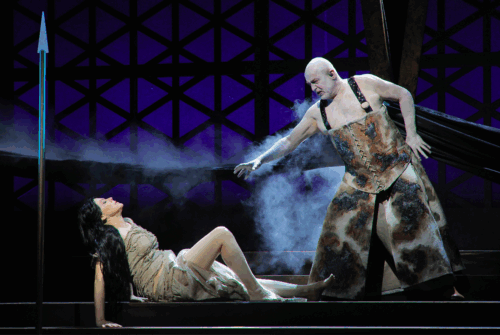
Magnificent in every way, San Francisco Opera’s Parsifal created a spellbinding five hours in the first performance on Saturday afternoon. Eun Sun Kim’s conducting and the responsive, sonorous contribution of the entire orchestra shaped Wagner’s time-stopping score with power and finesse. A cast with no weak spots delivered something close to perfection, and Matthew Ozawa’s resourceful, eye-catching production enhanced a story that can have its stagnant moments.
The first of five scheduled performances was simply overwhelming in its riches. Kim laid the foundation with a prelude that savored the silences between the introductions of the main leitmotifs that would permeate the entire score. Each phrase was shaped by distinctive dynamics and textures, meditatively at first, and reaching a series of majestic climaxes that somehow promised there was much more to come. The details she found brought softly expanding colors to these motifs throughout the performance, and the pace was dignified with no dallying. This orchestra has never sounded better.
Matthew Ozawa’s 2022 production here of Gluck’s Orpheus and Eurydice mined the emotional depths of that story. For Parsifal he zeroed in on the key themes at its core – connection and empathy, compassion and forgiveness. The curtain rose on two acolytes of the Holy Grail order asleep in a pre-dawn forest, connected to each other by a long braid of hair. Suspended above them were two similar figures, connected by a gleaming chain. To the gentle zephyrs of the prelude’s closing phrases, the floating pair rose slowly and disappeared, presumably to heaven.
A lacy cloud of intricately interwoven lines hovered over an array of pillars in Robert Innes Hopkins’s set, suggesting the canopy of a forest. For the transition to the Grail ritual, the cloud lifted and rotating platforms realigned the pillars to become the columns of the knights’ religious sanctuary. A system of arches and trusses dropped slowly from above to complete the image of a medieval church. It felt as if the sanctuary had emerged magically in the forest.
Throughout the opera, projections provided striking and slowly-changing backdrops of skies. Lighting designer Yuki Nakase Link illuminated each moment with gradually morphing colors and, at the very end, the lighting culminated in a luminous golden glow that spread past the stage to the entire theater.
Extra characters added visual interest. A dancer portrayed Parsifal’s mother and interacted with him when he referenced her in narrating his back story. In the religious rituals, three dancers (choreography by Rena Butler) added depth to the rituals by enhancing what was going on rather than distracting. They also played a critical role in Parsifal catching the spear in Act II. During the opera’s several long narrations, Ozawa kept other members of the cast involved.
Everything about this production was stylized or at least exaggerated. This actually took a cue from Wagner, who used Buddhist, Hindu and Pagan cultures to expand on Christian lore. Jessica Jahn’s costumes alluded to science fiction exaggeration, among them an enormous ring of a collar on Amfortas’s robe and creased headpieces for the Grail knights. Two long strips of black cloth stretched like wings from Klingsor to both sides of the stage. They made him look terrifying and, at the same time, suggested that he too was trapped by his own sins.
It is always the music that matters most, of course. All five principals and the fourteen others in the cast list delivered with top-tier quality. They not only sang gloriously but conveyed the traits of their characters with distinction.
Four of the five principals have impressed in previous Wagner roles here, and the one company debut was a stunner. As Kundry, German mezzo-soprano Tanja Ariane Baumgartner unleashed a voice that could caress the sensuous music of her attempted seduction of Parsifal while under the spell of the evil Klingsor, and it rattled the walls with terrifying power in a mad rage when she was rebuffed.
In his previous ventures into Wagner starring roles in San Francisco (Lohengrin, Walther in Die Meistersinger, Siegmund in Die Walküre), tenor Brandon Jovanovich brought a lyric sound and plenty of power. His Parsifal topped them all. Singing with disarming ease and clarity he vividly traced the character’s journey from foolish youth to virtual saint.
In the taxing role of the wounded knights’ leader, Brian Mulligan’s steady and beautifully expansive baritone conveyed Amfortas’s pain without missing a note. And as Gurnemanz, bass Kwangchul Youn (recently Sarastro in The Magic Flute and King Marke in Tristan und Isolde here) commanded the stage in his long Act I narration despite a bit of a wobble to his well-grounded voice, and he sounded strong in Act III.
As the malicious Klingsor, veteran bass-baritone Falk Struckmann, who was Alberich in the company’s 2018 Ring cycle, bent his powerful and intensely focused voice into a sound to savor, deploying sneers and cajoles as needed.
Many of the smaller roles – esquires, knights and flower maidens with solo lines – were sung by Adler Fellows in the company’s affiliate artist program. It is difficult to select standouts: they were all terrific, as was bass David Soar as the offstage voice of the old king Titurel.
One element that stood out was the unusual portrayal of Kundry. She is always a mysterious character, with a back story of previous lives, cursed by Klingsor to seduce victims for him. In Wagner’s original version, Kundry dies at the end. In Ozawa’s version, having accepted Parsifal as her redeemer when he finally finds his way back to the Grail knights, she not only joins with Parsifal in bringing out the Holy Grail, but in a touching final tableau she raises the goblet along with him, as Kim and the orchestra made those final phrases float from the pit in quiet ecstasy.
This ‘happy ending’ certainly tracked with the production’s emphasis on forgiveness and compassion.
Harvey Steiman
Featured Image: Brandon Jovanovich (Parsifal) absolves Gurnemanz (Kwangchul Youn) in SFO’s Parsifal © Cory Weaver
Production:
Director – Matthew Ozawa
Sets – Robert Innes Hopkins
Costumes – Jessica Jahn
Lighting – Yuki Nakase Link
Choreographer – Rena Butler
Chorus director – John Keene
Cast included:
Gurnemanz – Kwangchul Youn
Amfortas – Brian Mulligan
Kundry – Tanja Ariane Baumgartner
Parsifal – Brandon Jovanovic
Klingsor – Falk Struckmann
Titurel – David Soar
Grail Knights – Samuel White, Jongwon Han
A Voice from Above – Nikola Prinz